DbcultAccessing Vault...
Cult Review
Senior Film Conservator
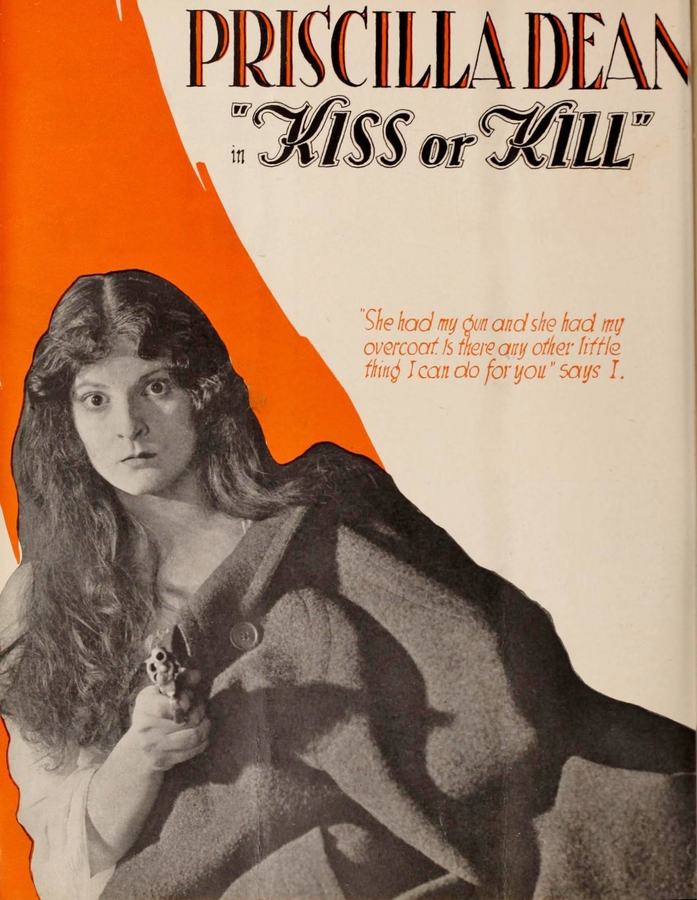
I. A Wallet Thrown Like a Grenade
Imagine the first post-war frame: the camera glides past trolley sparks and wet cobblestones, alighting on Harry Carter’s gaunt profile—every trench-scarred angle of his face inscribed with the ink of survivor’s guilt. The pickpocketing that follows is no mere narrative trigger; it is an act of self-immolation, a civilian re-enactment of no-man’s-land looting. Elmer Clifton, ever the poet of pulp, lets the stolen billfold land with the metallic clank of a Mills bomb. From that clang forward, Kiss or Kill never exhales.
II. Middleton’s Palace of Plate-Glass Morality
Alfred Allen’s Middleton arrives in iris-in like a malign magus: silk lapels, gardenia boutonniere, voiceless yet commanding through intertitles trimmed with baroque curlicues. His mansion—equal parts Jacobean oak and nouveau-riche chrome—functions as both fortress and fishbowl. Notice how cinematographer Friend Baker tilts the lens ever so slightly when Middleton leans in to extort Henry: the walls skew, chandeliers loom like decapitated halos. The visual grammar anticipates German Expressionism a year before Die Faust des Riesen would import nightmare angles to Hollywood backlots.
III. Paper Bullets: The Will as McGuffin & Moral Litmus
Forget the diamonds, the bearer bonds, the railroad deeds—here the contested object is parchment, ink, wax seal. The forged codicil that disinherits Ruth is less a legal document than a social X-ray: it exposes how patriarchal capital continues to swindle women from beyond the grave. Clifton and pulp polymath Max Brand compress acres of Gilded-Age critique into a single prop; every time the safe yawns open, the film seems to hiss follow the paper trail of perfidy.
IV. Priscilla Dean: Flame-Haired Cipher & Proto-Feminist Lens
Ruth Orton could have been another wilting daisy in distress. Instead, Dean—channeling her House of Glass ferocity—plays her as kinetic ambivalence. In medium shot she caresses a tintype of her dead father; in the very next frame she flings a vase at Craig’s head with vaudeville velocity. The performance is calibrated between melodrama and modernity, a calibration that foreswears the saccharine aftertaste of Happiness of Three Women. When Ruth finally clutches the authentic will, her sob is not relief but rage at every ledger that ever erased her name.
V. Herbert Rawlinson’s Craig: Idle Aristocracy as Slow-Motion Train Wreck
Decked out in white-flannel narcissism, Craig drifts through soirées like a man smelling his own boutonniere. Rawlinson—usually cast in genial rom-com lanes—here weaponizes his square-jawed handsomeness; every grin carries the glint of a back-alley scalpel. His engagement to Ruth is a corporate merger masquerading as courtship, an angle the film savages long before A Gentleman’s Agreement would interrogate WASP sanctimony.
VI. Chromatic Silence: How Tinted Stock Becomes Character
Though most extant prints are black-and-white, archival notes indicate original release prints carried a chromatic score: amber for interiors the tint of nicotine-stained guilt; cerulean for nocturnal exteriors suggesting subaqueous escape. If you’re lucky enough to catch a 16 mm collector’s print with hand-dyed washes, watch how Henry’s pivotal safe-cracking scene oscillates between livid rose (danger) and sickly green (temptation). The palette functions like the leitmotifs in Paradise Lost—emotional shorthand smuggled into the optic nerve.
VII. Tempo of the Chase: Eisensteinian Montage on Poverty Row
Clocking in at a fleet 58 minutes, the narrative still finds room for a three-minute cross-cut sequence worthy of Potemkin: cops thunder down stairwells, Middleton jangles telephone wires, Ruth paces Victorian parlor, Henry fingers dynamite detonators. The tempo is propelled by an orchestral score—if your venue hires a live trio—syncopated to locomotive percussion. Even without accompaniment, the visual cadence of truncated shots (average 2.3 seconds) drags the viewer by the collar.
VIII. Elmer Clifton: From Griffith Apprentice to Guerrilla Auteur
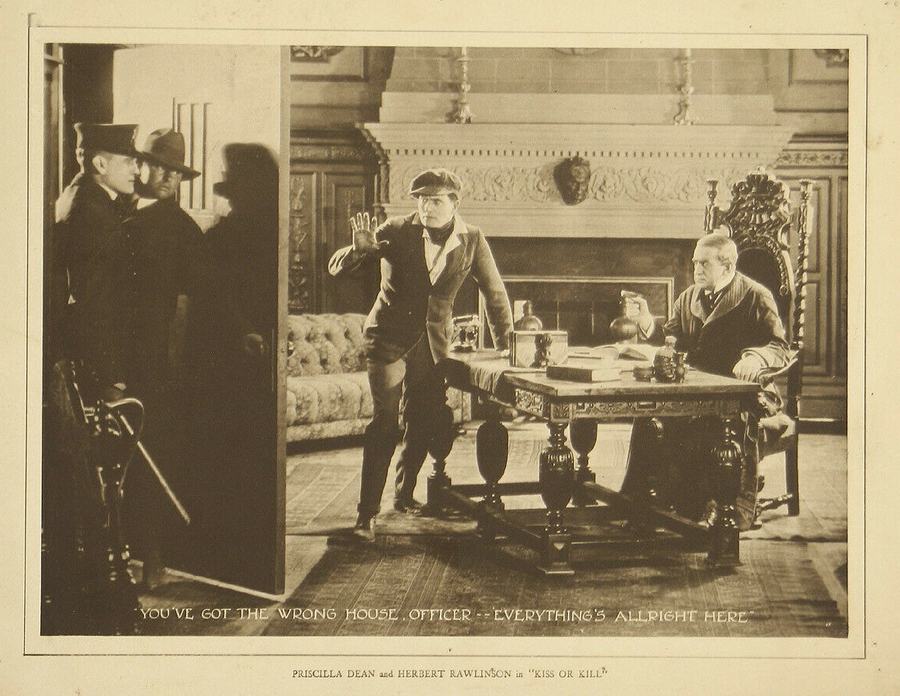
Often dismissed as a journeyman, Clifton here evidences the montage lessons he absorbed under Griffith’s tyrannical tutelage. Note the axial cut during Henry’s rooftop escape: the camera jumps 30 degrees closer without a matching eyeline, violating classical continuity yet intensifying vertigo. Such proto-New-Wave audacity rarely surfaces in contemporaneous programmers like The Barricade, content to park the camera at proscenium distance and let Victorian declamation do the work.
IX. Max Brand’s Dialogue: Haiku Violence in Intertitle Form
Brand, churning out westerns between screen gigs, injects a poet’s concision: “A man can outrun dogs, but not the ledger of his sins.” Observe the alliteration, the metaphysical ledger, the hint of karmic arithmetic. These titles flash like switchblades, then vanish, leaving the viewer to stitch meaning in the dark.
X. Gendered Space: Thresholds, Mirrors, Locked Doors
Domestic architecture in Kiss or Kill is gender-coded. Middleton’s ballroom—vast, phallic chandelier overhead—belongs to masculine surveillance. Ruth’s parlor—cluttered with doilies, stifling with lace—becomes a gynocentric redoubt. The safe, hidden behind a portrait of Ruth’s father, sits at the nexus: patriarchal loot guarded by feminine iconography. When Henry cracks it open, he’s not just stealing paper; he’s breaching the membrane that segregates the sexes in post-war capitalism.
XI. PTSD as Subtext: The Shell That Walks Like a Man
Contemporary reviews missed the tremor in Harry Carter’s hands, the flinch when car exhaust backfires. Yet modern eyes detect the tell-tale markers: insomnia, affective flattening, hyper-vigilance. The film never utters “shell shock,” but its visual rhetoric—close-ups of Henry’s darting pupils, jump-cuts to mortar-burst hallucinations—renders trauma with documentary candor. The pickpocketing thus becomes a compulsive re-staging of frontline looting, the wallet a surrogate enemy dog-tag.
XII. Moral Ambiguity: The Antihero Before Noir
Henry Warner is neither Valentino rake nor Fairbanks swashbuckler. He is a conscript of circumstance, a man who pockets another’s identity to reclaim his own. When he finally renounces flight for love, the gesture feels less like moral epiphany than cost-benefit calculus: better the confinement of domesticity than the endless gauntlet of alleyways. This refusal to sandpaper the protagonist’s edges anticipates the venal leads of William Voß. Der Millionendieb.
XIII. The Kiss That Almost Isn’t
The title dangles a binary—Kiss or Kill—yet the kiss arrives obliquely: a chaste brush of Henry’s lips across Ruth’s gloved knuckles after he returns the will. The camera holds on Dean’s visage as it cycles through disbelief, gratitude, cautious arousal—all without a single subtitle. It is the film’s most radical ellipsis, an apotheosis of silent cinema’s capacity to vocalize the ineffable.
XIV. Legacy: Footnote or Fountainhead?
Condemned to public-domain purgatory, the film languishes on pixelated YouTube rips. Still, its DNA replicates in post-war noir from Out of the Past to Detour: the amnesiac veteran, the forged document, the woman both prize and avenger. When you next watch a sociopath smirk behind cigarette smoke, remember that Henry Warner got there first, breath fogging a wintry window as he weighed kiss against kill.
XV. Where to Watch & How to Curate the Experience
Scour regional archives—Rochester’s Dryden, Paris’s Cinémathèque—for 35 mm with live accompaniment. Failing that, sync the grayscale YouTube version with Max Richter’s Infra—the minimalist strings amplify Carter’s war-tic without overwhelming the antique ambience. Pour a rye neat, dim the lamps, and let the flicker remind you that every heist is a love story in which something—dignity, memory, a woman’s patrimony—must be stolen back.
Kiss or Kill is the missing link between Griffith’s Victorian moral algebra and the sulfurous fatalism of Wilder’s Double Indemnity. It is a nickelodeon sermon delivered in the cadence of machine-gun fire, a love letter written on the blank side of a death certificate. See it not as relic but as Rosetta Stone—decipher the scratches and you’ll read the pre-history of American noir scrawled in jittery grins and gunpowder shadows.
IMDb —
1920
Community
Log in to comment.