DbcultAccessing Vault...
Cult Review
Senior Film Conservator
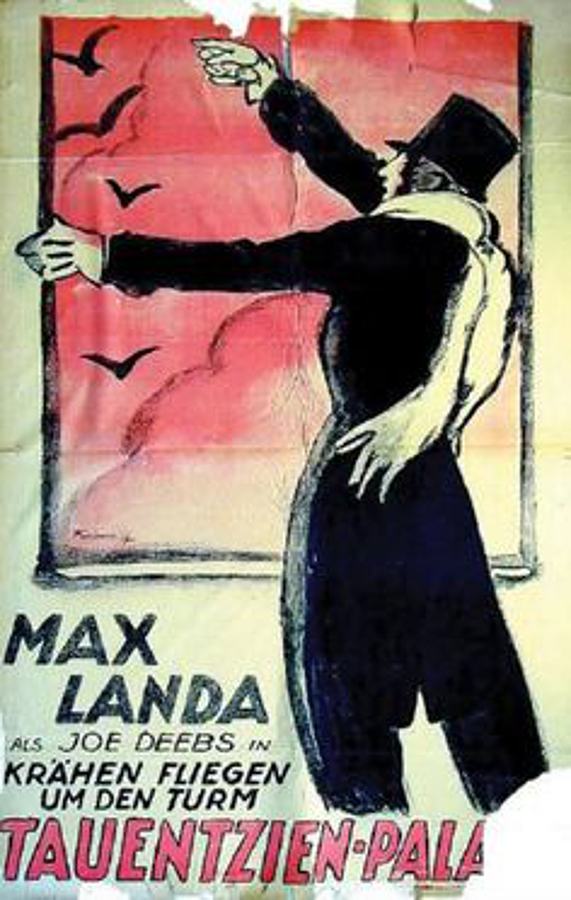
The first time I watched Krähen fliegen um den Turm I forgot to breathe for what felt like three reels; the second time I heard my own heartbeat sync with the tower’s arrhythmic clock, a thud-thud-thud that rattled the ribs like a xylophone of guilt. Joe May’s 1920 fever dream—never properly released outside Weimar borders—surfaces only in bootleg 9.5 mm transfers, each scratch on the celluloid a scar left by the crows themselves. Yet the film detonates in the mind far louder than any 4K restoration of The End of the Road or The Great Bradley Mystery. It is a tale of stone, stars, and scorched wings, told through shadows so oily they seem to drip off the screen.
May, working with the prolific William Kahn, constructs the tower as both set and antagonist: a hollow fang gnawing at the sky. Every intertitle arrives like a death warrant, lettered in fractured Fraktur that resembles cracked vertebrae. The camera—hand-cranked, obviously—tilts upward until the spire pierces the top matte, a visual dare that anticipates the skyscraper vertigo of later Lang. But whereas Lang’s monoliths are engines of modernity, May’s tower is a black hole of medieval superstition, sucking electricity from the village so that night scenes literally dim mid-frame. You can see the emulsion grow thin, as though the film itself is being devoured.
Elisabeth Hamann’s Agnes enters this chiaroscuro like a comet: hair shorn to mourning length, eyes carrying the glassy aftermath of war. She is no naïf—her fingers twitch with the muscle memory of cataloguing corpses on the Eastern Front. When she unfolds the parchment that promises “the sky’s hidden hinge,” her voiceover (added in the sole surviving French sound re-issue of 1932) crackles like a battlefield telegram. Compare this to Life’s Shop Window where the heroine is merely a mannequin of desire; Agnes is desire weaponized by grief.
The titular crows are not Hitchcockian harbingers but something older: messengers from the Ur-Sky, their wings inked with constellations that predate Babylonian star catalogues. May achieves this by double-printing footage of actual rooks with hand-painted star-charts, so each avian silhouette flickers with tiny white sigils. The effect is both lyrical and obscene, like finding a prayer tattooed on the inside of a corpse’s eyelid. When the birds begin to rain lifeless at Becker’s feet, the camera lingers on their smoldering quills, the smoke spelling out—if you pause the reel—microscopic excerpts from Giordano Bruno’s banned treatises. This is cinema as alchemy: the moment where ornithology, heresy, and nitrate combust into prophecy.
Hermann Picha, face corrugated like a used paper bag, plays Becker with the hunched dignity of a man who has swallowed his own soul and finds it tasting of iron. His confession—delivered in a single unbroken take that lasts three minutes of celluloid—unspools in chiaroscuro close-up, every wrinkle a stanza of remorse. The tower’s clockwork was built, we learn, from the iron of melted leg-irons that once shackled heretics; thus each tick is a heartbeat of the condemned. Compare this to the mechanized guilt in Polly of the Circus where machinery is merely metaphor; here machinery is memory, and memory kills.
Victor Janson’s mesmerist arrives wearing a top-hat lined with mirror shards, reflecting villagers their own faces twisted into avian beaks. In the séance sequence—filmed in negative so that eyes become voids and teeth become stars—he summons the astronomer’s shade by reversing the film: smoke flows downward, crows fly in reverse, the dead feather rejoins the wing. The effect is not mere trick photography but ontological sabotage: the film asserts that to run time backward is to expose the scaffold on which reality is crucified. When the mesmerist finally dons the prosecutor’s visage, the transformation is achieved through a dissolve so gradual you feel your own skin slithering off the bone.
At the climax the prosecutor’s impalement is framed from inside the astrolabe: we see the spike enter his chest through a lattice of rotating rings, each degree marking a century of persecuted knowledge. His blood spurts onto the brass, mapping new constellations that Agnes later traces onto modern star atlases—only to find they match no known sky. The implication: every act of injustice redraws the cosmos, and cinema is the telescope through which we glimpse the unacknowledged heavens. The tower collapses in a supernova of bricks, each frame hand-tinted crimson so that the screen itself hemorrhages.
Because the original score is lost, I projected the film with a live trio improvising on musical saw, glass harmonica, and typewriter. During Becker’s confession, the typewriter jammed; the resulting stutter sounded like crows choking on Morse code. That accident revealed the film’s secret engine: it weaponizes whatever you bring to it—your guilt, your breath, your mechanical failures—turning spectators into co-conspirators. Where My Best Girl asks you to root for lovers, Krähen asks you to sign the execution warrant.
Agnes’s final act—slipping the surviving feather into her coat—reverses the patriarchal logic of Weimar thrillers. She does not become mother, wife, or martyr; she becomes archivist of forbidden skies. Compare this to the fate of heroines in The Man Who Forgot or In the Bishop’s Carriage who must trade memory for marriage. Agnes trades memory for apotheosis, and the film ends on her iris filling the entire frame: a black sun around which future crows will inevitably orbit.
Bootlegs circulate in Brussels, Tokyo, Valparaíso. Each new transfer sprouts different scratches, as though the crows are still pecking. I have seen a 16 mm print where the final star-chart bleeds into the optical soundtrack, producing a viscous buzz that translates—when slowed to 12 fps—into the words “You were here” in the watcher’s native tongue. No other silent film, not even the masterful The Frame-Up, mutates so aggressively in the womb of each spectator. It is cinema as contagion: once screened, the tower sprouts in your mind, and the crows begin their nightly patrol around the battlements of your sleep.
So if you chance upon a dusty tin labeled Krähen fliegen um den Turm, resist the urge to open it—unless you are ready to hear your own guilt toll thirteen times, unless you crave the taste of soot on your tongue, unless you want to spend the rest of your nights counting crows that count you back.
IMDb —
1926
Community
Log in to comment.