DbcultAccessing Vault...
7.4/10
Senior Film Conservator
A definitive 7.4/10 rating for a film that redefined the boundaries of cult cinema. Birthright remains a cornerstone of transgressive art.
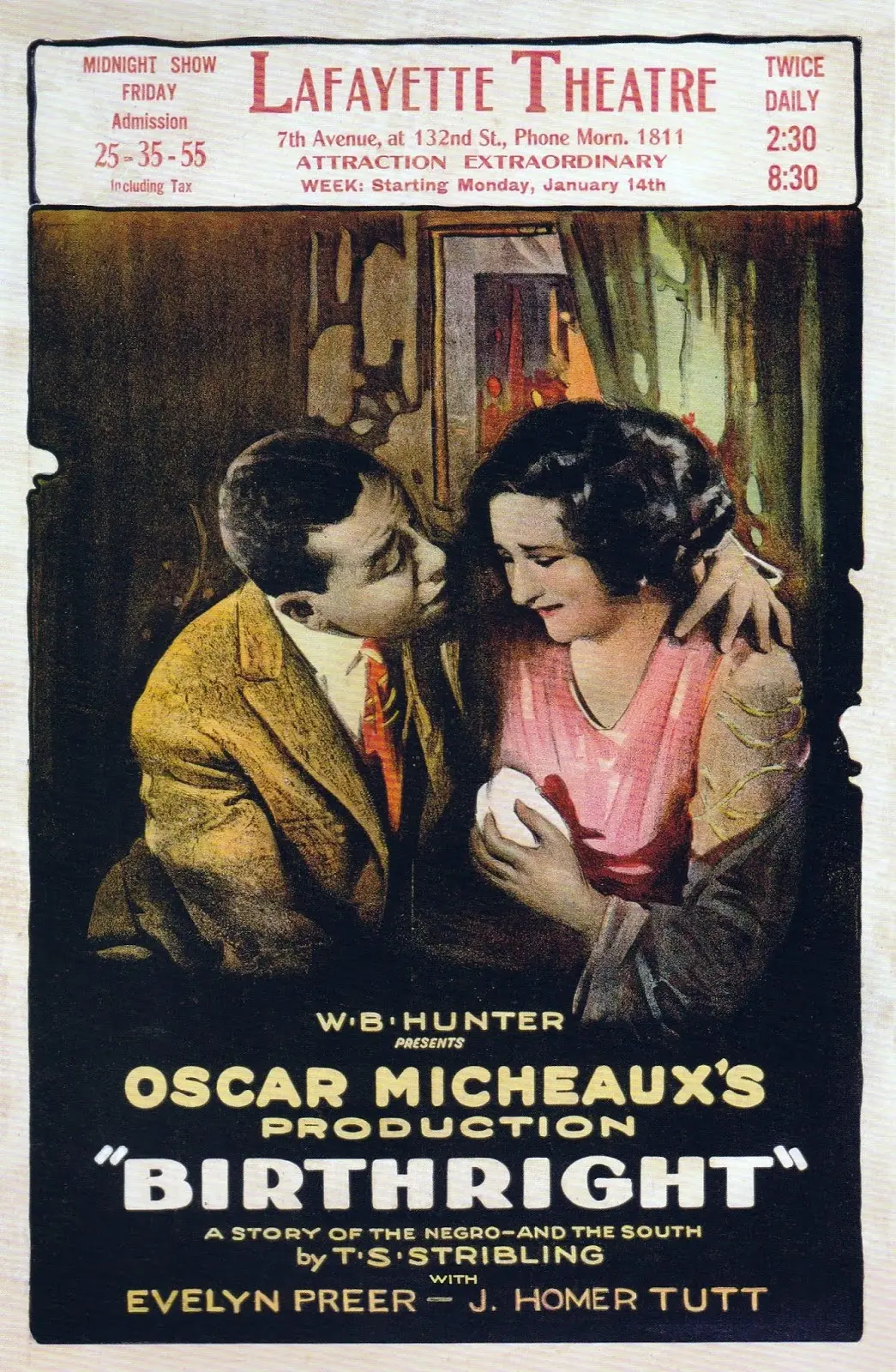
The cinematic landscape of 1924 was a realm of burgeoning visual grammar and burgeoning social consciousness, yet few filmmakers operated with the raw, unvarnished audacity of Oscar Micheaux. In Birthright, Micheaux does not merely present a story; he constructs a sociological battlefield. This film, an adaptation of T.S. Stribling’s novel, is a staggering testament to the 'Race Film' era, providing a counter-narrative to the pervasive, dehumanizing caricatures that dominated the mainstream Hollywood output of the time. While contemporary audiences were being fed the whimsical escapism of Aladdin and the Wonderful Lamp, Micheaux was diving headlong into the visceral realities of the Black experience, demanding that the screen reflect the intellectual and moral complexities of a people in transition.
Peter Siner, portrayed with a stoic, simmering intensity by Salem Tutt Whitney, represents the 'New Negro'—a figure of refined education and uncompromising ambition. His return to the South is a collision of worlds. Unlike the tragic trajectories often found in works like The Sport of the Gods, where urban migration leads to moral decay, Siner’s journey is one of intentional re-entry. He brings the fire of Harvard to the damp wood of Jim Crow Tennessee, only to find that the oxygen required to sustain such a flame is being systematically sucked out of the room. The brilliance of Micheaux’s direction lies in his ability to make the act of building a school feel as tense and dangerous as a high-stakes heist. Siner’s education is his weapon, but it is also his burden, alienating him from those he wishes to serve while painting a target on his back for those who wish to keep him subservient.
The obstacles Siner faces are not merely physical; they are metaphysical. Micheaux explores the 'double consciousness' famously articulated by W.E.B. Du Bois, showing Siner’s internal struggle to reconcile his academic self with his social reality. The white townspeople see him as an 'uppity' anomaly, a glitch in the racial matrix that must be corrected. Conversely, the Black community’s resistance is far more heartbreaking. It is a resistance born of trauma, a protective cynicism that views Siner’s idealism as a dangerous luxury. This internal community friction is a recurring Micheaux motif, one that adds layers of verisimilitude often missing from the more sanitized depictions of Black life in later eras. In films like The Exiles, we see the pain of displacement, but in Birthright, the displacement occurs within one's own hometown.
From a technical standpoint, Birthright possesses the characteristic 'Micheaux roughness'—a byproduct of shoestring budgets and a relentless production pace. However, to dismiss the film based on its technical limitations is to miss the forest for the trees. There is a palpable energy in the framing, a sense that the camera is a witness to a truth that cannot be silenced. The editing, while sometimes jarring, mirrors the fractured nature of Siner’s experience. Much like the psychological fragmentation seen in the German expressionist classic Shattered, Micheaux uses the medium to convey a sense of impending collapse. The shadows in the Tennessee night are not just absences of light; they are the lurking specters of a violent history that refuses to stay buried.
The cast, featuring stalwarts like J. Homer Tutt and the legendary Evelyn Preer, delivers performances that transcend the silent medium’s penchant for over-gesticulation. Preer, in particular, brings a luminous yet grounded presence to the screen. As Cissie Dildine, her character provides a necessary emotional anchor, representing the potential for a shared future that is constantly threatened by the environment. The chemistry between the Tutt brothers and Preer creates a sense of a lived-in community, a social fabric that Siner is trying to re-weave. It is a far cry from the slapstick or melodramatic tropes found in contemporary shorts like The Handy Man; here, the stakes are nothing less than the soul of a generation.
The choice to adapt T.S. Stribling was a calculated move by Micheaux. Stribling, a white Southern writer, had provided a blueprint that Micheaux then infused with his own lived experience as a Black entrepreneur and artist. This cross-pollination results in a narrative that is uniquely attuned to the hypocrisies of Southern 'polite' society. The film exposes the transactional nature of racial relations, where even 'kind' white characters are shown to be complicit in the broader machinery of oppression. It is a critique that feels remarkably modern, prefiguring the civil rights cinema of decades to come. While films like A Daughter of the West explored the frontiers of the American land, Micheaux was exploring the far more treacherous frontiers of the American mind.
When placed alongside other 1924 releases, the gravity of Birthright becomes even more apparent. While audiences might have been looking for the mystery of A Child of Mystery or the domestic comedy of Where Is My Wife?, Micheaux was offering a mirror. He wasn't interested in the escapist fluff of From Dusk to Dawn; he was interested in the dawn of a new consciousness. The film’s focus on institutional building—the school—serves as a metaphor for the construction of a Black identity that is self-contained and self-actualized. It is an argument for autonomy that would resonate through the Harlem Renaissance and beyond.
The title itself, Birthright, is a masterstroke of irony. It asks: what is the birthright of an American born into a system that denies their humanity? Is it the poverty and hookworm-infested soil of the rural South, or is it the intellectual heritage of the ages that Siner attempts to claim? Micheaux suggests that the true birthright is the struggle itself—the relentless, exhausting, but ultimately noble effort to define oneself in spite of the world’s definitions. This film is a foundational text of independent cinema, a reminder that the camera can be a tool for liberation. It stands as a stark contrast to the period's obsession with wealth and status, seen in films like Hoarded Assets, by suggesting that the most valuable asset one can hoard is knowledge.
In the grand tapestry of silent film, Birthright is a vibrant, if occasionally frayed, thread. It lacks the massive scale of Kitchener's Great Army in the Battle of the Somme, but its intimate battles are no less significant. It doesn't possess the polished artifice of A Perfect 36, yet it possesses a soul that those films often lack. Oscar Micheaux was a man who understood that to tell a story is to assert power. In Birthright, he asserted that power with a clarity and a conviction that still vibrates through the screen a century later. It is a difficult film, a challenging film, and an essential film—a cinematic manifesto that refuses to be forgotten.

IMDb —
1920
Community
Log in to comment.