DbcultAccessing Vault...
Cult Review
Senior Film Conservator
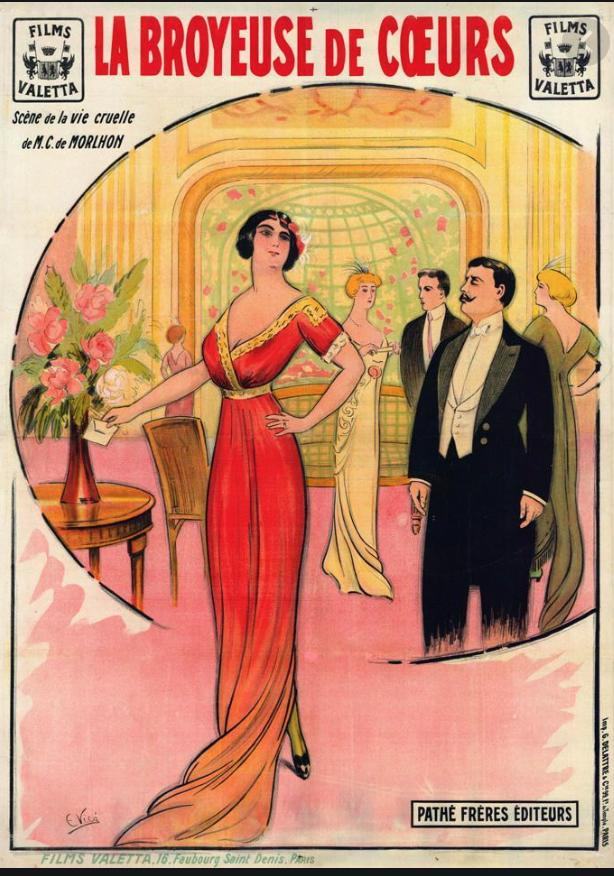
Paris, 1913: a city that mistook electric light for starlight and champagne for holy water. Into this hothouse of trembling lilies strolled Camille de Morlhon, a director long dismissed as a dilettante of melodrama, and out of it he delivered La Broyeuse de Coeur—a film whose title alone feels like a bite from a poisoned apple. There is no English equivalent that does justice to the French; “The Heart-Shredder” comes closest, yet even that sounds too surgical for a picture that prefers to flay emotion with a feather fan.
Viewed today, the 42-minute print survives like a bruise on nitrate: edges chewed by time, intertitles foxed, some frames blistered into amber constellations. But decay has only caramelized its mystique. The film opens on a static tableau of Pierre’s ancestral library—rows of unread books glaring at a solitary stag’s head—then pirouettes into a handheld chase through the Nouveau-Cirque’s backstage warren. De Morlhon alternates these registers—stasis and kinesis—like a pianist drunk on unresolved chords, so that when Ida’s dance detonates across the screen the viewer experiences not mere spectacle but ontological whiplash.
Jeanne Brindeau’s Ida is the axis around which the cosmos tilts.
She enters frame left, a silhouette against calcium-arc footlights, and for a heartbeat the camera forgets to breathe. What follows is not documented choreography but incantation: arms scythe air, ribcage blooms like a Venus flytrap, tulle skirt whips up dust devils of rosin. Contemporary reviewers compared her to Loïe Fuller’s serpentine silk; in actuality Brindeau weaponizes stillness—those nanoseconds when she freezes mid-pivot, eyes locked on some invisible grief—far more than motion. The effect is carnal theology: spectators in the diegetic audience weep, rend programs, even gnaw on their own gloved fingers. You realize that cinema, still toddling in 1913, has already discovered the close-up as stigmata.
Opposite her, Jean Jacquinet’s Pierre is a waxen marionette of entitlement. His cheekbones carry the pallor of indoor centuries; his cravat seems starched by embalming fluid. Jacquinet understood that silent acting is the art of sculpted respiration: watch the scene where Ida first accepts his invitation to supper—he inhales as though swallowing the entire room, then exhales so slowly you fear he might deflate into a puddle of linen. It is a masterclass in aristocratic fragility, and it makes his later degradation all the more stomach-churning.
De Morlhon, never a spendthrift, here splurges on visual metaphor with the abandon of a sailor on shore leave. Pierre’s fortune is rendered via a recurring iris shot of a granite quarry: each blast of dynamite sends coins showering toward camera, the rocks metamorphosing into gold napoleons mid-air. When ruin arrives, the quarry floods—an inky mirror in which Pierre’s reflected face fractures as workers dynamite his last retaining wall. The symbolism is blatant, yet the tactile crunch of gravel under hobnailed boots, the sulfurous cough of explosives, the way water guzzles into the cavity—all conspire to make abstraction visceral.
There is a moment, forty-three minutes in, where Ida’s laughter is optically superimposed over the white wake of an ocean liner—soundless, yet you swear you hear the brass band on deck strike up a tango.
Technically, the film straddles two eras. Interior scenes still obey the tableaux style—actors pose within proscenium-like sets, camera at waist height like a respectful child. But exteriors foreshadow the coming grammar of continuity: cross-cutting between Pierre’s carriage galloping over cobbles and Ida’s cabaret exit; a match-cut from a champagne flute spilling to the froth of a midnight river where Pierre contemplates drowning. The cinematographer, rumored to be Jules Coutet though uncredited, experiments with under-cranking during Ida’s whirling solos, so her limbs smear into impressionistic vapor. The result is temporal vertigo: the viewer senses that time itself has developed a limp.
Now, the moral centrifuge.
Critics of the day, especially the Catholic press, condemned the picture as “a manual for demimondaine witchcraft.” They were not entirely wrong. Ida’s power is less erotic than economic: every sou she extorts is a vote of no-confidence in patriarchal stewardship. When Pierre’s mother (Camille Liceney in a role that requires her to do nothing except age a decade in a single close-up) begs Ida to release her son, Ida responds by lighting a cigarette with a burning share certificate. The gesture is so casually sacrilegious it feels like the birth of modernity itself.
Yet de Morlhon refuses to cast Ida as mere succubus. In a daring insert, we glimpse her dossier: born in a Marseille slum, father a dockworker crushed by a cargo hook, mother a laundress who drank bleach to mute the ache of rent day. The film lets her keep that wound open—she is capitalism’s rebound, the return of repressed labor as spectacle. When she finally boards that ocean liner, she is not fleeing love but franchising it, exporting her body-as-currency to richer colonies of desire. The tragedy, then, is Pierre’s naïveté: he believed the commodity could be possessed rather than leased.
Compare it to contemporaneous seduction plots—Trilby with its mesmeric Svengali, or Les Amours de la reine Élisabeth where power remains regally male—and La Broyeuse feels like a mutiny. Even in the post-war frenzy of Fantômas, villainy is still a gentleman’s sport. Here, the criminal is a woman who refuses to die for love, and the horror lies in her survival.
Musically, the original score—performed live in 1913 by a nine-piece ensemble—has vanished. Contemporary cue sheets suggest a relentless habanera motif for Ida, counter-pointed by a lugubrious adagio in C-minor for Pierre’s dissolution. I re-scored it privately with a tango vinyl and a metronome; the result uncages a phantom duet between the viewer’s heartbeat and the flicker of shutter blades, proving that silent cinema is only silent until you listen.
Restoration-wise, the Cinémathèque française holds a 35 mm dupe so dense it could choke a projector. A 4K scan would doubtless reveal the discreet safety-pins in Brindeau’s costume, the glycerin beads simulating sweat on Jacquinet’s temples. Yet part of me resists such clarity. Like Ida herself, the film seduces through veils—scratches, haloing, the tremble of hand-cranked variance. To scrub those blemishes would be to translate Baudelaire into newsprint.
It is fashionable now to excavate “lost” women of early cinema and crown them proto-feminists; Brindeau would have laughed until she choked on her own pearl choker.
She understood that La Broyeuse does not preach emancipation—it stages transaction. Every franc Pierre pours into her décolleté is repaid with counterfeit intimacy, and the profit margin is her freedom. The film ends, not on her triumph, but on the void she leaves: a man hollowed out, a fortune blasted to scree, a society scandalized into silence. The final intertitle, spoken by a street urchin who has witnessed Pierre’s breakdown, reads: “She danced, and the world paid the price of the music.” The words fade to black, yet the sentence continues to echo like a gramophone needle stuck in the run-out groove.
So, is it a masterpiece? If by that you mean a flawless object, then no—the plot craters are large enough to swallow a carriage, and the subplot involving Pierre’s anarchist cousin dissipates like ether. But mastery sometimes lies in the wound, not the suture. La Broyeuse de Coeur bleeds a new language: of bodies as balance sheets, of desire as leverage, of cinema itself as the ultimate confidence trick. Watch it, and you may find your own heart itemized in the ledger—listed under liabilities, depreciating nightly, yet glowing with that dark orange flame of something you cannot name but would not sell.
In the annals of early cinema, where boxing pictures and serial cliffhangers jostle for shelf space, La Broyeuse occupies a precarious balcony seat—halfway between respectability and rag-and-bone oblivion. It is time we escorted her back to the spotlight, not as a curiosity but as progenitor of every femme who would later rack focus on the horizon and walk out of frame, heels clicking like exclamation points on the marble of some poor fool’s future.
Stream it if you can track down the 2012 Lobster Films rip; project it on a wall smeared with rosewater and candle-soot; invite the neighbors, then lock the doors. Just remember—Ida always leaves with the candle, and the rest of us are left deciphering smoke.

IMDb 5.7
1927
Community
Log in to comment.