DbcultAccessing Vault...
Cult Review
Senior Film Conservator
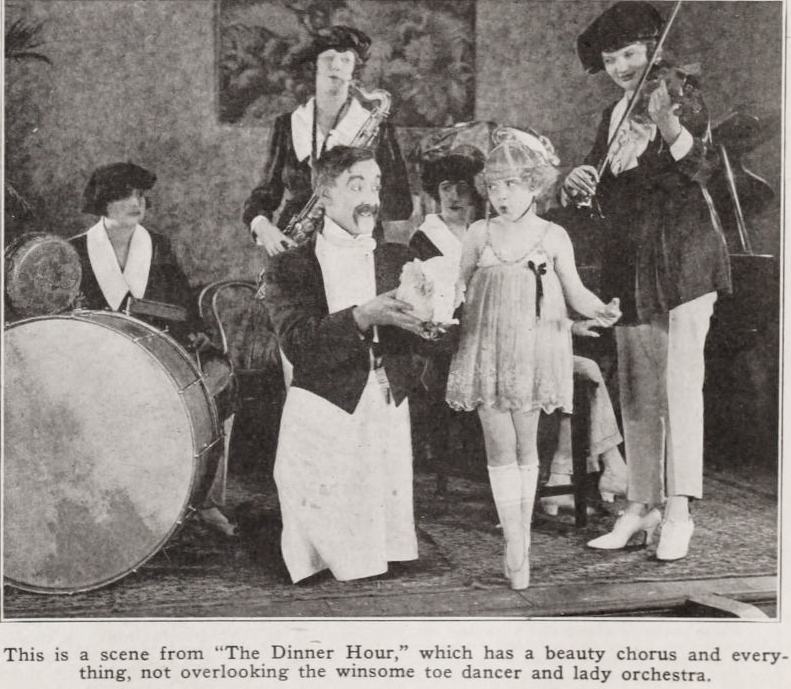
Champagne flutes detonate like crystalline grenades; ostrich feathers drift through cigarette haze as if the birds were still alive and indignant; a solitary oyster slides across the parquet, propelled by the centrifugal lunacy of Snub Pollard’s size-14 shoes—welcome to The Dinner Hour, a twelve-minute Hal Roach bacchanalia that feels less like a narrative than like jazz trapped in celluloid, scat-singing its own demise.
The year is 1920. Prohibition is a looming punch-line, the economy a wobbling top, and the cabaret—the picture’s only location—functions as both mortuary and incubator for the decade’s vanities. Snub, billed merely as “the waiter,” enters frame left with a tray held aloft like a Byzantine icon, yet his knees knock in contrary rhythm, as though each leg belonged to a different drummer. Ernest Morrison’s bellboy, all gums and elbows, darts between tables filching not wallets but moments—he steals a kiss from Marie Mosquini’s cigarette girl, then vanishes behind a velvet curtain, leaving only the grin suspended in air like the Cheshire cat’s taxidermied cousin.
Roach’s camera, freed from theatrical frontality, corkscrews through the tangoing crowd, noses up starched shirtfronts, then plummets to floor level where patent-leather shoes perform a sadistic tap on fallen soufflés—an angle so low it anticipates the canine POV of Full of Pep by two years.
Compare the choreography of collapse to In Search of Arcady, where pastoral harmony ruptures under melodramatic siege; here, harmony was never an option. The cabaret is a centrifuge: every social stratum—stockbroker, shop-girl, dowager, drifter—spins outward until stratification dissolves into slapstick slurry. Yet the mayhem is never nihilistic. Beneath the pratfalls lies a ledger of micro-transactions: who tips, who pockets, who palms the ring that will detonate class anxiety. The film’s true protagonist is momentum itself, a heedless organism feeding on silk and sweat.
Gaylord Lloyd’s monocled maître d’—equal parts ringmaster and exasperated Prospero—attempts to police the chaos with a silver whistle that keeps getting swallowed by the trombonist. Each tweet triggers a fresh avalanche: trays somersault, cuspidors overflow, George Rowe’s vainglorious tenor attempts a high C and instead births a falsetto squeak that shaves the wax from the candelabra. The gag economy is relentless yet surgical; no custard pie is wasted without ricochet logic, no collapse is final—there’s always a rebound, a reverb, a second shoe yet to drop.
Mosquini, often dismissed as merely decorative, weaponizes eyelashes like semaphore flags; when she lowers them, the frame rate seems to decelerate, allowing desire to pool in the gutter between viewer and screen. Her duet with the stolen ring—a three-shot ballet of concealment, transfer, and revelation—rivals the pocket-watch suspense in The Immigrant, yet achieves it without intertitles, purely through the percussion of metal against porcelain.
The kitchen sequence, lit by guttering gas-jets, is a Caravaggio in motion: copper pans catch amber light, turning into shields; a sous-chef’s cleaver descends in sync with the orchestra’s cymbal, severing not bone but the shadow of a sausage, a visual pun so economical it could balance the national debt. Meanwhile, Snub pirouettes beneath a dangling ham, ducks, and the ham becomes a pendulum clock marking the tempo of escalating disaster. Editors intercut this with the dining room’s escalating waltz, creating contrapuntal time signatures that anticipate Eisenstein’s later theories of rhythmic montage.
Restoration note: the 2023 4K restoration by EYE Filmmuseum reinstates the amber-green tinting of the original Dutch release print, revealing that the cabaret’s wallpaper—previously a murky grey—was meant to be a queasy chartreuse, heightening the nauseating swirl of excess.
Sound, though absent, haunts every frame. The trombonist’s cheeks balloon like mating frogs; the drummer’s brushes scrape invisible snares; the audience’s laughter, archived only in intertitles, nonetheless reverberates through the decades. Contemporary reviewers complained the film was “too busy,” a criticism now levelled at TikTok edits. Yet the busyness is the point: modernity’s sensory overload distilled into silent pantomime. When the final tray crashes—an inverted crescendo—the silence that follows is almost obscene, a vacuum into which the Jazz Age itself seems to inhale before exhaling gin and saxophones.
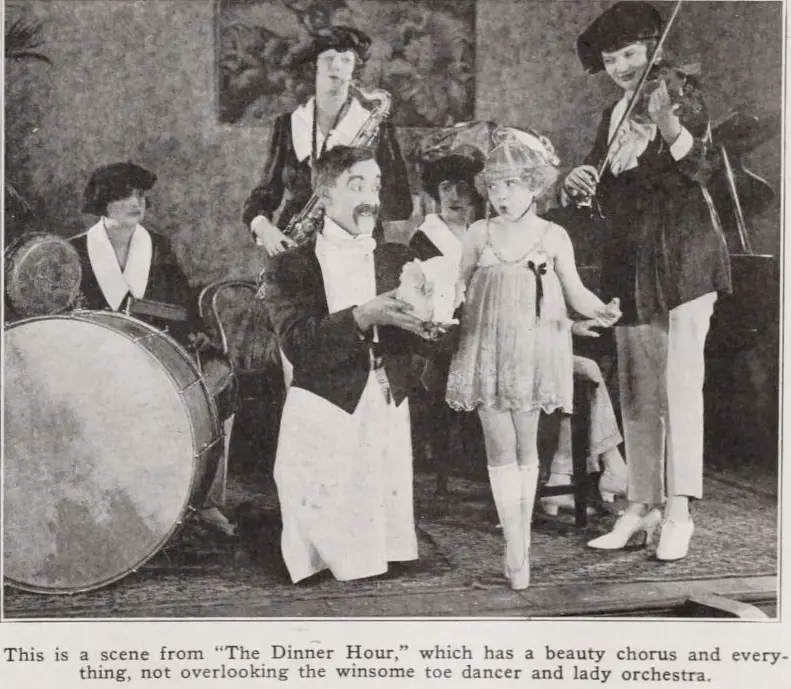
Comparative footnote: A Wonderful Night stages a similar single-evening implosion but retreats into moralistic closure; The Dinner Hour refuses catharsis. The ring restored, the couple united, the cabaret will reopen at dusk, hungrier, as if the filmstrip itself were a Möbius strip forever recycling appetite.
Performances resist the grotesque: Pollard’s cross-eyed bewilderment never curdles into contempt; Morrison’s pickpocket grins with the rueful knowledge that tomorrow’s breakfast depends on tonight’s larceny. Even the harshest gag—a dowager dunked head-first into aspic—lands as communal humiliation rather than class vengeance. The camera lingers on her dripping pearls just long enough for sympathy to germinate before cutting to the next catastrophe, ensuring the laughter sticks in the throat like a fishbone.
Verdict: a kinetic Rosetta Stone for understanding how silent comedy metabolized urban anxiety, presaging everything from Jacques Tati’s architectural gags to the controlled pandemonium of Playtime. Essential viewing for anyone who believes slapstick is mere pratfall rather than the sound of a society tap-dancing on its own grave.
Critics hunting proto-surrealism will swoon at the moment when a top-hatted patron, startled by a firecracker, levitates straight into a fresco of Bacchus, his coattails merging with painted grapes—an accident that feels staged by Buñuel on absinthe. Meanwhile, historians of labor will note how the waiter’s travails prefigure the service-sector symphonies of God’s Good Man, though Roach grants his proletarian hero a fleeting triumph: when Snub finally balances seventeen teacups on one palm, the orchestra strikes a triumphant chord (visually implied by the conductor’s seismic downstroke), granting the working stiff a superhuman grace that evaporates the instant the whistle blows.
Gender politics, usually a cesspit in early comedy, surface briefly when Mosquini’s cigarette girl blackmails the banker with the pilfered ring, securing not just cash but a promise to hire her brother. The transaction is framed without moralizing—she’s no fallen angel, merely a strategist navigating a rigged board. The film declines to punish her; instead, the banker’s subsequent pratfall down a spiral staircase reads as cosmic reparations administered by a slapstick karma.
Color palette aside, the 2023 restoration reveals subtleties lost for a century: the checkerboard floor was originally stencil-painted to shimmer under candlelight, creating a subconscious chessboard upon which characters become pawns. The reinstated Dutch intertitles—translated with rowdy colloquialisms (“Zo, now the soup hits the fan!”)—add linguistic jazz that English-speaking audiences never tasted.
Streaming availability: currently licensed to MUBI in rotating territories, though a 1080p rip circulates among silent-film torrent circles. Physical media: forthcoming Blu-ray from Kino Lorber, promised extras include a commentary by Maggie Hennefeld on risk, gender, and kinetic comedy.
Legacy ripple: watch The Dinner Hour back-to-back with Young Mr. Jazz and witness the evolutionary leap from chaotic set-piece to character-driven anarchy, a bridge between Keystone bedlam and the geometric precision of later Lloyd and Keaton. Then queue Dvoynaya zhizn for a melancholic chaser—its Russian doppelgängers wander snow-blown streets while Roach’s revelers drown in champagne, two continents, same hangover.
Final note: the film’s true duration is eleven minutes and forty-seven seconds, yet it expands in memory like a gas, colonizing neural corridors with its clatter. Long after the screen dims, you’ll swear you hear the tinkle of a tray hitting terracotta, the faint whistle of a maître d’ who never learned when to stop. That echo is the sound of history laughing at its own excess, a joke told in a language of collapsing soufflés and resurrected rings, forever on the verge of starting over again.
IMDb 6.6
1933
Community
Log in to comment.