DbcultAccessing Vault...
Cult Review
Senior Film Conservator
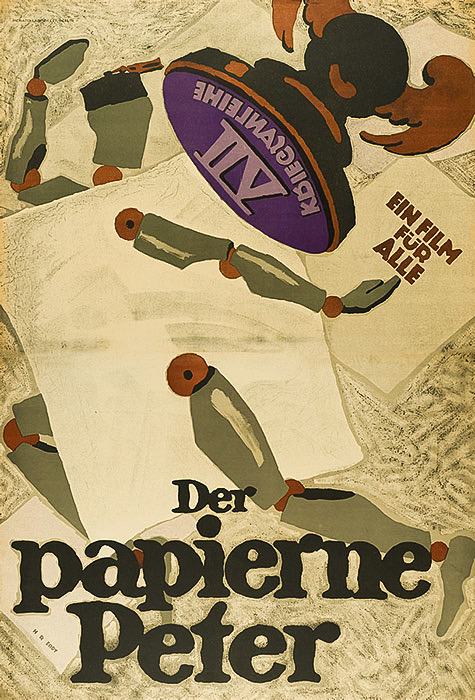
To gaze upon Der papierene Peter is to witness the very moment cinema realized it could lie—and in that lie, find a more profound truth. Released in 1917, a year when the world was fracturing under the weight of the Great War, this German silent short directed by Rochus Gliese represents a defiant retreat into the imaginative. It is not merely a film; it is a tactile experiment in visual literacy. While contemporary American cinema was often preoccupied with moralistic social dramas like Where Are My Children? or the gritty realism of The Measure of a Man, Gliese was busy deconstructing the physical boundaries of the screen.
The premise is deceptively simple: a paper figure gains a semblance of life. However, the execution is anything but rudimentary. Paul Biensfeldt, a stalwart of the era, brings a peculiar rhythmic energy to the production, but the true star is the interplay between the hand-drawn and the human. In an age before digital compositing, the technical audacity required to blend a two-dimensional entity into a three-dimensional space is staggering. Unlike the straightforward narrative thrust of The Last Volunteer, Gliese opts for a dream-logic that feels closer to the psychological depth found in The Mirror (1917).
The use of chiaroscuro—the sharp contrast between light and dark—is not just an aesthetic choice here; it is a structural necessity. Peter, the paper man, exists in the shadows and the highlights. He is a creature of contrast. This visual dichotomy mirrors the fractured psyche of a Europe in turmoil. While films like 1810 o Los libertadores de México were looking backward at nationalistic origins, 'Der papierene Peter' was looking inward at the fragility of the self. The paper medium is the perfect metaphor for the ephemeral nature of human existence—easily torn, flammable, and ultimately flat when stripped of its illusions.
The collaboration between Rochus Gliese and writer Hanns Kräly is the secret sauce that elevates this short above mere gimmickry. Kräly, who would later become a preferred scribe for Ernst Lubitsch, injects a sophisticated wit into the intertitles and the situational comedy. There is a levity here that contrasts sharply with the heavy-handed didacticism of The Vital Question. Instead of preaching, Gliese and Kräly invite the viewer into a playground of the subconscious. Ludmilla Hell provides a grounded presence that acts as the perfect foil to the surrealist antics, grounding the film’s flight of fancy in a recognizable emotional reality.
We see echoes of this stylistic bravery in other 1917 releases, yet few possess the same whimsical darkness. For instance, Fifty-Fifty deals with social balance, but 'Der papierene Peter' deals with the balance of the soul. The film’s pacing is a masterclass in silent editing. It doesn't rush; it breathes. Each movement of the paper protagonist is deliberate, a staccato dance that feels like a precursor to the jagged movements of 'The Cabinet of Dr. Caligari'. It is a bridge between the 'Cinema of Attractions' and the high art of the Weimar period.
To understand the radicalism of 'Der papierene Peter', one must contrast it with the global output of the time. While the National Red Cross Pageant was utilizing the medium for patriotic spectacle, Gliese was shrinking the world down to the size of a desk. There is an intimacy here that is often lost in the larger-than-life epics of the era. Even when compared to the emotional weight of Proletardrengen, 'Peter' stands out for its refusal to engage with the material world on its own terms. It creates its own physics, its own logic.
Consider the atmospheric tension in Malombra or the gothic undertones of Italian diva films. Gliese takes that same sense of 'otherness' and applies it to a piece of stationery. It is an act of supreme confidence. The film suggests that the most terrifying and wonderful things are not found in haunted castles, but in the tools of our own creation. This theme resonates with Vengeance Is Mine!, though Gliese swaps the bitterness of revenge for the melancholy of artifice.
Gliese’s background in theater design is evident in every frame. The sets are not merely backgrounds; they are extensions of the characters' internal states. This is a far cry from the more traditional cinematography of The Girl, Glory or the pastoral simplicity of Peggy. In 'Der papierene Peter', the screen is a canvas. The use of forced perspective and the manipulation of scale make Peter’s journey through the 'real' world feel like a descent into a fever dream. The director understands that in the silent era, the eye must be constantly engaged, not just by action, but by texture.
The film also touches upon the 'noble savage' or 'outsider' trope in a way that predates the more literal interpretations found in The Jungle Child. Peter is the ultimate outsider; he is literally made of a different substance than the world he inhabits. His struggle to integrate, to be 'real', is a poignant reflection of the artist’s own struggle to find a place for beauty in a world increasingly defined by industrial destruction. The film’s ending, which I will not spoil for the uninitiated, carries a weight of existential dread that is masked by its whimsical presentation—a classic Gliese maneuver.
Why does a century-old film about a paper man still matter? Because Der papierene Peter is a testament to the power of the frame. It reminds us that cinema is a trick of the light, a deceptive persistence of vision. It shares a DNA with the experimental fervor of The Curse of Eve, yet it remains more aesthetically cohesive. It is a film that demands to be watched with an open mind and a keen eye for detail.
In the grand tapestry of 1917 cinema, Gliese’s work is a bright, flickering thread of neon yellow in a sea of grey. It challenged the audience of its time to look beyond the literal and embrace the symbolic. As we navigate our own era of digital artifice and virtual realities, the paper-thin Peter feels more relevant than ever. He is the original avatar, the first ghost in the machine, a reminder that even the most fragile creation can leave a lasting mark on the celluloid of history. This is not just a movie for historians; it is a movie for anyone who has ever felt like they were made of paper in a world made of stone.
Final Verdict: A transcendent piece of avant-garde history that proves Rochus Gliese was decades ahead of his time. A must-watch for those who appreciate the intersection of animation and live-action storytelling.
IMDb 6
1936
Community
Log in to comment.