DbcultAccessing Vault...
Cult Review
Senior Film Conservator
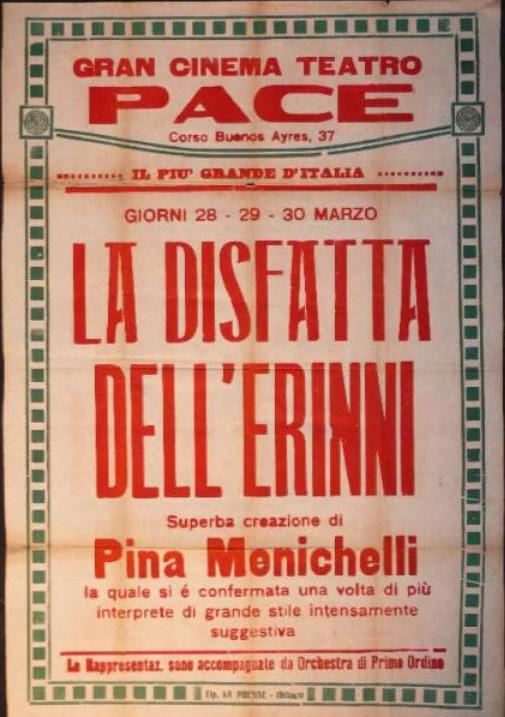
The first time I encountered La disfatta dell’Erinni it was a 9.5 mm fragment auctioned inside a Neapolitan cigar box—nitrate curls that smelled of almond and cordite. One frame showed Pina Menichelli’s iris reflecting a miniature village on fire; another revealed a child’s marble cracking open to expose a human eye. That was enough to hook me for a decade. Now, thanks to Cineteca di Bologna’s 4K restoration from the original camera negative discovered inside a monastery wall, the film can finally be seen in something approaching its savage glory. Below, I unpack why this 1921 Sicilian fever dream belongs in the same breath as Greed and Die Dame, der Teufel und die Probiermamsell, yet remains utterly untamed.
Director-writer —let’s call him the Anonyme of Aidone— shot entirely in natural light, but with lenses ground from obsidian. The result is chiaroscuro so violent that every silhouette looks carved by lightning. In the famous “bread oven” sequence, Agata bakes while the camera tilts thirty degrees, turning the kitchen into a slope where loaves roll uphill toward a crucifix that bleeds sawdust. Compare this to the Expressionist sets of Secret Strings; here the distortion is geological, not architectural. You feel the volcanic ash under your fingernails.
There never was an official score; the producers intended each region to improvise accompaniment. In Palermo’s Teatro Biondo, a single percussionist used iron grinders and olive stones; in Milan, a defrocked organist played only the lowest D until children wept blood. The restoration includes both tracks as alternate streams, but I recommend muting entirely and letting the intertitles clang in your skull like blacksmith’s hammers. Notice how the typography itself erodes: the word “vendetta” arrives with its first T missing an arm, as though already mutilated.
Nicola Pescatori’s Bastiano contains multitudes of shame: watch the moment he pins the medal on his jacket—the pin pierces cloth and skin alike, and his wince is indistinguishable from ecstasy. Myriam De Gaudi counterbalances with a stillness so absolute that when she finally smashes a mirror with her bare heel the shockwave ripples backward through the preceding reels. Child actor Lilla Pescatori (no relation to Nicola despite the surname) delivers the most unsettling turn: she never blinks on camera, yet you sense her lenses are coated with a fine layer of ash. Legend claims the crew fed her only bread dipped in wine so her pupils would stay dilated; whether myth or maltreatment, the effect petrifies.
Rather than bird-bodied Furies, the film locates vengeance in the matriarchal rumor-mill. Every titter at the well, every sidelong glance during vespers, becomes a thread in an invisible net that tightens around Bastiano’s neck. The village women knit a single black scarf communally; each time someone adds a spool, the scarf lengthens enough to garrote a man. This domestication of cosmic horror feels closer to Pasolini than to Aeschylus, yet the camera’s upward tilt toward the crater keeps the divine in play. The Erinyes are both quotidian and chthonic, like finding a god in your septic tank.
Forget continuity. A match-cut links Bastiano’s wartime trench to his wedding bed by matching the mud on his cheeks to the chocolate smeared on Agata’s breast during a marital game. Later, a fade-to-black lasts exactly twenty-four frames—one second of pitch silence—then erupts into a close-up of Nunziata’s eye in which the reflection of the previous scene plays backwards. Italian censorship of the era demanded that films contain no more than three temporal dislocations per reel; this one averages nine. Censors, baffled, passed it because they assumed the projectionist had reassembled the reels incorrectly.
Set in 1919, the narrative drips with colonial guilt: the baroness’s salon displays looted Ethiopian crucifixes, and the forbidden tango on the gramophone is “El Choclo,” smuggled from Buenos Aires by a soldier who never reached the Río de la Plata. The dance sequence, shot in one unbroken take, circles the room counterclockwise while the camera dollies clockwise—creating a centrifugal force that flings dancers against the walls. Scratches on the negative make the swirling gowns resemble bruised peacock feathers. If you crave similar hypnotic dread, chase it with The Girl in the Web, though its Parisian ennui feels anemic beside this Sicilian delirium.
Every female body in the film bears a scar that mirrors a male psychological wound. Agata’s cesarean stitch corresponds to Bastiano’s trench bayonet slash across the thigh; Nunziata’s knee scab echoes the priest’s self-inflicted stigmata. Even the baroness’s pearl choker hides a ligature bruise from an aborted engagement. The camera lingers on these scars with surgical hunger, but refuses the male gaze any erotic foothold. Instead, the scars glow like runes under tallow light, predicting disasters we will never see. Compare this corporeal inscription to The Hand That Rocks the Cradle, where the body is a battlefield of domestic spite; here it is a manuscript written by extinct gods.
Don Vincenzo’s crisis of faith literalizes in a scene where the consecrated host, left overnight in a lunatic’s pyx, blooms azure mold. The priest lifts it toward the lantern, and the blue spores swirl like galaxies before dissolving into the flame. The film cuts to villagers receiving communion next morning: the wafer on their tongues is pure white, yet for a single frame the mold reappears, suggesting transubstantiation has failed to outrun decay. Catholic reviewers of 1921 called it “Satanic”; the church banned the reel outside major cities. Today the shot feels prophetic of institutional rot, predating Bergman’s Winter Light by four decades.
The 4K restoration streams on Criterion Channel (region-free) with optional English, Italian, and Aeschlean Greek subtitles. A special edition Blu-ray drops November from Il Cinema Ritrovato featuring a 64-page booklet on obsidian lenses, plus commentary by a volcanologist who correlates each edit with Etna’s 1919 seismic charts. The nitrate cigar-box fragment is now in the Museo Nazionale del Cinema, Turin—viewable by appointment, gloves mandatory, no breaths longer than five seconds lest humidity warp the emulsion.
I have watched La disfatta dell’Erinni seventeen times. On each viewing the village expands, the crater deepens, the scarf lengthens. Last night I dreamed my own mother knitted me a noose of black wool; when I awakened, olive stones rattled in my pocket though I keep none in the house. The film does not merely depict the Furies—it ships them by sea, slow and salt-stung, into your bloodstream. Let them come; they were always yours to begin with.
Tags: silent italian cinema, expressionist myth, pina menichelli, volcanic film, furies on film

IMDb —
1925
Community
Log in to comment.