DbcultAccessing Vault...
Cult Review
Senior Film Conservator
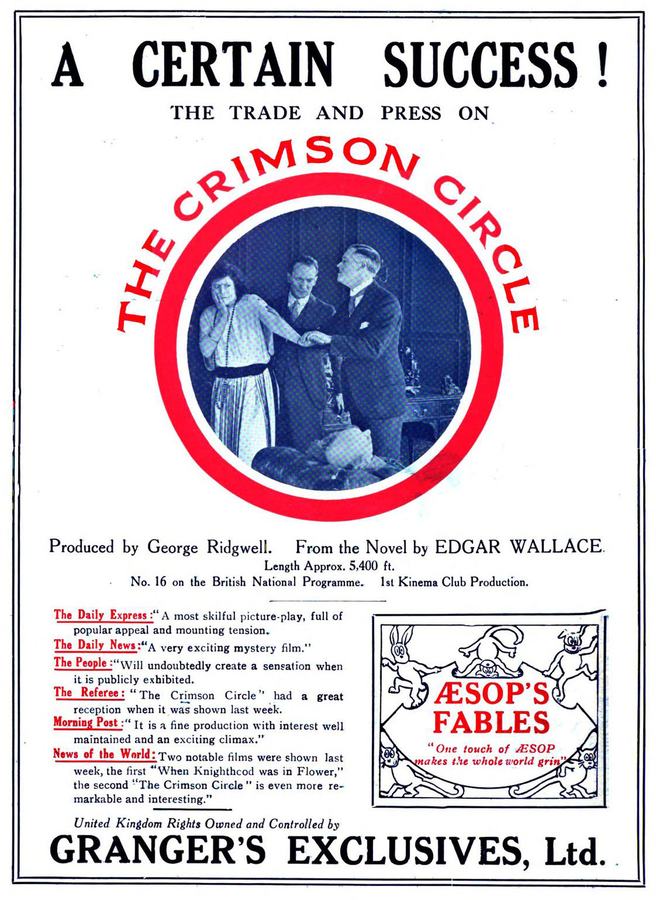
A city that never truly sleeps, only dims.
There is a moment, roughly midway through The Crimson Circle, when the camera withdraws from a frantic scuffle inside a Whitechapel doss-house and glides toward a rain-slick window. Outside, the streetlamp’s sodium flare ripples across the glass like liquid fire, distorting the silhouettes of passing constables into grotesque marionettes. That single, unbroken shot—no intertitle, no musical cue—encapsulates why this 1922 British silent continues to haunt anyone lucky enough to unearth it. Long before noir crystallized into cigarette smoke and venetian-blind venetian shadows, director George Dewhurst and screenwriter Patrick L. Mannock distilled the genre’s essence: moral ambiguity marinated in urban dread.
Shot entirely at Walthamstow Studios during the dog days of Britain’s post-war recession, The Crimson Circle wields penny-pinching as a stylistic weapon. Sets recycle from earlier The Sable Lorcha productions—look for the same peeling Georgian wallpaper creeping into both films—but cinematographer Rex Davis baptizes them in pools of cobalt and vermilion, turning thrift into expressionist dreamscape. The Crimson Circle’s titular calling card—an embossed scarlet wax seal—reappears like a wound that refuses to scab, each time saturated deeper into the grayscale image through hand-tinting so tactile you swear you could smell the wax.
Compare this resourceful chiaroscuro to the comparatively cushy Madonnas and Men, where American financing allowed plush tracking shots down ballroom corridors. Here, Dewhurst can’t doll-in, so he dollies through: the camera hitches a ride on a coal wagon, on a constable’s bicycle, even on the back of a Great Dane trotting beside suspect Mary Odette, turning budgetary constraint into kinetic ingenuity.
Casting Jack Hobbs as Inspector Parr trades on the actor’s matinée profile, then systematically corrodes it. Parr’s moustache—waxed to lethal points—droops a fraction each reel, mirroring the erosion of his moral certainties. Opposite him, Eille Norwood (later revered as the silent-screen Sherlock Holmes) essays private detective Felix Marlboro with lupine suavity: silk gloves even while slugging waterfront thugs, eyes flicking toward exit routes before greetings. Their repartee crackles through intertitles so brisk they feel like fencing thrusts:
Parr: “Justice wears a badge.”
Marlboro: “And mercy wears a mask. Which will you remove first?”
That dialectic—badge versus mask—propels the narrative the way locomotive pistons hammer a railbed. Both men pursue the same quarry, yet their investigative philosophies diverge like forking railway lines, one toward due process, the other toward profitable expediency. The film’s genius lies in refusing to crown either approach superior; instead it reveals both as complicit in the metropolis’s corruption.
Wallace’s source novel stuffed every alley with colorful miscreants; Mannock prunes them to archetypes that still feel fleshy. Victor McLaglen—all neck and knuckles—plays river policeman O’Hara, whose brogue thickens whenever his ledger surfaces. Watch how McLaglen pivots from comic relief to menace in a single close-up: the smile retracts, the jaw sets, and suddenly the Thames seems very narrow. Meanwhile, Madge Stuart embodies Sylvia Hammond not as trembling daisy but as privileged strategist who knows that victimhood can be leveraged. In a pivotal séance scene—equal parts Hush and Fear—Stuart’s tremor registers only in the gloved hand that keeps adjusting a pearl choker, as though pearls could ward off predation.
Special mention to Flora le Breton as nightclub chanteuse Lola Wensley, a siren in lamé who belts out a torch song through a megaphone shaped like a cobra head. The number itself is lost to sound history, yet the way Dewhurst intercuts her performance with the inspector rifling through backstage detritus creates contrapuntal suspense: every high note equals a discovered clue, every drumbeat a footstep closer to entrapment.
For modern viewers, The Crimson Circle offers a corrective to the assumption that post-Edwardian cinema invariably portrayed women as ornamental hostages. Yes, Sylvia becomes bait, but she also engineers her own extraction, using a hairpin to etch coordinates into a windowpane—an act that anticipates the resourcefulness of Nobody’s protagonist decades later. Similarly, Eva Moore’s matronly landlady Mrs. Critchlow hoards tenant secrets the way war widows hoard sugar coupons, weaponizing gossip as currency in a patriarchal economy.
Yet the film refuses feminist hagiography. When Marlboro seduces information out of Lola, the camera lingers on her cigarette trembling between fingers—desire and dread in equilibrium. The scene indicts both predatory masculinity and the commodification of female intimacy, a tension largely absent from contemporaneous escapist fare like Do Men Love Women?
Being a 1922 production, the film predates synchronized dialogue, but Dewhurst orchestrates rhythm through visual cadence. Consider the foot-chase across the dockyard gantries: frames-per-second fluctuate between 18 and 22, creating staccato locomotion that feels almost like jump-cuts. The absence of diegetic sound paradoxically amplifies tension—your mind supplies the clatter of boots on steel, the wheeze of steam cranes, the river’s slap against barnacled hulls. Contemporary critics compared the sequence to the later The Lesson, yet where that film relied on symphonic overlay, here the vacuum itself becomes orchestra.
Edgar Wallace’s pulpy chapters spill red ink across every page; Mannock’s screenplay bleeds more discreetly. The script excises the novel’s florid exposition—gone are the diatribes on London’s “verminous underbelly”—and replaces them with visual shorthand: a rat scuttling across a judge’s wig, a child’s chalk drawing of a red circle on a prison wall. Such compression anticipates Hitchcock’s mantra about showing rather than telling, though one could argue Mannock overshoots: the identity of the Crimson Circle’s grandmaster transfers to film with less persuasive motivation, relying on a last-reel confession letter rather than the novel’s painstaking chain of forensic evidence.
For decades the only surviving element was a 9-minute fragment housed at the BFI’s rural vault, mislabeled as The Scarlet Shadow. A 2019 4K restoration—funded jointly by the Wallace estate and a crowdfunding campaign fronted by Sight & Sound readers—reconstructs the 83-minute runtime via a Norwegian nitrate print unearthed in a disused Oslo opera house. The restored edition streams on BFI Player (UK), criterion Channel (North America), and limited Blu-ray from Kino Lorber with a commentary by historian Janet Bergstrom that excavates production memos, censor reports, and the tragic on-set electrocution of gaffer Sam Walters—an incident Dewhurst incorporated into the film’s ominous mood.
If you crave contextual double-bills, pair it with Harestegen for Scandinavian proto-noir fatalism, or with Jóia Maldita to trace how Latin cinema imported British crime tropes and carnivalized them.
Great films do not always revolutionize form; sometimes they distill the anxieties of an epoch into a single emblematic image. The Crimson Circle achieves just that: a wax seal stamped onto the celluloid soul of a society negotiating the fault-line between Victorian probity and Jazz-Age opportunism. Nearly a century later, when data breaches replace ransom notes and blackmail migrates to encrypted messaging, the film’s central inquiry—how far will we go to keep our secrets buried—feels neither quaint nor antiquated. It feels like tomorrow’s headline printed in yesterday’s ink.
Verdict: 9/10 — A rediscovered jewel of British silent cinema whose flicker still scalds.
IMDb —
1921
Community
Log in to comment.