DbcultAccessing Vault...
Cult Review
Senior Film Conservator
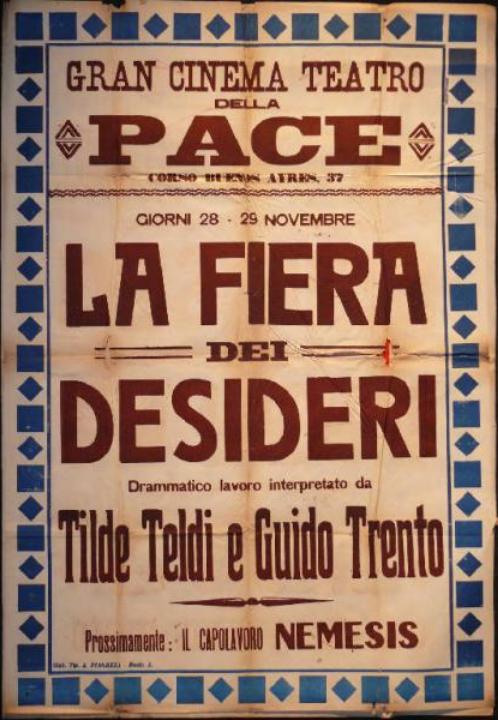
There are films that merely narrate, and then there are cinematic experiences that etch themselves onto the very fabric of your being, resonating long after the final frame flickers into darkness. 'La Fiera dei Desideri' stands unequivocally in the latter category, a profound, almost philosophical, exploration of human aspiration and its often-illusory rewards. While much of early Italian cinema remains shrouded in the mists of time, this particular work, featuring the luminous Mary Salvini, emerges as a beacon, illuminating the social and psychological landscapes of its era with an astonishing prescience.
From its very title, 'The Fair of Desires,' the film announces its allegorical intent. It’s not merely a story; it’s a journey into the collective unconscious of a society grappling with modernity, where the pursuit of prosperity and status often overshadows the more profound yearnings of the soul. The central figure, Clara, brought to vivid, almost heartbreaking life by Salvini, is our Virgil through this opulent yet treacherous inferno. Her arrival in the bustling, unnamed metropolis feels less like a geographical transition and more like a passage into a dreamscape, a world where every glint of gold and every whispered promise holds a seductive, dangerous allure. Salvini’s performance is a masterclass in silent acting, her eyes conveying volumes, her subtle gestures articulating the tremors of a heart caught between innocence and the encroaching complexities of the world. One cannot help but draw parallels to the wide-eyed idealism seen in characters navigating urban jungles in films like Evangeline, though Clara’s journey feels distinctly more internal, a battle waged within the confines of her own burgeoning self-awareness.
The 'Fair' itself is less a physical location and more a state of being, a grand societal stage where individuals parade their aspirations, their carefully constructed facades, and their deepest, often unexamined, longings. The cinematography, a breathtaking display of chiaroscuro and artful composition, transforms the fairgrounds—or perhaps, the city’s grand ballrooms and bustling markets—into a living, breathing entity. Shadows dance with light, hinting at the duality of appearance and reality, while the opulent sets, adorned with intricate details, speak volumes about the era’s obsession with material grandeur. Every frame is meticulously crafted, inviting the viewer to scrutinize the superficial sheen of wealth and the subtle cracks in its veneer.
It is within this mesmerizing crucible that Clara encounters a diverse cast of characters, each embodying a different facet of desire. Emanuele Riadnoff’s Marco, the charismatic entrepreneur, is a fascinating study in ambition, his initial charm slowly giving way to a portrait of a man consumed by the very empire he meticulously built. His arc serves as a potent commentary on the emptiness that can accompany material success, a theme explored with equal poignancy, albeit in a different context, in films like Champagne Caprice, which similarly dissected the moral decay beneath glittering surfaces. Tilde Teldi's Elena, the melancholic artist, offers a stark contrast, representing the soul's yearning for authentic expression, a desire often at odds with the fair's commercial pulse. Her quiet dignity and profound sadness resonate deeply, highlighting the spiritual cost of living in a world obsessed with the tangible. Lea Campioni's Isabella, the enigmatic socialite, completes this compelling tableau, a figure of seemingly effortless grace and attainment, yet whose eyes betray a profound, almost existential, weariness, suggesting that even at the pinnacle of societal achievement, the soul can remain starved.
The narrative’s genius lies in its refusal to offer simplistic moralizing. Instead, it presents Clara with a series of choices, each fraught with its own set of consequences. Her initial attraction to the fair’s glittering facade is entirely understandable; who among us hasn’t been swayed by the promise of an easier, more glamorous existence? The film masterfully depicts the seductive power of social climbing and fleeting affections, making Clara’s missteps feel tragically human rather than merely naive. There’s a universality to her struggle, a timeless quality that transcends the specific historical setting. The subtle guidance offered by Vasco Salvini’s character, an older, perhaps disillusioned, observer, provides a quiet counterpoint to the cacophony of ambition. He is the voice of experience, a silent mentor whose wisdom is conveyed through knowing glances and weary smiles, never through overt pronouncements.
As Clara delves deeper into the fair’s underbelly, she witnesses the betrayals, the hollow victories, and the crushing weight of unfulfilled expectations that lurk beneath the surface. The film’s pacing, deliberate and evocative, allows these revelations to unfold organically, mirroring Clara's own growing disillusionment. This journey of awakening, from wide-eyed optimism to a more nuanced understanding of human nature, is the film's beating heart. It compels us to reflect on our own desires: are they truly ours, or have they been subtly shaped by societal pressures and external validation? This self-examination is a powerful echo of the internal conflicts explored in films like The Temptations of Satan, albeit with a more psychological and less overtly supernatural lens.
'La Fiera dei Desideri' is a triumph of visual storytelling. The director’s keen eye for symbolic imagery is evident throughout. A recurring motif of masks, both literal and metaphorical, underscores the theme of hidden identities and societal performance. The contrast between the vibrant, almost frantic energy of the fair’s public spaces and the quiet, often dimly lit, private moments of reflection for Clara and Elena is particularly striking. These visual cues are not mere adornments; they are integral to the narrative, deepening its thematic resonance and allowing the audience to engage with the film on an intellectual and emotional level.
The film’s use of light and shadow is particularly masterful. Grand ballrooms are bathed in an almost artificial glow, emphasizing the superficiality of the gatherings, while Clara’s moments of introspection are often cast in softer, more natural light, symbolizing her journey towards authenticity. The costumes, meticulously designed, are not just period-appropriate; they serve as extensions of the characters' inner lives, with Isabella's elaborate gowns contrasting sharply with Clara's simpler attire, mirroring their differing approaches to life and desire. Even the architecture of the city itself becomes a character, its towering facades and winding alleyways reflecting the complexity and moral ambiguities of the human condition. One might compare its intricate world-building to the detailed social commentary within A Diplomatic Mission, where the setting itself plays a pivotal role in shaping character destinies.
What truly elevates 'La Fiera dei Desideri' beyond a mere period drama is its enduring relevance. In an age saturated with curated images of success and happiness, the film’s central question—what constitutes true fulfillment?—remains as pertinent as ever. Clara’s ultimate choice, to abandon the glittering mirage of the fair for a path less trodden but more authentic, is a powerful affirmation of self-discovery. It is a quiet revolution, a testament to the courage required to look inward rather than constantly seeking external validation.
The film’s influence, though perhaps understated in broader cinematic histories, can be felt in the subsequent development of character-driven dramas that prioritize psychological depth over overt melodrama. It paved the way for more nuanced portrayals of women navigating complex societal expectations, a theme that would continue to evolve in films for decades to come. The performances, particularly Mary Salvini's, are a masterclass in the art of silent film, proving that profound emotion can be conveyed without a single spoken word. Her ability to convey Clara’s evolution, from wide-eyed ingenue to a woman of quiet strength and conviction, is nothing short of breathtaking.
The film also serves as a captivating historical document, offering a glimpse into the social anxieties and cultural shifts of early 20th-century Italy. The tension between tradition and modernity, the allure of the burgeoning industrial age, and the persistent quest for identity amidst rapid change are all woven into the fabric of its narrative. While it might not possess the overt political statements of some contemporary films, its critique of societal values is no less potent for its subtlety. It reminds us that the human heart’s deepest desires often lie beyond the grasp of material possessions or fleeting social triumphs. It’s a film that asks us to pause, to reflect, and to consider what truly nourishes the soul in a world perpetually designed to distract it. A truly unforgettable cinematic experience.

IMDb —
1920
Community
Log in to comment.