DbcultAccessing Vault...
Cult Review
Senior Film Conservator
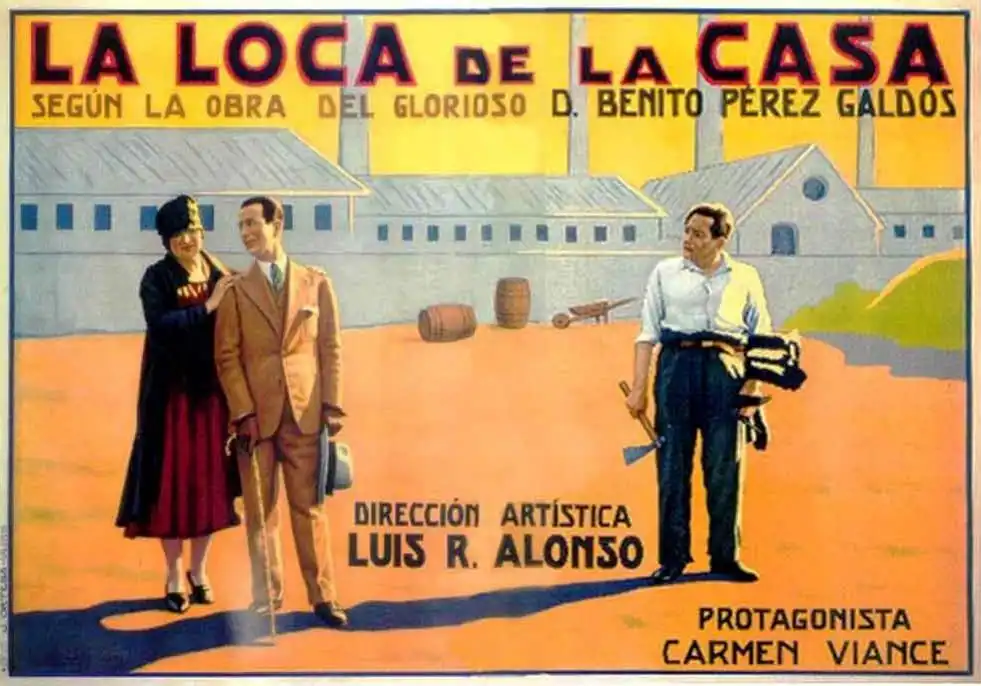
La loca de la casa is a tough sell for most people today, let's be honest. If you’re not already knee-deep in early 20th-century melodrama, or if the idea of a deeply earnest, often static narrative makes your eyes glaze over, then you can probably skip this one. But for those who appreciate the quirks of silent cinema, or if you're just curious about how these kinds of stories were told a hundred years ago, there’s a strange, almost archival charm here. It's definitely not for casual viewing; this is for the dedicated, the patient, or the mildly masochistic.
The whole premise hinges on Victoria (Carmen Viance) having to save her family from complete ruin. The title card setting this up feels, well, a little too urgent. The family’s desperation is conveyed mostly through a lot of hand-wringing and the patriarch, played by Modesto Rivas, staring off into the middle distance with a particularly fixed expression. You can almost feel the movie trying to convince you this moment matters, really matters, to the point where it becomes a bit much.
Victoria's decision to 'hang up her robes' is a visual moment that, depending on the print you catch, might be lost in the grain, but the *idea* of it is powerful. She’s giving up a life of quiet contemplation, maybe even a spiritual calling, for a purely transactional one. Viance plays this with a kind of resigned sorrow that actually lands, especially in her eyes. It's one of the few places where the emotion feels genuinely internal rather than just theatrically displayed.
Then there's the 'rude and greedy Indian,' who turns out to be played by Juan Nadal. His introduction is... something. He enters a room, and the camera just holds on him for a beat too long, almost daring you to dislike him. His 'rudeness' is mostly a series of sharp, quick gestures and a general lack of smiling. Greed? Oh, that’s communicated by him frequently touching his pockets, or, in one scene, actually counting coins right in front of Victoria, completely oblivious to her discomfort. It’s not subtle, not at all, but there’s a bluntness to it that’s almost refreshing in its directness.
The chemistry between Victoria and Nadal's character is, as expected, non-existent. Which, I suppose, is the point. Their scenes together are a masterclass in awkwardness. He’s always a little too close, she’s always trying to create distance. There’s a dinner scene where he keeps looking at her, and she keeps looking at her plate, and the silence between the title cards stretches on, making you squirm a bit. It’s effective, but also a little draining.
Pacing is all over the place. Some scenes fly by, particularly the ones establishing the family’s old, grand but crumbling home. Others, like Victoria’s solitary walks in what looks like a very dusty garden, just drag. You find yourself wondering if the director just liked the way the light hit those particular rose bushes.
One small detail that stuck with me: Victoria's wedding dress. It’s beautiful, in a way, but it feels almost too heavy, too restrictive. It’s not a dress of joy; it's practically a costume of sacrifice. And her hair, usually quite simple, is done up in a way that feels almost unnatural for her character, like she’s being forced into a new identity, quite literally from head to toe.
There are moments where the film tries to inject a little too much dramatic flair. A sudden thunderstorm during a moment of emotional turmoil feels less like natural symbolism and more like the sound designer just hitting the 'storm' button. It pulls you out of the character's internal struggle and reminds you you're watching a movie trying really hard.
Manuel San Germán, as another suitor or perhaps a past love, has a few scenes where he just looks utterly heartbroken. His reaction shots, especially when he realizes Victoria is truly lost to him, are some of the most understated and effective performances in the whole thing. He doesn't overplay it, which is rare for the era, and it makes his brief appearances memorable.
The ending, without giving anything away, tries for a grand emotional release. Does it earn it? Not entirely. The journey to get there is so deliberately paced and, at times, so unrelentingly bleak that the resolution feels a little tacked on, a convenient narrative shift rather than an organic conclusion. It’s like the filmmakers suddenly remembered they needed to wrap things up with a definitive statement.
Overall, La loca de la casa is a fascinating artifact. It’s not going to win over anyone new to silent film, but if you’re already in that niche, there’s enough here—the specific awkwardness, the occasionally powerful visual, the sheer commitment of Carmen Viance—to make it a worthwhile, if sometimes challenging, watch. Just be prepared for a slow burn and some truly unsubtle character work.

IMDb 7.3
1932
Community
Log in to comment.