DbcultAccessing Vault...
Cult Review
Senior Film Conservator
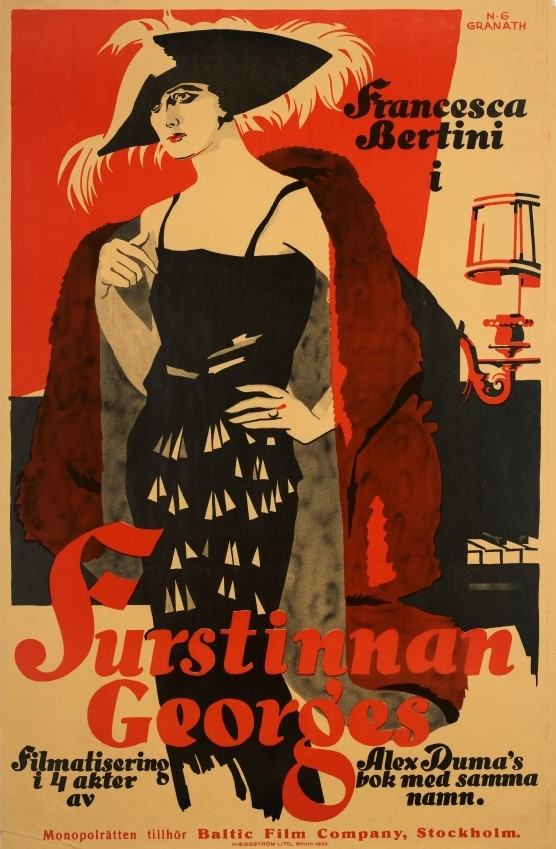
A moon-drowned aristocrat, a ballroom of jackals, and one last pearl clutched like a heartbeat—La Principessa Giorgio is a poisoned sonnet to the twilight of European nobility.
Gaze long enough at Giovanni Schettini’s La Principessa Giorgio and you’ll swear the film itself exhales lake-cooled ether; its images tremble on the brink of dissolution, as though the celluloid were soaked in absinthe and then left to dry on a parapet overlooking Como. Shot in the spring of 1915 while Europe methodically dismembered itself elsewhere, this Italian fever-dream arrives like a hand-delivered letter from a ghost who insists she’s still alive. The plot—ostensibly the chronicle of a princess divesting herself of the last gilded splinters of empire—unspools instead as a necromantic ritual in which décor devours character, and history performs a danse macabre on the backs of its own footnotes.
De Sanctis, poised between Leaves from Satan’s Book’s theosophic suffering and the bourgeois anguish of The Great White Trail, radiates a disintegration so refined it feels aristocratic even in collapse.
Schettini’s camera—part predatory feline, part penitent acolyte—tracks Giorgio through salons where stucco cherubs seem to snicker overhead. He favors mirrors that split her face into frightened twins, and candlesticks that throw horned shadows onto frescoed ceilings. The cumulative effect is not mere decadence; it is epistemological rot, a visual argument that memory itself is a spendthrift heir auctioning off the family soul lot by lot.
Beppo Corradi’s penniless Count Anselmo arrives in white tie and the smile of a man who has already pawned his future. His courtship of Giorgio plays like a chess problem composed by Satan: every compliment is a retractable blade. Their tête-à-têtes occur beneath Tiepolo skies that have yellowed with cigarette haze; Schettini lingers on the count’s fingers drumming against a Gobelin tapestry, as though testing which thread will give first—fabric or dynasty. When he finally twirls Giorgio onto the balcony, the lake behind them heaves with reflected chandeliers, and for a vertiginous instant wealth and water appear indistinguishable.
Enter Alberto Albertini’s Monsignor Azzi, a clerical accountant whose crucifix glints like a balance-scale. He offers salvation at compound interest, promising to spirit Giorgio’s secret son into a seminary if she will but sign over the deeds to her ancestral vineyard. The scene is blocked with ecclesiastical symmetry: two gilt chairs, a desk blotter soaked in sealing wax, and a crucifix casting a shadow shaped suspiciously like a question mark.
Luigi Cigoli’s Dr. Valverde—eyes varnished with fatigue—slides a slender vial across the marquetry tabletop: “One drop for every disappointment, two if you plan to waltz.” Giorgio’s addiction is never named, yet Schettini renders it in synesthetic shorthand: a chandelier’s crystal pendants blur into hypodermic silhouettes; a string quartet sways in and out of tune as her pupils dilate. The camera executes a slow, dolly-in pirouette while she dances with the Count, her gown a corona of silk that consumes the ballroom like a napalm bloom.
In the morning, debts are tallied in the margins of yesterday’s sheet music. Creditors arrive wearing carnival masks—an unnerving touch that anticipates the Venetian nightmare of Die Silhouette des Teufels. They sip hot chocolate while auctioning Giorgio’s past: a snuffbox once fondled by Metternich, a lock of Byron’s hair, the last photograph of her child before he was erased from the family archive. Each transaction is sealed with a wax press that bears the family crest: a swan pierced by a dagger—an emblem so candid it could serve as the film’s thesis statement.
Midway, Schettini stages the most delirious set-piece of early Italian silent cinema: a midnight masquerade whose theme is “The Four Last Things”—Death, Judgment, Heaven, Hell—except every guest misinterprets the prompt. Knights arrive in papier-mâché armor soaked in champagne; courtesans sport wings made of unpaid invoices; a cardinal struts in scarlet stockings embroidered with tiny bankruptcies. The camera glides through corridors like a tipsy omniscience, pausing to ogle a skeletal mime who keeps offering Giorgio an hourglass filled with quicksilver.
Spoilers begin to rain like confetti made of subpoenas.
Giorgio, masked as the Moon, corners her son—now a teen acolyte who believes his mother dead. She attempts to press a pearl into his palm, but the boy, spooked by her trembling ardor, flees into a labyrinth of hedges sculpted like coiling serpents. Schettini cuts to a wide shot: the garden party seen from the villa’s roof, lanterns flickering like fireflies caught in a spider’s web. A gunshot cracks; the music halts mid-bar. In the ensuing stampede, silk tears, masks slip, and for one hallucinatory frame the crowd becomes a single multi-headed beast gnawing at its own entrails.
At dawn, Giorgio staggers onto the jetty wearing a robe stitched from torn banknotes. The lake is a sheet of polished obsidian; mist swallows the horizon. She steps into a gondola whose gilded prow bears the same swan-and-dagger crest. Schettini holds on her face—an extreme close-up that dissolves through four superimpositions: the child she lost, the lovers who bled her dry, the pearls scattered like teeth across parquet, and finally her own reflection morphing into the villa’s crumbling façade. The boat drifts out of frame; the camera does not follow. Instead, it tilts upward to a sky bruised by sunrise, leaving us stranded on the pier with the nauseating suspicion that history itself has just absconded with the last witness.
In this final refusal of closure, Schettini out-Bergmans Bergman years before the Swede ever filmed a shoreline. The absence of the protagonist becomes a negative-space portrait of an epoch: the Belle Époque bleeding out in real time, too refined to scream, too bankrupt to survive.
Gemma De Sanctis operates in micro-movements: a quiver at the corner of the mouth, a blink that arrives a fraction too late, as though her eyelids were negotiating interest rates with gravity. Watch the way her fingers graze the air when offered morphine—half benediction, half pickpocket. It is a masterclass in corporeal diminishment, reminiscent of Francesca Bertini’s harrowing turn in Integritas yet steeped in a uniquely ducal ennui.
Corradi’s Count, by contrast, swaggers with the oily resilience of a man who has read every Balzac novel and learned precisely the wrong lessons. His smile arrives on a delay, like a telegram delivered after the recipient has died. When he finally whispers, “We are all exiles in the country of our own debts,” the line lands with the hollow thud of a sealed ledger dropped into deep water.
Cinematographer Alberto Albertini (pulling double duty as actor) bathes every frame in the spectral glow of mercury-vapor lamps, turning skin into alabaster veined with violet. Shadows pool like spilled absinthe; highlights bloom then wilt within the same shot. The color palette—monochrome yet emotionally polychromatic—anticipates the cyanotype nightmares of Die Silhouette des Teufels while remaining tethered to a specifically Lombard baroque.
Repeated visual motifs perform a sinister fugue: cracked mirrors, pearl necklaces snapped like vertebrae, window-grilles shaped like accounting ledgers. Even the intertitles—rendered in Art-Nouveau typeface—ooze with subtext: “She traded tomorrow for a single yesterday” appears over an image of a child’s shoe abandoned on a balustrade.
Contemporary accounts mention that some prints toured with a live quartet instructed to play Liszt’s La Lugubre Gondola at half-speed, bowstrings slackened to mimic human sighs. Viewed today with curated accompaniment, the film acquires an ectoplasmic audio afterlife: every creak of gondola wood feels like a distant door closing on the 19th century.
Where The Exploits of Elaine externalizes menace into cliffhanger machinery, La Principessa Giorgio implodes melodrama into chamber-oratorio; where A Petticoat Pilot celebrates pluck, this film mourns the moment pluck itself is repossessed. Its true spiritual sibling is Leaves from Satan’s Book—both posit history as a debtor’s prison where even redemption arrives with compound interest.
Seen through the prism of 2024’s crypto-baronies and NFT fiefdoms, the princess’s ordeal feels prophetic: reputation as volatile currency, bloodline as collateral, oblivion as the ultimate creditor. Schettini offers no redemption arc—only the chill recognition that every empire, personal or geopolitical, ends not with bang nor whimper but with the soft squelch of a pearl dropping into deep silt.
La Principessa Giorgio is available on restored 2K Blu-ray from Cineteca di Milano, complete with optional commentary by contrarian film-scholar Dr. Livia Morgante who argues—convincingly—that the gondola never existed.

IMDb —
1919
Community
Log in to comment.