DbcultAccessing Vault...
5.3/10
Senior Film Conservator
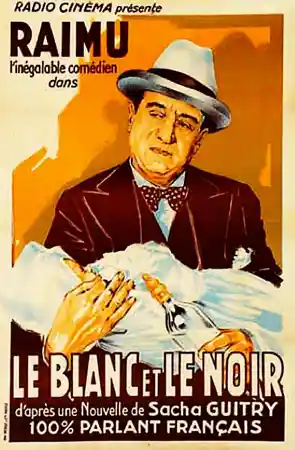
A definitive 5.3/10 rating for a film that redefined the boundaries of cult cinema. Le blanc et le noir remains a cornerstone of transgressive art.
If you like old French movies where people talk way too fast and wave their hands around, then yes. You should probably watch this if you are a fan of Raimu or if you want to see what passed for a 'scandalous comedy' in 1931.
But honestly? If you get easily annoyed by very old-fashioned views on race and marriage, you are going to hate this one. It’s a relic, for better or worse. 🎞️
The whole thing is written by Sacha Guitry. If you know his stuff, you know it's basically a stage play that someone decided to film.
The plot is pretty simple but gets messy fast. Marguerite thinks her husband, Marcel, is cheating on her because he's always 'traveling for business.'
She's probably right, but we don't really see much of his side of things at first. She decides the best way to feel better is to cheat back. Eye for an eye, I guess.
There is this scene in a dark room where she meets a stranger. It's shot in a way that feels very claustrophobic.
The lighting is weirdly dark, even for a black and white movie. I found myself squinting at the screen trying to see if I missed a face.
Then, nine months later, the baby arrives. And the baby is Black.
This is where the movie gets really uncomfortable by modern standards. The way the characters react is... well, it's 1931.
They treat it like a huge cosmic joke and a tragedy at the same time. It reminded me a bit of the frantic energy in Horse Play, but with a lot more talking.
Raimu plays the husband, Marcel. He has this amazing face. It looks like a thumb that is slowly melting.
He can say so much just by looking confused. In the scene where he first sees the baby, his eyes do this weird twitchy thing that made me laugh, even though the situation is supposed to be heavy. 🤨
I noticed that the sound quality is a bit crunchy. It’s an early sound film, so you can hear the background hiss quite clearly.
Sometimes the actors shout their lines because they probably weren't sure if the microphones would pick them up. It feels very 'live' in a way that modern movies don't.
There is a nurse played by Pauline Carton. She is probably my favorite part of the movie.
She has this deadpan expression while everything around her is falling apart. She looks like she’s seen everything and just wants to go home and have a glass of wine.
One thing that bugged me was how the house is laid out. People seem to walk through doors and end up in places that don't make sense.
It’s very much a 'theatrical' set. It doesn't feel like a real home. It feels like a place where people go to have arguments.
Fernandel shows up too. He’s very young here. His teeth are the biggest thing in the frame whenever he talks.
He doesn't have a huge role, but you can see the star power already. He has this energy that makes everyone else look like they are standing still. 🐎
I think the movie gets better once the baby is actually born. The first half is a lot of Marguerite wandering around and looking worried.
It drags a bit. Some of the conversations about 'honor' and 'business' go on for about three minutes too long.
I found myself checking my phone during one of the long speeches by the doctor. I think his name was Dr. Masson? I already forgot.
If you’ve seen The Cat Creeps, you know that early 30s vibe where everyone is a bit stiff. This has that, but the French dialogue makes it feel more fluid.
The ending is... strange. It doesn't really resolve things in a way that feels satisfying.
It just kind of stops. It’s like Guitry ran out of paper and just said 'okay, that’s enough for today.'
I think I liked it more as a history lesson than as a movie. It tells you a lot about what people thought was funny back then.
It’s about as subtle as a brick to the head. But the acting from the leads keeps it from being a total slog.
I spilled some water on my rug while watching the middle part. It was more exciting than the scene where they talk about the travel schedule. 💧
There's this one reaction shot of a guy in a hallway that lasts way too long. He just stares at the camera. I think he forgot his line.
Anyway, it’s a weird piece of cinema. Watch it if you’re bored and want to see something that would never be made today.
Don't expect it to be a masterpiece. It's more like a dusty old postcard you find in an attic. It’s interesting because it’s old, not necessarily because it’s great.
I might watch it again just to see Fernandel’s face, but I’ll probably skip the first twenty minutes.
It’s definitely better than some of the other stuff from that era, like maybe The Phantom Honeymoon which was just a chore to get through.
Final thought: Raimu deserves a medal for making that character even slightly likable. He’s a jerk, but he’s a funny jerk.
IMDb 5.8
1915
Community
Log in to comment.