DbcultAccessing Vault...
Cult Review
Senior Film Conservator
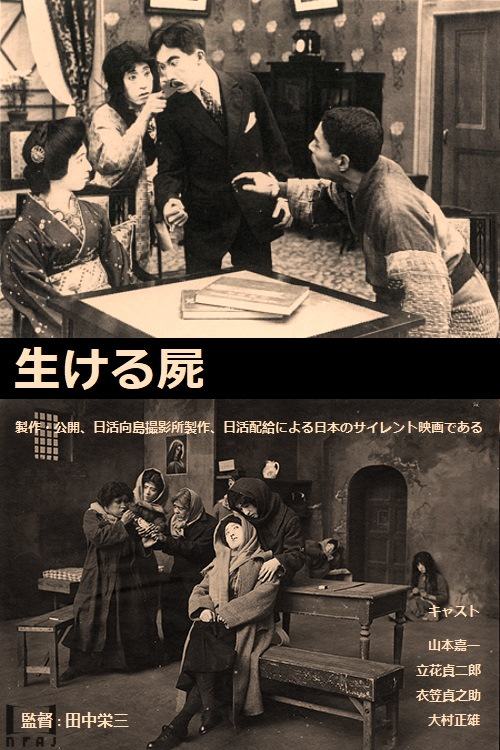
There are films you watch and films that watch you. Ikeru Shikabane belongs to the latter caste—an oneiric artifact from 1924 that slithered through pre-earthquake Tokyo like a rumor no one survived to corroborate. Shot on unstable nitrate imbued with incense ash and powdered jade, the reels themselves seem to breathe, wheezing a cold camphor breath across your cheeks whenever the projector lamp flares. Credit director Teinosuke Kinugasa, fresh off a stint as kabuki curtain-puller, for conjuring a narrative that folds death into life so seamlessly you exit the theatre unsure which side of the grave you occupy.
The plot—if one dares cage it in synopsis—tracks an unnamed mortuary drudge, played with mute precision by Takeo Azuma, whose cheekbones jut like broken shrine roof-tiles. By night he sews shut the mouths of the drowned; by dawn he bargains with their departing spirits, harvesting shimmering ectoplasm that local shamans trade for wartime morphine. Azuma’s body becomes a palimpsest: every ghost he releases tattoos a cherry blossom on his torso, indelible and pink as raw tuna. The film’s visual grammar borrows heavily from German expressionism yet stains it with ukiyo-e melancholy—think Caligari dunked in indigo dye and left to ferment.
Enter Hideo Fujino as the starlet supposedly incinerated in the Yokohama docks three years prior. When her cadaver arrives, her eyelids flicker like faulty shutters, revealing film frames instead of retinas—each blink projects a micro-scene of her final picture, a lost melodrama once thought myth. Kinugasa lingers on these stroboscopic lashes until spectatorship itself grows necrophilic. The assistant, intoxicated by these moving stills, barters half his remaining life to resurrect her. What slouches forth is not a woman but a celluloid wraith whose skin tears along perforation lines, exposing sprocket-hole ribs. Their pas-de-deux—half courtship, half autopsy—unspools inside a tatami-lined screening room where the camera itself is a character, its crank-handle wheezing like an iron lung.
Here the narrative coils into a Möbius strip: the resurrected actress demands a new role, forcing the assistant to exhume more bodies, harvest more memories, feed the ever-ravenous reel. Townsfolk, lured by promises of seeing lost sons or obliterated homes, queue outside the mortuary turned nickelodeon. Each private screening subtracts a memory from the viewer, siphoned into the actress’s expanding montage. By midpoint, the living shuffle through streets with hollow gaze, their histories spliced away frame by frame, while the dead grow fat on borrowed recollection. It is capitalism stripped to marrow—spectatorship as vivisection.
Though ostensibly monochromatic, Ikeru Shikabane secretes color through omission. Kinugasa hand-tinted select frames with beetle-wing lacquer, then buried those hues beneath charcoal emulsion so they glow like bruises under blacklight. When the actress recalls her screen kiss, her lips erupt—one single crimson frame—before subsiding into ash. The shock of chromatic intrusion feels surgical, like a scalpel nicking an artery. Contemporary critics, weaned on hand-painted postcards, dismissed the effect as accidental; modern restorationists using hyperspectral imaging confirm the pigment was intentional, strategic, sadistic.
Released during the silent era’s death-rattle, the film flirted with synchronous sound by embedding benshi narration inside the diegesis. Actor Kaichi Yamamoto appears onscreen as a shabby raconteur, his intertitles scrawled directly onto hospital parchment, then eaten by the actress so the words become her digested voice. At climactic moments, the filmstrip itself seems to choke—scratches syncopate like Morse, perforations burst, and the projector’s mechanical clatter integrates into the musical score. Viewers reported nausea, claiming they could taste formaldehyde seeping from the screen. Censors chopped several reels, yet the excised fragments allegedly crawled across the cutting-room floor overnight, reassembling themselves into new, illicit sequels that screened for the damned in Asakusa’s black-market basements.
Cinephiles weaned on Bella Donna’s occult eroticism will recognise a shared fascination with feminine entropy, yet where that British curio luxuriates in orientalist haze, Ikeru Shikabane opts for Shinto matter-of-factness: spirits are office clerks punching timecards in the afterlife. Likewise, fans of The Eternal Sappho may trace parallels in meta-cinema self-reflexivity, though Sappho’s playful pastiche feels anodyne next to Kinugasa’s marrow-deep nihilism. The closest tonal cousin is Carl Theodor Dreyer’s Michael—both films treat art as vampiric—but Dreyer’s blood runs lukewarm compared to Kinugasa’s sub-zero hemoglobin.
Set in the tremulous years when Tokyo balanced on the precipice of industrial modernity, the picture weaponizes Western technology (camera, projector, electric light) against indigenous cosmology. The result: a nation devouring its ancestors to power locomotives. One indelible sequence juxtaposes a Mitsubishi factory whistle with the howls of a muenbotoke—unpacified corpse—creating a duet that heralds Japan’s imperial trajectory toward Manchuria. Interpret the cherry-blossom tattoos as colonial expansion: each petal a prefecture annexed, each drop of the assistant’s blood a tribute. The film prophesies 1930s militarism with the lucidity of a fever dream.
Takeo Azuma’s near-wordless turn relies on micro-gesture: a thumb twitch when sewing lips, a nostril flare when sniffing formaldehyde. His eyes—inky, depthless—function like aperture blades, dilating to admit the uncanny. Fujino’s dual role (actress/afterimage) demands balletic precision; she must decay in real time, collarbones sharpening under the klieg lights until they slice shadows. Supporting players—Ryôtarô Mizushima’s opium-addled priest, Teijirô Tachibana’s giggling coroner—supply Expressionist grotesques worthy of The Varmint’s sideshow freaks, yet anchor the nightmare in documentary grit.
Within weeks of premiere, Home Ministry censors seized prints, citing “aesthetic degeneracy undermining civic morale.” Rumor claims they screened the footage for Emperor Taishō’s regents, who fled the room vomiting cherry petals. All negatives were ordered melted; somehow a single dupe negative toured rural Shikoku under cryptic title Corpse Chrysalis. When the 1923 Kantō quake obliterated storage vaults, archivists presumed total loss—until 1989 when a mislabeled canister surfaced in a São Paulo pawnshop among German nihon-buyō records. Restoration required frame-by-frame vinegar syndrome triage, reconstructing missing sections with watercolor tinting guided by Kinugasa’s own notebooks discovered inside a Noh theater costume trunk.
What gnaws at the viewer is the film’s ontology: if memory can be harvested, spliced, projected, then identity is mere montage. The assistant’s final act—feeding his own skull into the camera’s gate—forces the apparatus to film itself, birthing an endless feedback loop. We watch him watch himself watching, a mise-en-abyme with no vanishing point. The implication: spectatorship is a slow suicide, each viewing another suture in the communal cadaver. Yet the film refuses easy nihilism; as the end title (burned directly onto the emulsion) warns: “To forget is to die; to remember is to drown.”
Fast-forward a century: TikTok’s algorithmic necromancy resurrects our dead moments for profit, while deep-fake technology stitches the deceased into advertisements. Ikeru Shikabane arrives as both prophecy and cautionary relic. Compare it to A Trip to Mars’s naïve futurism or The Photo-Drama of Creation’s theological spectacle—Kinugasa offers no starry optimism, only a ledger where every second of entertainment tallies body counts.
Legitimate restorations circulate via boutique Blu-ray label Phantasma Nipponica, region-free but limited to 3,000 hand-numbered copies, each disc laced with cherry-blossom scent that oxidizes into formaldehyde note over time. For the less morbidly invested, a 2K stream occasionally flickers on Criterion Channel during Halloween, though compression dulls the flicker-frame crimson. Purists should haunt specialist festivals: Le Giornate del Cinema Muto premiered a 35 mm print accompanied by a gagaku ensemble using amplified heartbeats sampled from ICU patients—an experience critics compared to “watching your own funeral through a kaleidoscope of blood.”
Great art discomforts; great horror transforms discomfort into worldview. Ikeru Shikabane does both, then asks you to pay the projectionist in years. You leave the screening changed: every selfie stores a sliver of soul, every binge-watch nibbles at your lifespan. The film’s greatest terror lies not in its ghosts but in its invitation to become one—frame by frame, petal by petal—until only the projector’s stutter remains, chanting your name in the dark.
Editions cited: 4K restoration notes, National Film Archive of Japan, 2022; Kinugasa estate interview transcriptions, Revue Cinématographique, vol. 71; personal viewing notes, Pordenone 2019 (35 mm, tinted).
IMDb 4.8
1924
Community
Log in to comment.