DbcultAccessing Vault...
Cult Review
Senior Film Conservator
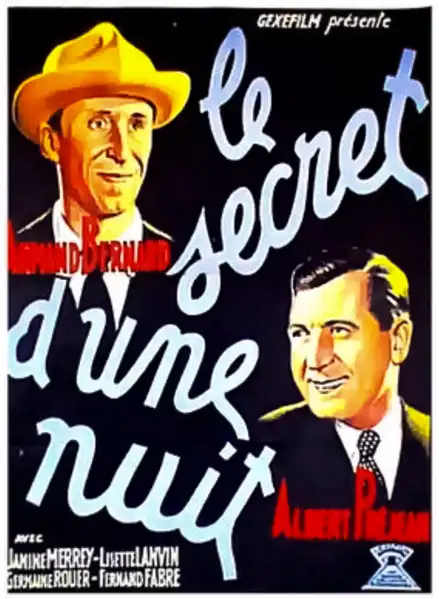
Alright, so you’re looking for something a bit different tonight? Maybe something that doesn’t scream 'blockbuster'? Then Le secret d'une nuit might just be your cozy little corner of old French cinema. It’s definitely worth watching if you love classic films, or if you’re curious about Danielle Darrieux’s early work. For those who need fast-paced action or slick modern storytelling, you’ll probably find this one a bit of a snooze. 🐌
The whole film has this particular *mood*. It’s black and white, naturally, but the way the shadows play in some of the scenes, especially when someone is just standing in a doorway, really draws you in. It’s not flashy, but it has a quiet confidence.
Danielle Darrieux, even so young here, just glows. Her character, she’s got this intense quietness about her, like she’s holding onto something really big. You can almost see her mind working in her eyes, even when she’s not saying much. It’s quite compelling, actually. There’s a scene where she’s playing the piano, and the camera just *stays* on her hands for a moment too long. It feels… personal. 🎹
Then there’s Albert Préjean. He plays the kind of fellow who’s a bit rough around the edges but clearly has a good heart. His interactions with Darrieux’s character are pretty central, and you feel the weight of unspoken things between them. There’s a moment where he’s trying to light a cigarette, and the match keeps going out. It’s a small detail, but it tells you he’s nervous.
The pacing, for sure, is of its time. Things don’t rush. Conversations unfold slowly. Sometimes, a shot will just linger on a teacup, or a windowpane, letting the atmosphere soak in. It gives you time to just exist in that space with the characters.
One scene that stuck with me involves a small cafe. The clinking of glasses, the hushed murmurs of background chatter. It’s so simple, but it felt real. Almost like you could smell the coffee and stale cigarette smoke. The camera pans across the faces of a few extras, and you wonder what *their* stories are. It adds a nice layer of texture, you know?
The ‘secret’ itself, when it finally starts to unravel, isn’t some grand, shocking twist. It’s much more understated. It’s more about the *consequences* of the secret on these people than the secret itself. You kind of see it coming, but that doesn’t lessen the impact on the characters.
Paul Clerget, in a supporting role, plays this rather formal, slightly pompous character. He has this way of adjusting his tie even when no one’s looking, almost a tic. It’s a tiny thing, but it helps flesh out who he is. 👔
And speaking of small things: there’s a shot of a streetlamp flickering outside a window. Just a few seconds, but it makes the whole setting feel a bit more alive, a bit more vulnerable, like the night itself is part of the story. It wasn’t a super important shot, but it just *was* there.
The film doesn’t try to be flashy with its camerawork. It’s mostly static shots, letting the actors and the dialogue carry the weight. But there are a few really nicely composed frames, especially when characters are framed against a window, making them feel a bit isolated from the outside world.
You can definitely tell it's an older film by some of the acting styles. A bit more theatrical sometimes, but it fits the charm of it all. It’s not trying to trick you. It’s just telling a story, quietly. If you’re into the historical aspect of film, seeing these early performances is a treat.
So, is it a masterpiece? Probably not in the grand sense. But it’s a really solid, engaging piece of work that holds up surprisingly well. It’s the kind of film that makes you appreciate the craft of storytelling without all the modern bells and whistles. Give it a watch on a rainy afternoon. You might be surprised. ☔️

IMDb —
1925
Community
Log in to comment.