DbcultAccessing Vault...
Cult Review
Senior Film Conservator
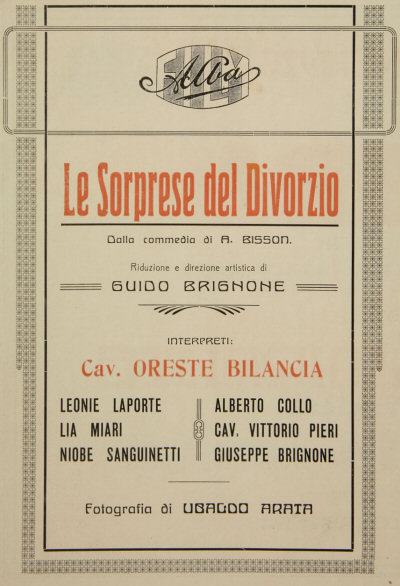
Stepping back into the hallowed halls of silent cinema, one occasionally unearths a forgotten gem whose thematic resonance echoes with startling clarity even a century later. Such is the case with Le sorprese del divorzio, a cinematic artifact from 1917 that, despite its vintage, speaks volumes about human relationships, societal pressures, and the perennial quest for self-fulfillment. Directed with a nuanced hand by Guido Brignone, and penned by the collaborative genius of Alexandre Bisson, Antony Mars, and Brignone himself, this film transcends its era, offering a profound meditation on the institution of marriage and the often-unforeseen aftermath of its dissolution.
The very title, 'The Surprises of Divorce,' hints at a narrative rich in unexpected turns, a promise that the film delivers upon with compelling grace. At its core lies the unraveling of the seemingly perfect union between Isabella, portrayed with remarkable depth by Lia Miari, and Giorgio, brought to life by the commanding presence of Vittorio Pieri. Their world is one of elegant soirées and whispered expectations, a gilded cage for Isabella, whose quiet dignity masks an untapped wellspring of individuality. Giorgio, restless and perhaps deluded by the allure of novelty, succumbs to the charms of Celeste, a vivacious socialite embodied by Niobe Sanguinetti, whose superficiality initially masquerades as modern sophistication. The ensuing divorce, a scandalous affair in the rigid social milieu of the time, sets in motion a chain of events that challenges every character's perception of happiness, freedom, and identity.
What truly distinguishes Le sorprese del divorzio is its refusal to paint its characters in broad strokes of good or evil. Instead, it delves into the complex motivations and vulnerabilities that drive their actions. Giorgio, for instance, isn't merely a villain; he's a man caught between the societal pressures of maintaining appearances and a misguided yearning for a different kind of life. His pursuit of Celeste, initially presented as a path to liberation, gradually reveals itself to be a descent into hollow superficiality. Alberto Collo, as the cynical but observant friend, offers a subtle commentary on Giorgio's folly, his expressions a silent Greek chorus to the unfolding domestic tragedy.
The narrative arc of Isabella, however, forms the true emotional core of the film. Lia Miari delivers a performance of quiet intensity, transitioning from a woman overshadowed by her husband's presence to one who embraces her newfound autonomy with grace and resilience. The 'surprises' are most profound for her; the societal stigma of being a divorced woman, initially a crushing burden, paradoxically frees her to explore intellectual and artistic pursuits that her previous life had denied. This journey of self-discovery, beautifully articulated through Miari's expressive eyes and subtle gestures, resonates with a timeless message of female empowerment. Her transformation is not one of rebellion, but of quiet, determined growth, a theme that, even in 1917, would have struck a chord with audiences grappling with evolving gender roles. One might draw parallels to the spirited independence seen in films like Maria Rosa, where female protagonists similarly navigate restrictive societal norms to forge their own paths, albeit often through more overt dramatic conflict.
Guido Brignone's direction is a testament to the power of visual storytelling in the silent era. He employs a sophisticated cinematic language, utilizing carefully composed frames, evocative lighting, and intelligent use of intertitles to convey complex emotional states and narrative progression. The film avoids excessive melodrama, opting instead for a more introspective and psychologically driven approach. The scenes depicting Isabella's quiet moments of reflection, contrasted with the bustling, superficial world of Celeste and Giorgio, are particularly effective. Oreste Bilancia and Leonie Laporte, in their supporting roles, contribute significantly to the film's rich tapestry, their reactions and silent judgments adding layers of social commentary that underscore the era's stringent moral codes.
The screenplay, a collaborative effort, is remarkably prescient in its exploration of themes that remain relevant today. It tackles the illusion of happiness, the societal pressure to maintain appearances, and the often-painful process of self-discovery after a significant life upheaval. The writers, Alexandre Bisson, Antony Mars, and Guido Brignone, craft a narrative that is both deeply personal and broadly resonant. Their understanding of human psychology, particularly regarding the nuances of regret and redemption, is evident in every finely wrought scene. The film's ability to elicit empathy for its flawed characters, even Giorgio in his moments of disillusionment, speaks to the strength of their writing.
The cast of Le sorprese del divorzio delivers performances that are nothing short of captivating. Lia Miari, in particular, carries the emotional weight of the film with an understated power that is truly remarkable. Her transformation from a demure, somewhat fragile wife to a woman of quiet strength is portrayed with such conviction that it feels utterly authentic. Her ability to convey complex emotions without uttering a single word is a testament to her skill as a silent film actress. She masterfully navigates Isabella's initial heartbreak, her growing resilience, and her ultimate triumph of spirit, making her journey deeply moving.
Vittorio Pieri, as Giorgio, provides an excellent counterpoint. His initial arrogance and subsequent descent into regret are depicted with a compelling blend of bravado and vulnerability. One can see the cracks in his façade as his new life with Celeste fails to deliver the promised fulfillment. His performance is crucial in ensuring that the film's message about superficiality versus genuine connection lands with impact. The contrast between his initial smugness and later melancholia is stark and effective. Similarly, Niobe Sanguinetti, as the object of Giorgio's fleeting affection, perfectly embodies the shallow allure of Celeste. Her portrayal is not overtly villainous, but rather a study in charming insincerity, making Giorgio's disillusionment all the more poignant.
The supporting cast further enriches the narrative. Oreste Bilancia and Leonie Laporte, playing roles that likely represent the societal observers or perhaps even family members, add layers of social texture. Their silent reactions, their disapproving glances, or their subtle shifts in demeanor as Isabella transforms, are integral to establishing the film's social context. Even Giuseppe Brignone, presumably a relative of the director, delivers a memorable turn, ensuring that every character, no matter how minor, contributes meaningfully to the overall tapestry of the story. The ensemble's collective ability to convey intricate emotional landscapes without spoken dialogue is a powerful reminder of the artistry inherent in early cinema, echoing the profound human drama found in works like The Doctor and the Woman, which also relied heavily on visual storytelling to explore complex relationships.
Released in 1917, Le sorprese del divorzio emerged during a period of immense social upheaval, not just in Italy but across the globe. The shadow of World War I loomed large, and traditional societal structures, including marriage, were beginning to face scrutiny. This film, therefore, can be viewed not just as a domestic drama, but as a reflection of a broader cultural shift. The exploration of a woman's agency post-divorce was particularly progressive for its time, challenging the prevailing notion that a woman's identity was solely tied to her marital status. In this regard, it shares a thematic kinship with other films of the era that subtly pushed boundaries, perhaps even more subtly than overtly dramatic narratives like Wildfire, which often focused on strong, independent female characters in more action-oriented settings. Here, the independence is psychological and emotional.
The 'surprises' aren't just for the characters within the narrative; they are also for the audience, who are invited to reconsider their own preconceived notions about divorce and its consequences. The film deftly avoids simplistic moralizing, instead presenting a nuanced view where freedom can be both a blessing and a burden, and where true happiness often lies in unexpected places. This sophisticated approach to a potentially sensational topic elevates it beyond mere melodrama, situating it as a thoughtful piece of social commentary. Its exploration of the internal lives of its characters makes it an intellectual cousin to films like Kvinden med de smukke Øjne, which similarly delved into the psychological complexities of desire and societal expectation.
While perhaps not as widely known today as some of its American or French contemporaries, Le sorprese del divorzio deserves a prominent place in the annals of early Italian cinema. It is a film that speaks to the enduring human experience of change, loss, and the arduous yet ultimately rewarding journey of self-discovery. Its nuanced portrayal of divorce, a topic still fraught with complexity, was remarkably forward-thinking for its time. The film's message — that true liberation comes not from external circumstances but from internal transformation — remains as potent and relevant today as it was over a century ago. It reminds us that sometimes, the greatest surprises emerge from the wreckage of what we thought we wanted, leading us to a more authentic and fulfilling existence.
The subtle interplay of longing and disillusionment, the quiet strength of Isabella, and the eventual reckoning of Giorgio, all contribute to a cinematic experience that is both intellectually stimulating and emotionally resonant. It stands as a testament to the fact that even without spoken dialogue, cinema possesses an unparalleled capacity to explore the deepest facets of the human condition. For those interested in the evolution of storytelling, the burgeoning themes of female independence, and the sheer artistry of silent film, Le sorprese del divorzio is an essential viewing experience, a quiet triumph that continues to surprise and enlighten. Its narrative complexity and emotional depth position it favorably amongst other character-driven dramas of the period, such as Shadows of the Past or Conquered Hearts, showcasing the universal appeal of stories centered on personal struggle and eventual triumph.
In an era when cinema was still finding its voice, Guido Brignone, along with his talented cast and writers, crafted a film that speaks with an eloquence that transcends the absence of sound. It is a compelling argument for the enduring power of silent cinema to explore complex social issues and profound personal journeys. The film's understated elegance and thoughtful narrative ensure its place as a significant contribution to early cinematic art, a work that continues to offer valuable insights into the human heart and the unpredictable tapestry of life.

IMDb —
1934
Community
Log in to comment.