DbcultAccessing Vault...
Cult Review
Senior Film Conservator
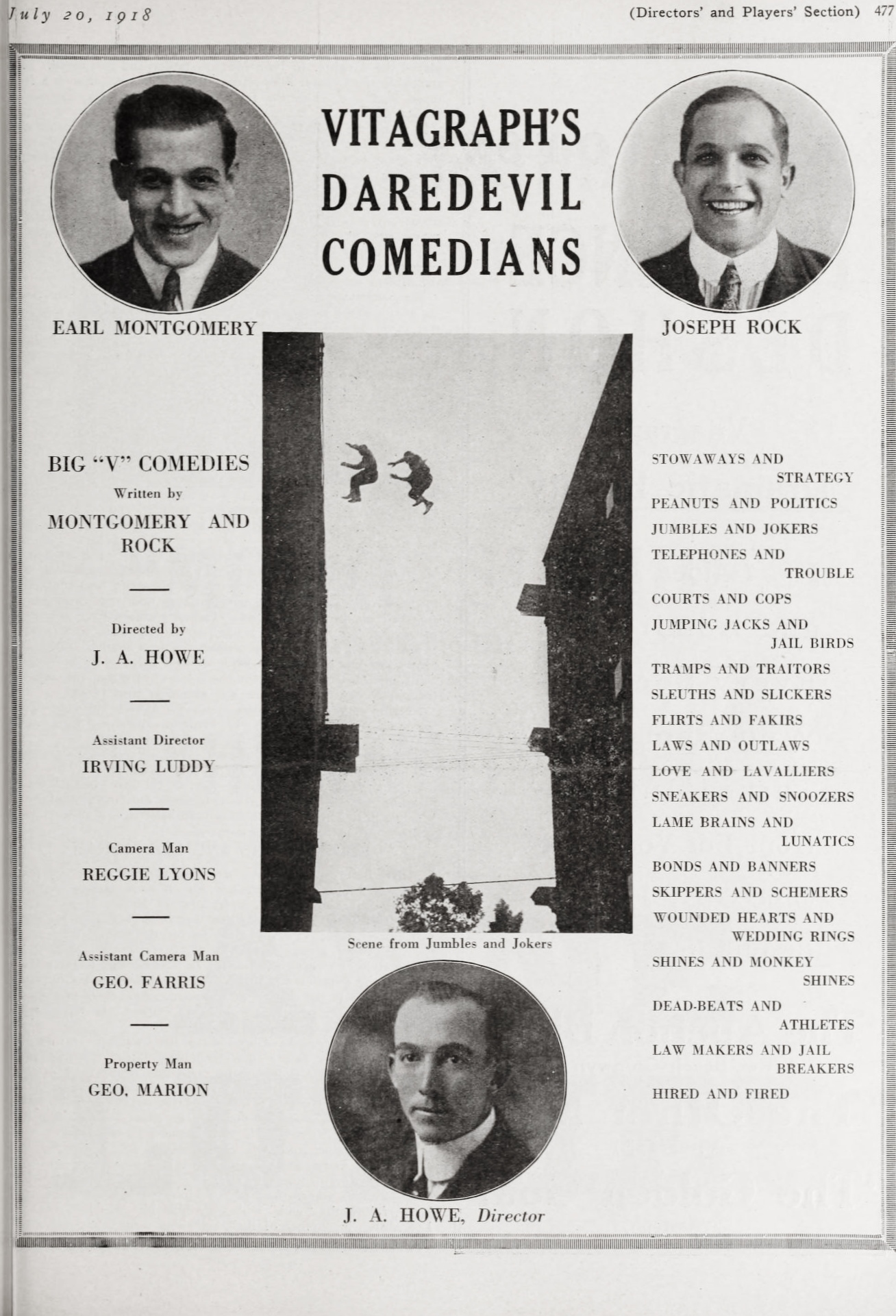
In the pantheon of silent-era slapstick, the shadows cast by giants like Keaton and Chaplin often obscure the vibrant, frenetic contributions of duos like Joe Rock and Earl Montgomery. Their 1923 effort, Skippers and Schemers, stands as a testament to the sheer architectural ingenuity of the short-form gag. Unlike the brooding atmospheric tension found in contemporary dramas such as The Brand of Satan, Rock and Montgomery operate in a realm of pure kineticism, where the laws of physics are merely suggestions and the maritime setting provides a fluid stage for their particular brand of choreographed mayhem. This isn't merely a film; it is a rhythmic exercise in the geometry of the fall, the timing of the splash, and the persistence of the fool.
The film’s premise is deceptively simple, yet it functions as a masterclass in spatial comedy. By confining the action to the precarious environment of a boat, the writers (who, in a display of vaudevillian polymathy, are the stars themselves) transform every rope, bucket, and gangplank into a potential antagonist. There is a palpable sense of the 'working-class struggle' that permeated much of the era's comedy—a theme also explored, albeit with more urban cynicism, in A Nine O'Clock Town. Here, however, the struggle is literally against the tide. The 'Skippers' are less masters of the sea and more victims of its unforgiving buoyancy, while the 'Schemers' represent the eternal human drive to shortcut one's way to prosperity, a motif that echoes through the more dramatic social climbing seen in The Price She Paid.
What distinguishes Skippers and Schemers from the standard two-reeler of its day is the peculiar chemistry between Rock and Montgomery. Joe Rock, with his wiry energy, acts as the frantic engine of the piece, while Montgomery provides the often-baffled counterweight. Their interaction avoids the repetitive 'hit-and-miss' cycle of lesser duos, opting instead for a cumulative escalation. Each gag builds upon the debris of the previous one, creating a narrative of cascading failure that feels remarkably modern in its nihilistic commitment to the bit.
Technically, the film navigates the limitations of 1923 cinematography with a surprising degree of fluidity. The camera, though largely static in the grand tradition of the time, is positioned with a keen eye for depth. We see characters in the foreground struggling with rigging while, in the background, the seeds of the next disaster are visibly sown. This layered visual storytelling is far more sophisticated than the theatrical staging found in early silents like The Question. There is a specific sequence involving a telescopic mishap that rivals the visual puns of the high-budget features of the decade, such as The Great Love, though Rock works with a fraction of the resources.
"The genius of Skippers and Schemers lies not in its plot—which is as thin as a weathered sail—but in its understanding of the human body as a malfunctioning machine. Rock and Montgomery don't just act; they collide, they recoil, and they endure."
One cannot overlook the sheer physicality required for these roles. In an era before sophisticated safety protocols, the stunts performed by the duo carry a visceral weight. When a character is dunked into the harbor or swung precariously over the deck, the impact is real. This authenticity provides a grounding force to the otherwise absurd proceedings. It’s a stark contrast to the more ethereal, romanticized struggles depicted in Rosemary Climbs the Heights, where the obstacles are primarily social and moral rather than gravity-based and sodden.
When placed alongside other comedies of the period, such as The Laugh on Dad, Skippers and Schemers feels significantly more aggressive in its pacing. It lacks the sentimental domesticity that often bogged down early 20s shorts, choosing instead a path of relentless forward motion. It shares a certain rebellious DNA with The Revolt, though its rebellion is directed at the incompetence of the self rather than the strictures of society. The film also avoids the pageant-like artifice of Miss U.S.A., leaning instead into the grimy, salt-crusted reality of the waterfront.
Interestingly, the film’s portrayal of the 'schemer' archetype offers a lighthearted critique of the American Dream. Rock and Montgomery are perpetually on the verge of a 'big break' that is clearly beyond their capabilities. This thematic thread—the delusional pursuit of status—is a common trope of the era, seen through a much darker lens in My Unmarried Wife or the Hungarian drama A vörös Sámson. In the hands of these comedians, however, the tragedy of failure is transformed into the catharsis of the pratfall.
To dismiss Skippers and Schemers as mere low-brow entertainment is to ignore the intricate 'dance' of the production. The timing of the door slams, the precision of the near-misses, and the expressive facial contortions of Montgomery all require a level of discipline that rivals the dramatic intensity of Her Beloved Enemy. There is a sequence in the second reel involving a malfunctioning winch that serves as a perfect microcosm of the film’s philosophy: man creates machines to make life easier, only for those machines to become the instruments of his humiliation. It is a recurring motif in the silent era, yet Rock and Montgomery imbue it with a specific nautical flavor that feels fresh even a century later.
The film also benefits from a lack of the heavy-handed moralizing that occasionally marred films like Little Speck in Garnered Fruit. There is no lesson to be learned here, no redemption to be found. The characters end roughly where they began, perhaps a bit wetter and more bruised, but fundamentally unchanged. This lack of growth is, in itself, a profound statement on the cyclical nature of the human condition—or perhaps it's just an excuse for another bucket of water to the face. Either way, it works.
In the broader context of Joe Rock’s career, Skippers and Schemers is a pivotal entry. It showcases a producer-actor-writer who understood the 'unit' system of comedy production perfectly. By collaborating with Montgomery, he found a foil that allowed for a more complex interplay than the solo 'lonely tramp' archetype. This duo dynamic paved the way for the more polished pairings of the late 20s and early 30s. While it might not have the sweeping romanticism of Három hét or the rugged frontier spirit of Deuce Duncan, it possesses a raw, unpretentious vitality that is increasingly rare in contemporary cinema.
Viewing Skippers and Schemers today requires a recalibration of the senses. We are used to the rapid-fire editing and CGI-enhanced spectacles of the modern age. Yet, there is something deeply satisfying about the tactile nature of this 1923 short. The wood of the ship looks heavy; the water looks cold; the falls look painful. It is a visceral connection to a bygone era of filmmaking where the primary special effect was the bravery and timing of the performers. The film remains a delightful, chaotic, and essential piece of the silent comedy puzzle—a reminder that sometimes, the best way to navigate the complexities of life is to simply lean into the next wave and hope you don't lose your hat.
As the final iris-out closes on Rock and Montgomery’s waterlogged escapades, one is left with a sense of profound admiration for the sheer labor of the laugh. In the grand tapestry of film history, among the epics and the tragedies, Skippers and Schemers is a bright, salt-stained thread that refuses to fade. It is a masterclass in the art of the 'small' film, proving that with enough imagination and a total lack of self-preservation, a simple boat and two determined comedians can create something truly timeless.
IMDb —
1927
Community
Log in to comment.