DbcultAccessing Vault...
6.7/10
Senior Film Conservator
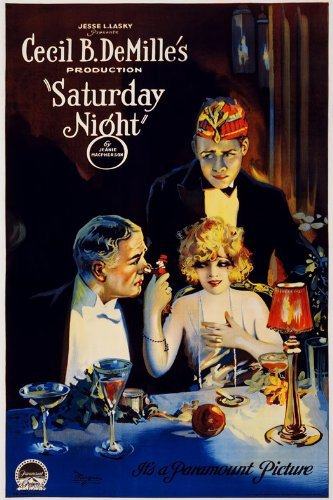
A definitive 6.7/10 rating for a film that redefined the boundaries of cult cinema. Saturday Night remains a cornerstone of transgressive art.
A century ago, when champagne was illegal and hips still dared to sway, Cecil B. DeMille uncorked Saturday Night—a film whose very title drips with irony: every sequined minute unspools the death of an era rather than the carouse it promises. The reels, once thought lost in a lab fire, resurfaced two years ago in a Parisian basement, nitrate kisses intact, and they detonate on contact like a perfume atomizer filled with gunpowder.
The story—deceptively triangular—folds in on itself until it becomes Möbius. Iris, heiress to a fortune measured in locomotives and colonial sinew, steps from a ballroom where Strauss is mangled by a bored quartet, slides into the seat of a Packard Twin-Six, and instructs Tom to drive until the city lights thin into constellations. That single request rewires fate: the chauffeur becomes groom, the mistress becomes pariah, and the manor’s staff—once invisible—erupt into the foreground like background players who refuse to stay chalk outlines.

Macpherson’s screenplay treats marriage not as romantic culmination but as real-estate transaction. Each vows-scene is cross-cut with ledger entries: shares rise, dowries evaporate, a single signature re-deeds entire counties. When Richard—jilted, immaculate—retaliates by marrying Shamrock, the camera lingers on her chapped knuckles against his monogrammed cuff. The juxtaposition is surgical; love becomes a hostile takeover.
DeMille, ever the voluptuary, lavishes half the budget on sets that breathe. Iris’s boudoir is a mausoleum of Lalique crystal; when she smashes a vase, shards spray like iced starlight. Tom’s quarters above the garage reek of petrol and ambition—an easy metaphor, yet the director shoots it from a low angle so the ceiling presses down like a class ceiling made literal. In the divorce-court sequence, Corinthian columns dwarf the protagonists; justice is literally larger than they are, and indifferent.

Compare this to Fate’s Mockery, where interiors are shadow-puppet flat. Here, depth is weaponized: every corridor elongates alienation, every mirror doubles deceit.
Theodore Roberts’s patriarch barrels through scenes like a galleon in full sail, beard crackling with patriarchal static. Edythe Chapman, as Iris’s mother, utters lines through a smile so rigid it could slice camembert; watch her pupils—two black pin-pricks swirling with calculations. Leatrice Joy’s Shamrock is the film’s marrow: she enters in a laundry caftain, exits in mink, yet never loses the stoop of someone who has scrubbed blood from linen. Her final close-up—eyes glassy, lips parted as if about to speak a curse that never comes—deserves postage-stamp immortality.
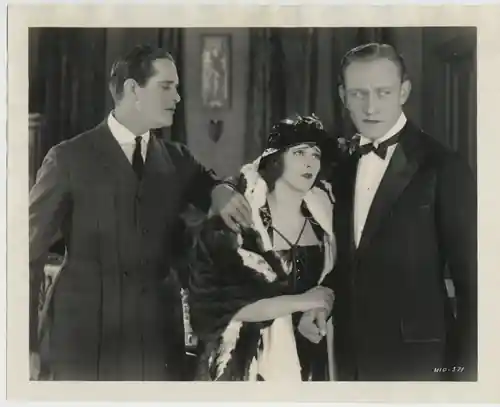
John Davidson’s Richard is silk over switchblade; when he kisses Shamrock’s gloved hand, the camera catches the tremor of self-loathing rippling through his shoulder. It is a masterclass in miniature.
Though monochromatic, the film erupts in synesthetic hues. Iris’s wedding gown—described in intertitles as “the shade of legal parchment”—glints like moon on bone. Tom’s grease-streaked coverall absorbs light so completely he becomes a negative space around which the world overexposes. The restoration team tinted night sequences a bruised indigo; champagne geysers were hand-painted uranium-yellow, giving every toast the halo of radium.
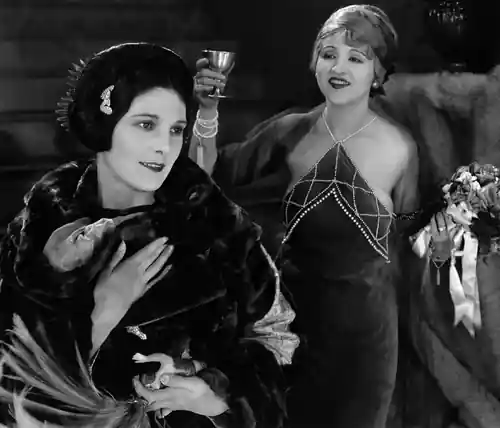
Editing patterns mirror cardiac arrhythmia. Act I glides on extended takes—minuets of seduction. Mid-film, after the first divorce decree, the montage becomes staccato: a flurry of newspaper headlines, ticker-tape, gavels, train wheels, all accelerating until the film itself seems to hyperventilate. By the finale, shots elongate again, but the languor now feels post-coital, post-catastrophe.
This pulse stands in contrast to Cyclone Smith Plays Trumps, which maintains barn-dance tempo throughout. DeMille trusts silence to ache, then ruptures it with cymbal-clash cuts.

Make no mistake: this is feminist magma beneath patriarchal crust. Iris’s first rebellion is not the elopement but the moment she refuses to sign her father’s business contract, effectively seizing the pen that scripts her life. Shamrock’s trajectory—laundress to lady to landowner—charts a proletarian fairytale, yet the film denies catharsis; in the penultimate scene she reclines on a settee upholstered in the same fabric she once scrubbed, fingering the nap as though testing a wound. The cycle of labor ossifies into décor.
The surviving score—reconstructed from a 1923 cue sheet—calls for two pianos, celesta, and trap set. At the screening I attended, the musicians leaned into dissonance: unresolved ninths under love scenes, lullabies played in parallel minor during daylight. The effect is vertiginous; you half expect the screen to tear open and spill 1920s Manhattan into your lap.
Stack Saturday Night beside Western Firebrands and the latter feels like kids playing cowboys in a cardboard canyon. Place it against I Accuse—another DeMille societal exposé—and you’ll find the same scalpel, but here it’s heated white-hot. Only In Bad rivals its cynicism, yet lacks this film’s tactile sensuality.
Watch the final shot: Iris stands on a Riviera pier, hair unbobbed for once, wind whipping strands across her mouth like black seaweed. Behind her, biplanes skywrite product slogans—an anachronism that feels prophetic. The camera retreats until she becomes a pinpoint amid Art-Deco telescopes and celluloid dreams. It is 1922 forecasting 2022: influencer culture, brand omnipresence, women still bargaining their way out of gilded cages.
When the lights rose, a teenage viewer beside me whispered, “So nothing changes.” Precisely. The film’s greatest special effect is not the floodlit mansions or the painted champagne, but the mirror it holds to our perpetual Saturday night—where we dress, flirt, betray, repent, and wake hung-over on Sunday, vows reset like a game of roulette.
Verdict: compulsory viewing for anyone who believes the past was quaint. It was vicious, velveted, and—judging by this print—flammable as nitrate stock soaked in hubris.
IMDb 5.2
1932
Community
Log in to comment.