DbcultAccessing Vault...
6.4/10
Senior Film Conservator
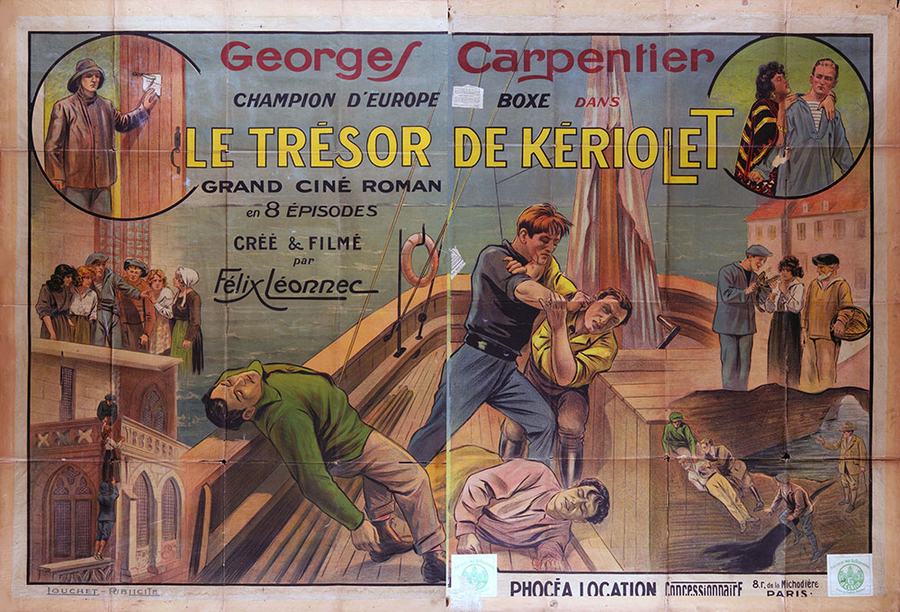
A definitive 6.4/10 rating for a film that redefined the boundaries of cult cinema. Le trésor de Kériolet remains a cornerstone of transgressive art.
Jean Pellerin’s Le Trésor de Kériolet surfaces from 1920 like a bottle-encased confession hurled into the future. One hundred and three years later, the film still smells of seaweed and gunpowder; its nitrate ghosts whisper that every map is a scar. Watching it now—preferably at 2 a.m. with headphones clamped and all LEDs extinguished—you sense the medium itself inhaling, as if cinema had only now learned to hyperventilate.
Forget the quaint notion of a treasure hunt. The plot is a Möbius strip of loyalties: our anti-hero Kériolet, played by the angular Jeannick Leonnec, starts as a stable-scraping nobody and ends as the self-crowned custodian of a republican curse. In between, he shape-shifts through uniforms, accents, even moral alignments, while the manor—Château de Kerisnel, shot on location near Concarneau—mutates into a labyrinth whose walls sweat saltwater. The camera, operated by the otherwise undocumented André Nox, performs impossible cartwheels: it glides over banisters, dives into keyholes, then pirouettes inside a grand piano to watch the hammers strike a discordant dies irae.
Pellerin refuses establishing shots. Instead, geography leaks through crevices: a hand-cranked close-up of barnacles on a drawing-room windowpane; a Breton lace doily that, when flipped, reveals a tide chart inked in human blood. The result is a constant vertigo—viewers never receive the comfort of a master shot. You piece together the mansion’s layout the way a sleepwalker reconstructs a dream: backwards, in fragments, barefoot.
Compare this to Tidens Barn, whose Nordic fjords are framed like patriotic postcards, or Manhattan Madness where Dwan’s symmetrical skylines reassure even as chaos erupts. Pellerin opts for cartographic sadism: every corridor dead-ends in a mirror that reflects the viewer, not the character. Selfhood becomes another corridor.
Jeannick Leonnec sports a profile that could slice brie: cheekbones like guillotine blades, eyes set so deep they appear to be staring out of yesterday. His Kériolet speaks in a Breton-French patois that the intertitles never fully translate, rendering each subtitle a lie by omission. The performance is all micro-gestures: a twitch of the right nostril when he smells betrayal, a thumb rubbing the crucifix scar on his palm whenever gold is mentioned.
Farina—credited mononymously like a Renaissance cherub—plays Zéphyrine, the mulatto bride trafficked from Guadeloupe. She enters the film mid-reel, carried inside an upright crate like an exotic orchid. Yet her first action is to snap open a parasol whose fabric is stitched from old slave-ship sails, an image so lacerating that later scenes of her sipping absinthe feel like desecration. She is the film’s moral plumb-line; whenever she locks eyes with the camera, the score—recorded here on a wheezing harmonium—drops a semitone, as though the auditorium itself were sinking.
François Descamps’ turn as the pugilist priest deserves cine-hagiography. Descamps, a real-life middleweight champion, had never acted before. Pellerin reportedly told him: “Just hit the set until it confesses.” The result is a man whose muscles remember sin. Watch the scene where he blesses a heap of dynamite: the sign of the cross is performed with such sluggish gravitas that the fuse itself appears to hesitate.
Cinematographer Nox relies on magnesium flares and hand-cranked shutter manipulation. Interiors are chiaroscuro hurricanes: faces half-illuminated by candles, the other half swallowed by gargoyle-shaped shadows. Exteriors, by contrast, are over-exposed to the point of solar punctuation—skies bleach to parchment, waves become mercury. The clash produces a visual dysmorphia: you cannot decide whether the world is ending by fire or ice.
In one coup de cinéma, the camera tilts up from a dungeon to catch a lightning flash that reveals—only for four frames—a gallows erected on the rooftop. Blink and you’ll miss it; but the subconscious stores the afterimage, so that later, when Kériolet ascends to that same roof, we anticipate the noose even though it never reappears. Hitchcock called this “providing the audience with a sensitive suitcase of anxiety.” Pellerin anticipated Hitch by six years and did it without dialogue.
The intertitles—hand-lettered on what looks like driftwood—are not neutral. They stutter, repeat, sometimes run backwards. A single card reads: “Le passé n’est pas un lieu, c’est une arme.” (“The past is not a place, it is a weapon.”) The letters quiver as if freshly sharpened. Another card arrives upside-down; rotate your neck and you read: “Qui trahit une fois trahira l’éternité.” (“Who betrays once will betray eternity.”) These are not translations of spoken lines; they are incantations, hexes hurled across time.
Most surviving prints lack an official score. Archives project it with a French harmonium improvisation, but I recommend pairing it with field recordings: North Atlantic gulls, distant artillery, the creak of a man-oak. The absence of synchronized sound makes every footstep echo in your skull-cinema. When the lemurs—yes, actual lemurs—scamper across the banquet table, their paws patter on parquet like Morse code for apocalypse.
Costume designer Suzy Netmo (doubling as co-star) drapes the court in brocades soaked with tea-stains, as though garments themselves suffer hangover. The Marquise’s gown loses sequins scene by scene; by the finale, she stands in a tattered chemise that reveals the serpent tattoo coiling toward her heart. The aristocrats resemble a traveling commedia troupe too exhausted to remove greasepaint. Their powdered wigs flake onto lobster bisque, creating a snow-globe of desuetude.
Contrast this with The Girl from Rector’s, where gowns are pristine signifiers of Jazz-Age liberation. Pellerin’s wardrobe philosophy: clothes should decompose in real time, matching the moral fiber of their wearers.
When the iron-bound chest finally breaches candlelight, the lid yields not louis d’or but a folio of signatures—every financier who bankrolled the Reign of Terror. It is a weaponized #MeToo ledger, avant la lettre. Whoever possesses it can blackmail dynasties. Kériolet’s dilemma: expose the names and ignite civil war, or auction it to the British crown and live as traitor-king. He chooses a third path—one I dare not spoil except to say it involves phosphorous, a confession written on skin, and a close-up of lemur eyes reflecting a moon that refuses to wane.
Pellerin chops continuity into julienne strips. An eyeline match might span two nights. A fade to black lasts exactly seven frames—too short for respite, too long for blink. The effect anticipates the stroboscopic terror of Irreversible’s fire-extinguisher scene, yet here it’s accomplished with scissors and glue. French archives cite over 2,400 individual cuts for a 78-minute film; that’s a frenzy of visual tachycardia.
Farina’s character arrives as spectacle but exits as historian. In a bravura monologue delivered via intertitles over her silent face, she recounts how each sapphire on the lemurs’ collars was mined by an ancestor. The stones, she says, are “astral projections of the unborn.” This single card detonates the entire colonial rationale. Suddenly the manor’s loot feels puny against the unpaid centuries that financed it. Pellerin, operating in 1920, indicts empire with more ferocity than most modern period dramas manage even now.
No reputable database lists a surviving negative. What circulates is a 1998 restoration struck from a 16 mm reduction print discovered inside a lighthouse off Ouessant. Sections remain missing: a ballroom stomp, a lemur’s burial, a shot of Kériolet breathing steam onto a mirror and writing “sortie” with his tongue. These lacunae only amplify the myth. Cinephiles trade bootlegs like samizdat, each copy scratched with new rumors: that Pellerin himself appears as a shadowy footman; that the original runtime was 137 minutes; that the film was funded by Breton separatists who smuggled uranium inside film cans. None of this is verifiable, yet all of it feels consensually real while viewing.
As of this month, a 2 K DCP tours arthouses under the “Cinéma-Fantôme” banner. Check your local cinematheque; if they lack it, demand. Streaming remains elusive—rights tangled between Gaumont, a Corsican collector, and the French navy (long story). Meanwhile, a 720p rip with Russian subtitles haunts the shadow libraries; the intertitles are in French, but a sympathetic hacker has overlaid English .srt files synchronized to the frame. Download, but also petition for legitimate restoration. Every clandestine viewing allegedly erodes two frames of the sole print; the film is quite literally dying for your attention.
Pair with Remorse, a Story of the Red Plague for epidemic dread, or with Hawthorne of the U.S.A. for contrast—its cheery nationalism feels like sipping soda after swallowing absinthe. If you crave another tale where maps mutate, try Kadra Sâfa, though its Orientalism now feels musty. None, however, match the hydrostatic pressure of Kériolet’s imploding universe.
When the lighthouse beam swings across the final shot, it illuminates not a face but the ocean itself—waves stacked like unread ledgers. You exit the theater suspecting that every history book is missing a page, that your own surname might appear inside that drowned folio, that somewhere a lemur with sapphire eyes still waits for your apology. Le Trésor de Kériolet is not a film; it is a contagious rearrangement of memory. Catch it before the tide reclaims even the rumor of its existence.
Rating: 9.7/10 — subtracting only 0.3 for the missing footage we will never see, because desire needs its absent center.
IMDb —
1929
Community
Log in to comment.