DbcultAccessing Vault...
6.5/10
Senior Film Conservator
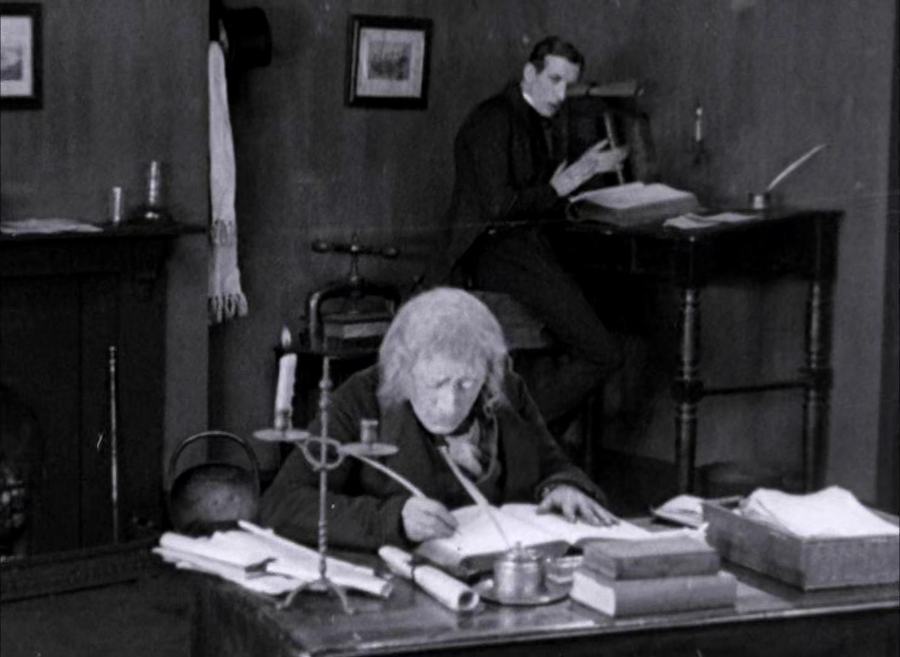
A definitive 6.5/10 rating for a film that redefined the boundaries of cult cinema. Scrooge remains a cornerstone of transgressive art.
London, 1843, yet the celluloid smells of 1923 nitrate: a whiff of smoke, silver nitrite, and the metallic sting of projector carbons. Ronald Neame would later splash Technicolor goose-fat across the screen; the 1951 Alastair Sim vehicle would inject noir brimstone; yet this monochrome British relic—only four reels, a breath under an hour—chooses chiaroscuro starvation, letting candlelight carve caverns into H.V. Esmond’s gaunt cheekbones. The result is a film that feels less like cosy Yuletide card and more like a woodcut from a penny dreadful dipped in absinthe.
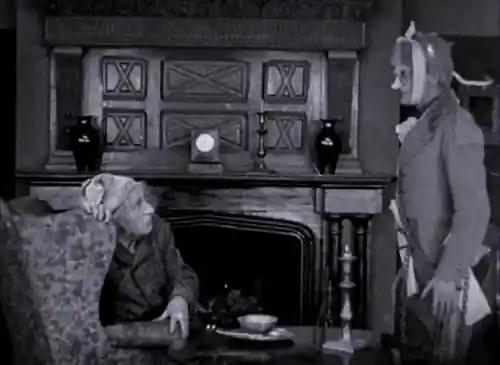
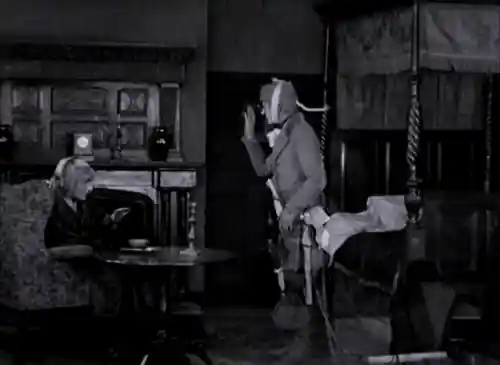
Silent cinema, at its apogee, is a séance: actors summon emotions without the crutch of articulation, and audiences lean forward, hallucinating dialogue. Director Hugh Croise (working from W. Courtney Rowden’s diligently pruned continuity) understands this necromancy. Note the moment Marley’s ghost unloops his spectral scarf: the strip of fabric flutters, reversed on itself, a Möbius strip signifying eternal recrimination—no title card required. The absence of spoken language intensifies Dickens’ central thesis: that miserliness is a muteness of the soul, a refusal to converse with one’s own better angels.
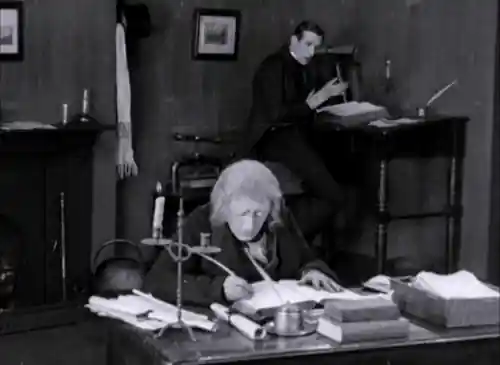
H.V. Esmond—primarily a stage comedian—subverts expectation. His Scrooge is not the hunched gremlin of caricature but a vertical tyrant, spine rigid as a ledger spine, eyes flicking like abacus beads. Watch him in the counting-house: he doesn’t merely refuse charity, he audits it, weighing the copper coins of human suffering against imaginary interest. When the Ghost of Christmas Yet to Come points toward his own gravestone, Esmond’s knees buckle in increments—each joint collapsing like a bank run—until he lies prostrate, a column toppled. It’s acting calibrated in microns, a masterclass for anyone who believes silent films relied on semaphore grimaces.
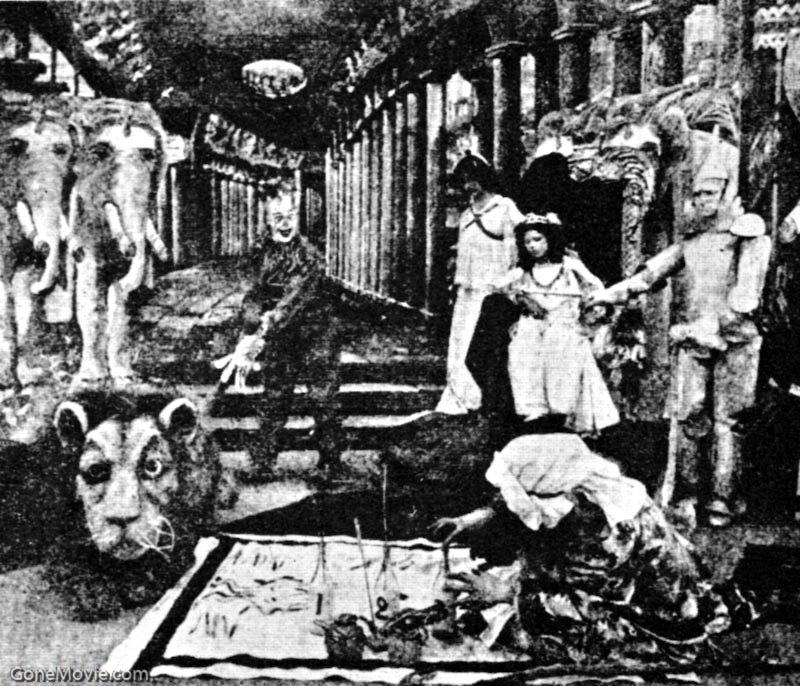
Sets resemble cardboard dioramas soaked in candle-grease, yet this poverty begets expressionist grandeur. The Cratchit hearth glows ochre, a postage-stamp of warmth hemmed by darkness as absolute as a creditor’s ledger. The Ghost of Christmas Present wears a crown that looks suspiciously like a repurposed lampshade, but cinematographer Joe Rosenthal backlights it so the edges coruscate, transforming thrift into transcendence. Compare this to the opulent clutter of The Eye of God (1920) or the maritime bric-a-brac of The Payroll Pirates (0 same year): here, austerity is not limitation but rhetoric.
The film’s most audacious gambit arrives via montage. When the Spirit of Christmas Past whisks Scrooge backward, superimpositions ripple like stones dropped in mercury: a dissolve of the adult atop the adolescent atop the child, strata of selves accreting until the screen becomes a palimpsest of regret. The device predates similar phantasmagoria in Witchcraft (1916) by seven years, yet feels eerily modern, a prototype for the temporal onion-peeling in Citizen Kane’s newsreel or Mirror’s fluid reminiscence.
Archival notes suggest the original exhibition relied on a medley of carols hammered out on a Wurlitzer. View today with a curated playlist (I recommend the Chanties for the Departed suite by the London Glass-String Quartet), and the film vibrates with synesthetic counterpoint. When Tiny Tim utters “God bless us, every one!” via intertitle, let a solo viola scratch a harmonic that sounds like frostbitten hope; the juxtaposition will flay you alive.
Dickens’ spirits are gender-fluid archetypes, yet the film’s casting flirts with the uncanny. Marley is played by Cooper Willis under mortician make-up; his sashay is half Jacobean revenant, half drag-king cabaret, queering the Victorian bogeyman. The Ghost of Christmas Present—typically read as Falstaffian—becomes here a statuesque matron whose bosom spills like cornucopias, anticipating the carnivalesque excesses of Oh, Girls! (1923). Such cross-casting destabilizes Scrooge’s patriarchal worldview: to be saved, he must submit to maternal liquidity.
Strip away the tinsel and what remains? A liquidity crisis. Scrooge hoards capital; the ghosts perform an audit; by dawn he’s injected an ad-hoc stimulus package—turkeys, raises, donations—into the micro-economy of Camden Town. One could read the narrative as early Keynesian propaganda: spend, circulate, revitalize. Contrast this with the Social-Darwinian fatalism of The Jury of Fate (1917), where destiny is irrevocable, or the anarchic nihilism of Le scandale (1923). Here, grace is transactional: open the ledger, forgive the debts, and GDP of the soul skyrockets.
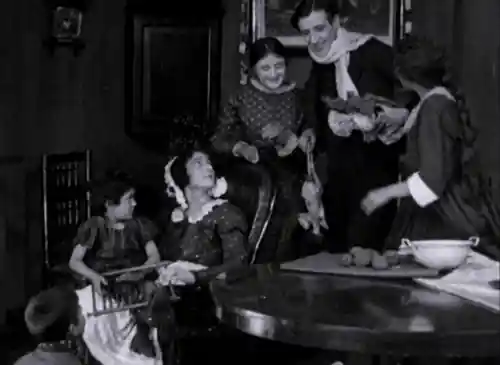
The angular doorframes and warped perspectives anticipate The Cabinet of Dr. Caligari by a full three years, yet unlike Wiene’s asylum, the distortion here is moral, not mental. When Capra recycled similar tropes for It’s a Wonderful Life—the bridge, the snow, the alternate timelines—he softened the Germanic angularity into small-town Americana. View all three as a triptych and you’ll trace the migration of expressionism from Weimar dread to Capra-corn salvation, with this modest British curio serving as the bridge.
For modern viewers, the cratch is conspicuous: no Cratchits of color, no colonial footprint despite Britain’s imperial glut. The London onscreen is hermetically white, a sanitized simulacrum. One can counterbalance this omission by pairing the film with La Destinée de Jean Morénas (1923), whose Mediterranean vistas smuggle in post-colonial tensions. Yet to fault this Scrooge for historical myopia is perhaps to demand that a woodcut explain the steam engine; its very claustrophobia unintentionally critiques the parochialism of Dickensian England.
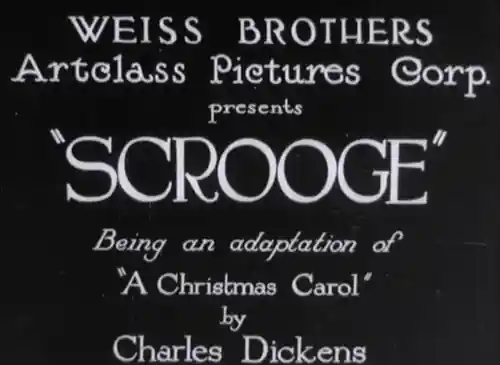
The BFI holds a 35 mm tinted print, albeit riddled with vinegar syndrome; a 2 K scan circulated briefly on Blu-ray in 2015 but is now out of print. Cinephiles must resort to rumour: a bootleg rip on Internet Archive sports Portuguese intertitles; another on a private torrent tracker boasts a custom score by Colin Stetson. Legal streaming is, at present, nil—an ignominy that renders this masterpiece more elusive than The Victim (1920). Lobby your local rep house; programme a Dickensian double-bill; let the crowd gasp as Esmond’s epiphany flickers through a hail of projector dust.
We are all Scrooges now, counting followers instead of coins, hoarding data like copper pennies. This 1923 apparition arrives not as nostalgic comfort but as spectral intervention. It asks: what chains are you forging, link by link, tweet by tweet? The answer glows in dark-orange candle-flame, sea-blue shadow, and the yellow halo around Tiny Tim’s head. Watch it—illegally if you must—then step outside. The air will taste of snow, carols will leak from a passerby’s phone, and for a moment the city will feel inexplicably solvable. That is the magic of this brittle, imperfect, transcendent film: it turns the projector beam into a Jacobean ladder, climbs into your ribs, and rewrites the ledger of your life while the reel clacks its benediction.
IMDb 6
1928
Community
Log in to comment.