DbcultAccessing Vault...
Cult Review
Senior Film Conservator
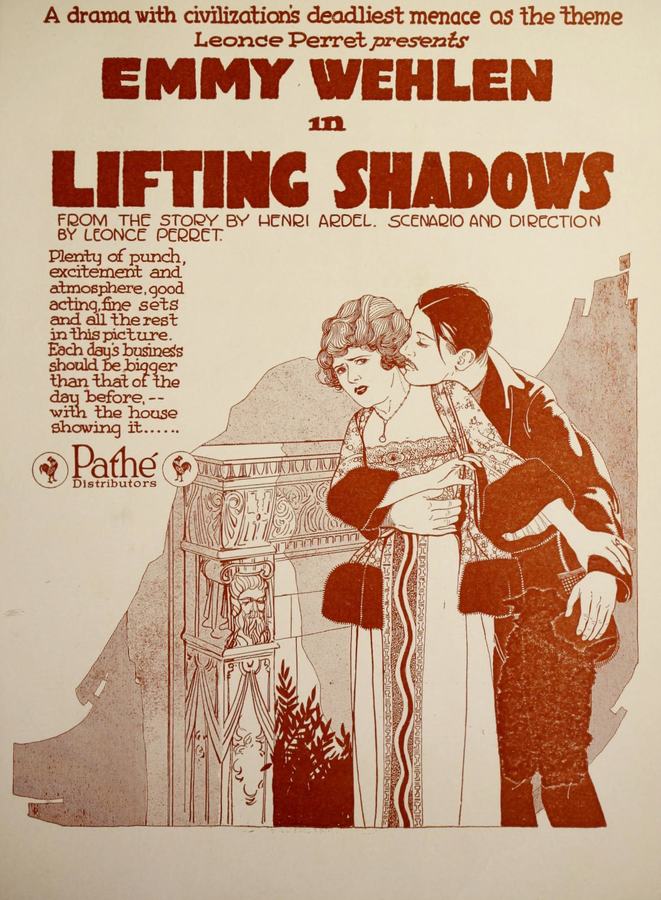
Léonce Perret’s 1920 opus, Lifting Shadows, stands as a quintessential artifact of post-war cinematic transition, bridging the gap between the raw visceral energy of early European drama and the burgeoning sophistication of American narrative structure. The film introduces us to Vania, portrayed with a haunting, ethereal fragility by Emmy Wehlen. Vania is not merely a protagonist; she is a personification of the displaced intellectual class, a woman whose very identity is forged in the crucible of the Russian Revolution. When her father, the firebrand Serge Ostowski, is obliterated by his own instrument of destruction, the metaphor is clear: the revolution devours its own children. This prologue sets a somber, almost nihilistic tone that permeates the remainder of the film, distinguishing it from the more frivolous social comedies of the era such as The Indestructible Wife.
The migration to America, often depicted as a journey toward enlightenment, is here rendered as a descent into a different kind of purgatory. Vania’s marriage to Clifford Howard (Stuart Holmes) is a masterclass in the portrayal of domestic Gothic horror. Holmes, an actor who excelled at depicting the reptilian underbelly of high society, plays Howard as a man whose soul has been hollowed out by morphine and malice. This isn't the romanticized struggle of a misunderstood artist, but the grinding, ugly reality of addiction. The contrast between Vania’s revolutionary background—rooted in idealistic, if violent, change—and Howard’s stagnant, self-destructive decadence provides a rich layer of social commentary that was far ahead of its time.
The middle act of Lifting Shadows pivots from historical drama to a claustrophobic psychological thriller. The Howard estate becomes a prison of mahogany and silk, where Vania’s survival depends on her ability to navigate her husband’s mercurial temper. The cinematography here, managed with Perret’s characteristic eye for depth and lighting, utilizes shadows not just as a visual motif, but as a narrative weight. We see Vania shrinking within the frame, dwarfed by the opulence that bought her safety but cost her agency. This thematic exploration of the 'gilded cage' invites comparison to other contemporary works like The Unattainable, yet Perret injects a grittier, more European sensibility into the proceedings.
The climax of this domestic tension—the shooting of Clifford Howard—is handled with a jarring, staccato rhythm. In a drunken rage, Howard becomes the very monster Vania fled from in Russia. The act of killing him is portrayed not as a triumph, but as a tragic necessity that further isolates her. When Emmy Wehlen’s Vania pulls the trigger, the camera lingers on her face, capturing a complex mosaic of horror, relief, and the sudden realization that she has once again become a creature of violence. It is this moment that elevates the film from a standard melodrama to a profound character study. Unlike the more rhythmic pacing found in Sporting Life, the tension here is jagged and unforgiving.
The introduction of Hugh Mason, played with a stoic, almost knightly resolve by Wyndham Standing, shifts the film into the realm of the courtroom drama and the romantic tragedy. Mason is the archetype of the noble protector, yet his nobility is predicated on a lie—or rather, a void of information. Vania’s refusal to confess her deed to the man who loves her is the film’s most compelling psychological hook. It explores the 'imposter syndrome' of the soul; she believes that Mason loves a version of her that does not exist. This moral ambiguity is a recurring theme in the screenplays of Henri Ardel, who often placed his characters in positions where truth and survival were at odds.
The legal proceedings are filmed with a sense of impending doom. As Mason builds a defense based on her perceived innocence, the audience is complicit in Vania’s deception. We want her to be free, yet we recognize the corrosive nature of her secret. This tension is far more sophisticated than the binary morality found in many 1920s films, such as Nugget Nell. The film asks: can a love built on a foundation of omission ever truly survive? The 'shadows' of the title refer not just to her past in Russia, but to the darkness she carries within her heart even in the bright light of Mason's affection.
Just as the domestic drama threatens to overwhelm the narrative, Perret reintroduces the political subplot. The revolutionaries who have tracked Vania to America represent the 'return of the repressed.' They seek her father’s papers—a classic Hitchcockian MacGuffin that serves primarily to force the characters into a final confrontation. The presence of these radicals in the American suburbs creates a fascinating juxtaposition. It reflects the genuine 'Red Scare' anxieties of the American public in 1920, where the 'Old World' chaos was seen as a contagion threatening the 'New World' order. This element of the plot mirrors the intrigue found in The Tarantula, though with a more explicitly political bent.
The hiring of detectives by Mason to protect Vania adds a proto-noir element to the film. We see the beginnings of the private eye trope—men who operate in the periphery to ensure the safety of the elite. The final intrusion into Vania’s home is choreographed with exceptional skill. Perret uses the architecture of the house—the staircases, the long hallways, the heavy drapes—to create a sense of tactical suspense. The revolutionary is not just an assassin; he is a ghost from Vania’s past, a physical manifestation of the violence she thought she had left behind in the ruins of her father’s laboratory.
The resolution of Lifting Shadows is perhaps its most controversial element from a modern critical perspective. The dying confession of the revolutionary—claiming he was the one who actually killed Clifford Howard—is a blatant deus ex machina. It serves to scrub Vania clean of her 'sin' in the eyes of the law and, more importantly, in the eyes of her lover. While this may feel like a narrative cheat, it was a common trope in silent cinema to ensure a 'happy' ending that satisfied the censors and the audience's desire for moral equilibrium. It echoes the convenient resolutions seen in Oil's Well That Ends Well.
However, if we look beneath the surface of this plot convenience, there is a deeper irony. Vania is 'freed' not by the truth, but by a different kind of lie—or at least a very timely truth that conveniently erases her own agency in the act of self-defense. The film suggests that for a woman like Vania to survive in the world of men like Mason, she must be perceived as a victim rather than a combatant. Her actual act of killing her husband in self-defense is deemed too 'dark' for her redemption, so the narrative provides a surrogate killer to take the blame. This layer of subtext makes Lifting Shadows a much more cynical and interesting film than it initially appears.
Technically, Lifting Shadows is a triumph of its era. Perret’s direction is fluid, avoiding the static 'proscenium arch' style that still plagued many productions in 1920. The use of close-ups is particularly effective, allowing Emmy Wehlen to convey the internal tumult of Vania without the need for excessive intertitles. The costume design, contrasting the austere garments of the revolutionary with the lavish gowns of the American socialite, tells a story of class migration in itself. The film’s pacing is deliberate, allowing the atmosphere to thicken before the bursts of violence, a technique Perret perfected in works like The Feast of Life.
In conclusion, Lifting Shadows is a complex, multi-layered drama that navigates the turbulent waters of trauma, addiction, and political upheaval. While its ending may lean on the melodramatic conventions of its time, the journey it takes to get there is paved with psychological insight and visual splendor. It remains a vital piece of silent cinema history, a bridge between continents and eras, and a testament to the enduring power of the 'fallen woman' narrative when handled with the sophisticated touch of a master like Léonce Perret. It is a film that, much like its protagonist, emerges from the smoke of revolution to find a precarious, yet beautiful, peace.
A definitive look at a forgotten gem of the 1920s, Lifting Shadows remains a haunting exploration of the secrets we keep to preserve the love we think we don't deserve.
IMDb —
1917
Community
Log in to comment.