DbcultAccessing Vault...
Cult Review
Senior Film Conservator
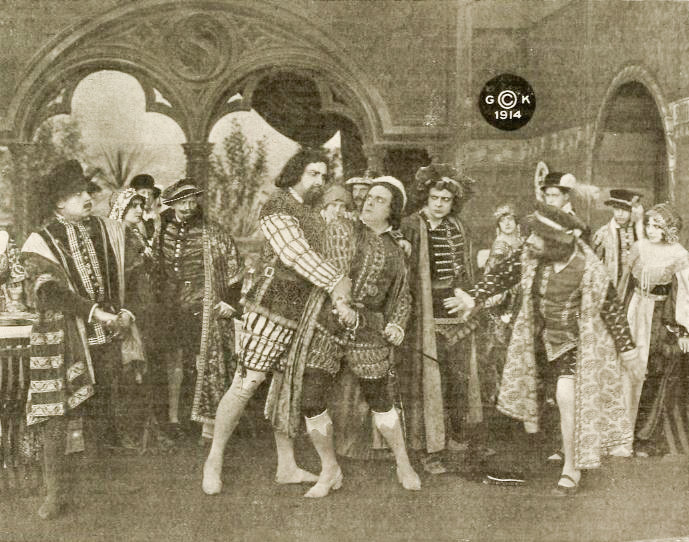
There are films that merely narrate, and then there are those that reek of tarred rope and gunpowder, that leave brine crystallised on the projector gate. Lion of Venice—a 1919 Italian mega-spectacle now resurrected on translucent Blu-ray—belongs to the latter tribe. From the first iris-in on the rippling standard of St Mark, Arrigo Frusta’s screenplay treats patriotism not as bunting but as a stiletto slipped between the ribs: the film’s pulse is the moment loyalty mutates into vengeance, and vengeance into an almost ecclesiastical penance.
Frusta engineers a triptych of falls: territorial, erotic, civic. Cyprus, that sun-scorched chessboard, is lost not through cowardice but through the cold arithmetic of supply lines—an anti-climax so bracingly modern it could have been penned by Kubrick. Rienzi’s tactical retreat, shot with prow-level cameras that skim the foam like dolphins, becomes a danse macabre of listing masts; the editor intercuts parchment maps, wax-sealed orders, and close-ups of water sloshing in the bilge, turning geography into gastro-intestinal dread. When the captain finally limps under the Punta della Dogana, Venice rewards him with the equivalent of a golden handshake and a dagger in the kidney: his fiancée traded, his name forged, his mother expiring from the sheer weight of heraldic shame.
Cinematographer Paolo Colaci (also essaying the thankless role of Orsini) chisels light with the cruelty of a scalpel. Interiors of the Palazzo Ducale are rendered in tenebrist chiaroscuro: torches smear vermilion across obsidian walls, councillors’ faces half-submerged in umbra, suggesting a republic that governs by candle-snuffing. Exterior maritime sequences, filmed in the lagoon under the fierce Apulian sun, bleach sails to parchment and transform Negri Pouget’s Bianca into a Grecian statue whose marble eyes still weep salt. The pirate stronghold—actually the cliffs of Grignano—receives a cobalt gel that makes the Adriatic resemble liquid lapis, a chromatic prophecy of the sea’s later baptism in blood.
Fernanda Negri Pouget, her eyelids lacquered with kohl, conveys Bianca’s marital entombment through micro-gestures: the way her thumb obsessively circles the wedding ring as though trying to unscrew it from existence. In the chapel of Our Lady of the Water, she removes her veil, letting moonlight pool in the silk like mercury, and whispers her vow to Orsini while her pupils remain fixed on Rienzi—an act of ocular adultery more erotic than any kiss. Paolo Colaci’s Orsini is less moustache-twirling villain than petite bourgeois opportunist; his jealousy carries the banal acidity of a civil servant passed over for promotion. Watch the way he fingers the tassel of his biretta while framing Rienzi—every twirl calculates social ascent.
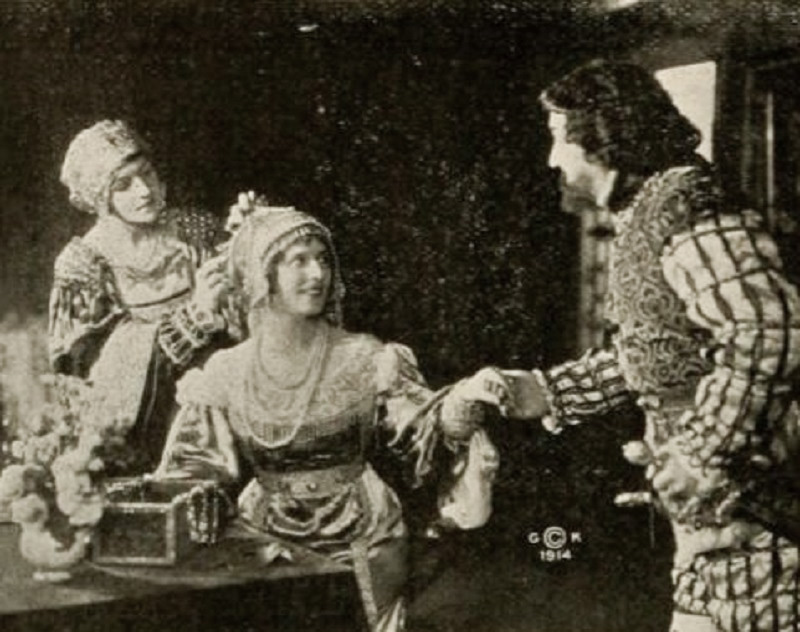
As Adriane, Lena Lenard supplies the film’s moral gyroscope. Her transformation from decorous maiden to pirate-camp siren who still hides a lion flag under her cloak is rendered without intertitles; instead, the camera tracks her decisive gait across the deck, the tilt of her chin shifting by degrees until she becomes a Valkyrie in velvet.
Frusta’s boldest conceit is to personify the republic itself as a carnivorous courtesan whose beauty is proportionate to her capacity for devouring sons. The Council of Ten, framed from a low angle, become a hydra of powdered wigs; their verdict on Rienzi is delivered in a cavernous hall where every footstep echoes like a nail in a coffin. Even the Doge’s salvaging intervention—engineered by his wife, a woman who has presumably learned that mercy is the sharpest political blade—cannot expunge the taint. Venice grants triumphal arches yet warehouses grudges in damp ledgers; the film suggests that patria is merely another woman who will sell you for a dowry.
Bianca’s embroidered lion functions like the veil of Veronica: a scrap of cloth that absorbs private anguish and then flaunts it in public space. When Adriane unfurls it atop the mainmast during the climactic melee, the gesture is filmed in reverse-slow-motion (achieved by cranking the camera at 12 fps and projecting at 18), so the fabric seems to breathe into existence like a memory too stubborn to die. The pirates’ cheer is not jingoistic; it is the involuntary reflex of men who suddenly remember childhoods in Genoese chapels, mothers teaching them to cross themselves before a painted lion. In that instant, Rienzi’s vendetta against Venice becomes a vendetta against his own capacity for forgetting.
The final conflagration pre-empts the proleptic montage of Eisenstein’s ice-battle by a decade and a half. Superimpositions of scimitars and halberds slice across the frame; smoke from burning galleys becomes a kinetic curtain through which combatants lunge like shadow puppets. The editor intercuts a close-up of the lion flag—now riddled with bullet holes—against extreme long shots of the Crescent standard sinking beneath the waves, forging a dialectic between emblem and empire. When Orsini, skewered by a splintered boom, gasps out his confession, the camera dollies back to reveal the deck tilted like a crucifix, the wounded Count framed against a sky cross-hatched by sail-rigging.
The new 4K restoration on Criterion sports a commissioned score by Luca Balbo that fuses Venetian folk oboe (ciarameda) with spectral electronics. Listen for the moment Rienzi tears the lion flag from Adriane’s hands: the drone drops to a sub-audible 24 Hz that vibrates in the viewer’s chest cavity, reproducing the physiological panic of exile. During the naval engagement, Balbo overlays the sound of a single oar slapping water—sampled at the exact spot in the lagoon where the sequence was shot—creating an ontological anchor that sucks the viewer into the 16th-century maelstrom.
Where Ten Nights in a Barroom moralised alcohol as a domestic saboteur, Lion of Venice indicts patriotism itself as the more addictive poison. The film’s trajectory—from civic sainthood to pariahdom to sacrificial reintegration—mirrors the arc of From Gutter to Footlights, yet replaces theatrical applause with cannon thunder. Bianca’s marital bondage rhymes with the sacrificial brides of Salomy Jane, but her embroidery needle is mightier than any six-shooter.
For all its visual majesty, the film cannot quite escape the racial binaries of its era: the Turks remain faceless hordes, their admiral a silhouette swathed in ostrich plumes. A contemporary viewer will flinch at the ease with which Muslim bodies are consigned to the shark-thick deep while Christian corpses are afforded lingering close-ups. Additionally, the interpolated comic relief—an inebriated boatswain who bungles knots—feels tonally jarring, as though someone spliced a Mack Sennett reel into a revenge tragedy.
Still, these cavils evaporate like spray once the lion flag ascends. Lion of Venice endures because it understands that nations are stitched, not forged; that every emblem carries the sweat of the hands that wove it; and that the line between traitor and savior is as thin as a single strand of gold thread against the Adriatic wind. Watch it on the largest screen you can find, volume cranked until the oar-slap becomes your own heartbeat. When the end credits roll, you may discover yourself instinctively reaching for needle and cloth, ready to embroider your own allegiance—however damned—onto the tattered fabric of whatever city, or love, once betrayed you.
IMDb 5.3
1927
Community
Log in to comment.