DbcultAccessing Vault...
Cult Review
Senior Film Conservator
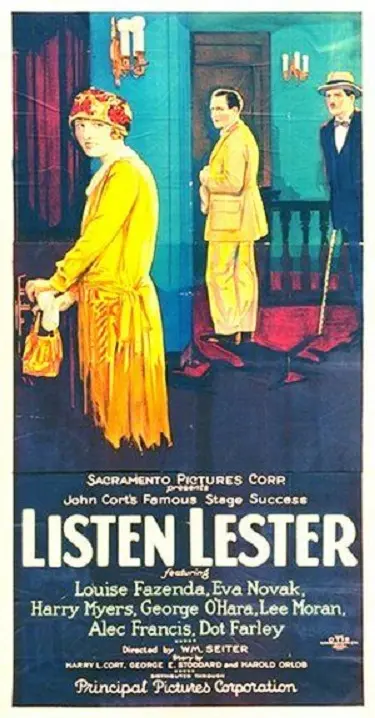
Stepping back into the cinematic landscape of 1924, one encounters a fascinating tapestry of storytelling, where the absence of spoken dialogue amplified visual expressiveness and the potency of physical comedy. Among the numerous offerings of that vibrant era, Listen Lester emerges as a delightful, if perhaps lesser-remembered, example of a burgeoning genre: the romantic farce. This film, a product of the collective creative energies of William A. Seiter, Lewis Milestone, Harry Linsley Cort, G.E. Stoddard, and Harold Orlog, whisks its audience into a whirlwind of misunderstandings, legal quandaries, and unexpected affections, all set against the sun-kissed backdrop of Florida. It’s a film that encapsulates the spirit of its time, where societal norms were gently (or not so gently) satirized, and the pursuit of happiness often involved a fair share of comedic chaos. The charm of Listen Lester lies not just in its intricate plot, but in its ability to transport viewers to a simpler yet equally complicated world, where a misplaced letter could ignite a storm of hilarious proportions.
At the heart of Listen Lester lies the predicament of Colonel Dodge, portrayed with a charming blend of flustered dignity and underlying roguishness by Alec B. Francis. Dodge, a widower of significant vintage and, shall we say, a lively past, finds his tranquil existence upended by the reappearance of Miss Arbutus Quilty, a former flame with a formidable memory and a packet of potentially devastating letters. Louise Fazenda, in the role of Miss Quilty, delivers a performance that perfectly balances the formidable with the comically persistent. Her threat of a breach-of-promise suit forces Dodge and his daughter, Mary (Eva Novak), to flee to the perceived sanctuary of Florida. This initial setup is a masterclass in comedic tension, immediately establishing the stakes and the farcical tone that will permeate the entire narrative. The decision to hire Miss Pink, a lady detective embodied by the inimitable Dot Farley, to retrieve the incriminating evidence adds another layer of delightful absurdity. Farley’s portrayal imbues Miss Pink with a no-nonsense demeanor that often clashes humorously with the escalating chaos around her, creating some of the film's most memorable moments. The initial pursuit, with Miss Quilty hot on Dodge’s heels, sets a brisk pace, promising a narrative replete with twists and turns. One might even draw parallels to the spirited chases found in other contemporary comedies, perhaps evoking the breathless energy of a film like The Speed Spook in its commitment to kinetic storytelling, albeit with a more romantic-comedic bent.
The ensemble cast of Listen Lester is undoubtedly one of its strongest assets, each performer contributing to the film's effervescent charm. Alec B. Francis, as Colonel Dodge, navigates the delicate tightrope between exasperation and endearing vulnerability. His character is not merely a caricature of an old fool, but a man genuinely caught in the web of his own past romantic entanglements, making his plight oddly relatable despite its outlandish circumstances. His expressions, typical of the silent era's reliance on exaggerated yet nuanced facial acting, convey a spectrum of emotions from panicked desperation to resigned acceptance. Louise Fazenda's Miss Quilty is a revelation. She is not simply the antagonist; she is a woman wronged, albeit one with a theatrical flair for justice. Fazenda imbues Quilty with a formidable presence, her eyes gleaming with a mixture of determination and perhaps a touch of lingering affection, suggesting that her motives might be more complex than mere revenge. Her comedic timing is impeccable, often stealing scenes with a well-placed glare or a dramatically wielded piece of paper. The dynamic between Francis and Fazenda forms the comedic backbone of the film, their sparring a delightful ballet of wills.
Then there's the younger generation, represented by Eva Novak as Mary and George O'Hara as Listen Lester. Novak's Mary is the picture of youthful innocence and loyalty, her concern for her father palpable, yet she is also open to the burgeoning romance that blossoms with Lester. George O'Hara's portrayal of Listen Lester, the house detective, is imbued with a charming earnestness. He's not the bumbling detective of some contemporary farces; rather, he's competent, if a little overwhelmed by the sheer absurdity of the situations he finds himself in. His involvement in the plot to recover the letters is initially accidental, but he quickly becomes a pivotal player, his inherent goodness shining through as he attempts to untangle the comedic web. The chemistry between Novak and O'Hara is subtle but effective, providing a sweet counterpoint to the more boisterous antics of the older characters. Their romance feels genuine, a quiet anchor amidst the storm of comedic chaos, much like the burgeoning affections in a film such as Love Never Dies, though with a decidedly lighter tone. Dot Farley, as Miss Pink, is a standout, her stern demeanor and almost robotic efficiency providing a hilarious contrast to the emotional turmoil around her. Harry Myers, too, contributes to the film's comedic tapestry, albeit in a supporting capacity, enhancing the overall feeling of a well-oiled comedic machine.
The directorial vision, shared by William A. Seiter and Lewis Milestone, is evident in the film's energetic pacing and clever visual gags. Seiter, known for his prolific work in comedies, and Milestone, who would later achieve acclaim for more dramatic fare, demonstrate a keen understanding of the silent comedy idiom. They orchestrate the various plot threads with precision, ensuring that the escalating complications never descend into outright confusion, but rather build upon each other to maximize comedic effect. The screenplay, credited to Harry Linsley Cort, G.E. Stoddard, and Harold Orlog, is a testament to the era's aptitude for intricate farcical plotting. The writers masterfully weave together the primary breach-of-promise narrative with the burgeoning romance between Mary and Lester, ensuring that both storylines receive adequate attention and contribute to the overall comedic rhythm. The dialogue, conveyed through intertitles, is sharp and witty, often delivering punchlines with succinct elegance. The use of visual storytelling, a cornerstone of silent cinema, is particularly effective here. The directors and writers rely heavily on physical comedy, exaggerated reactions, and well-timed entrances and exits to propel the narrative forward and elicit laughter. One can observe a certain craftsmanship in the way the various characters are brought together and separated, creating opportunities for mistaken identities and near-misses that are the hallmarks of successful farce. This intricate dance of characters and plot points might remind one of the carefully constructed narratives seen in films like The House of Mirth, though applied to a much lighter, more comedic register.
Beyond the immediate laughter, Listen Lester touches upon several thematic undercurrents relevant to its time. It playfully explores societal expectations around marriage and reputation, particularly for older gentlemen and unattached women. Colonel Dodge's frantic efforts to avoid scandal speak volumes about the social mores of the early 20th century. Miss Quilty's determination, while comedic, also hints at the limited avenues available to women seeking redress or security in that era. The film, however, doesn't delve into these themes with a heavy hand. Instead, it uses them as springboards for humor, ultimately advocating for honesty and genuine affection over deception and social climbing. The resolution, where Dodge settles down with Miss Quilty and Mary weds Lester, is a classic comedic double-wedding, signifying a restoration of order and a triumph of love in its various forms. It suggests that even the most convoluted paths can lead to a happy ending, a sentiment often echoed in the feel-good cinema of the period, perhaps even in the optimistic spirit of The Day of Faith, albeit from a wildly different genre perspective. The film's enduring appeal lies in its lighthearted approach to human folly and its celebration of connection. It's a reminder that sometimes, the most complex problems can be solved with a dose of good humor and a willingness to embrace the unexpected.
The technical aspects of Listen Lester, while perhaps not groundbreaking, are certainly competent and contribute significantly to its overall charm. The cinematography effectively captures the sun-drenched atmosphere of Florida, providing a visually appealing backdrop for the comedic antics. The use of natural light and well-composed shots enhances the storytelling, allowing the audience to fully immerse themselves in the various settings, from the Colonel's initial home to the bustling resort. The set design, while not extravagant, is functional and believable, creating distinct environments that serve the narrative well. Costuming, too, plays a subtle but important role, with each character's attire reflecting their personality and social standing, from Colonel Dodge's somewhat formal yet slightly disheveled look to Miss Quilty's determined, no-nonsense ensembles. These elements, combined with the energetic performances and the clever editing, ensure that the film maintains a brisk pace and never outstays its welcome. In an era where visual storytelling was paramount, Listen Lester stands as a testament to the craftsmanship of its creators, demonstrating how well-executed technical elements can elevate even the most straightforward of farces. It's a testament to the ingenuity of early filmmakers who, without the luxury of sound, mastered the art of conveying emotion and narrative through purely visual means, a skill that can be appreciated when watching other meticulously crafted silent films like The Moon of Israel, which relies on grand visuals to tell its epic story.
In conclusion, Listen Lester, while not always cited in the pantheon of silent film masterpieces, is a thoroughly enjoyable piece of cinematic history. It's a film that perfectly encapsulates the lighthearted spirit of the Roaring Twenties, offering a generous dose of laughter, romance, and harmless mischief. The performances, particularly by Alec B. Francis, Louise Fazenda, Dot Farley, Eva Novak, and George O'Hara, are uniformly strong, bringing their characters to vivid life without uttering a single word. The collaborative efforts of writers William A. Seiter, Lewis Milestone, Harry Linsley Cort, G.E. Stoddard, and Harold Orlog yield a screenplay that is both intricate and accessible, delivering a satisfying narrative arc. For those with an appreciation for silent comedies, or simply anyone looking for a charming escape into a bygone era, Listen Lester offers a delightful diversion. It reminds us that sometimes, the simplest pleasures—a well-timed gag, a blossoming romance, and the triumph of good over comedic adversity—are the most enduring. It’s a film that, much like the unexpected turns in Surprise, keeps you engaged and entertained until the very last frame, leaving a lingering smile long after the credits roll.
IMDb 6.2
1923
Community
Log in to comment.