DbcultAccessing Vault...
Cult Review
Senior Film Conservator
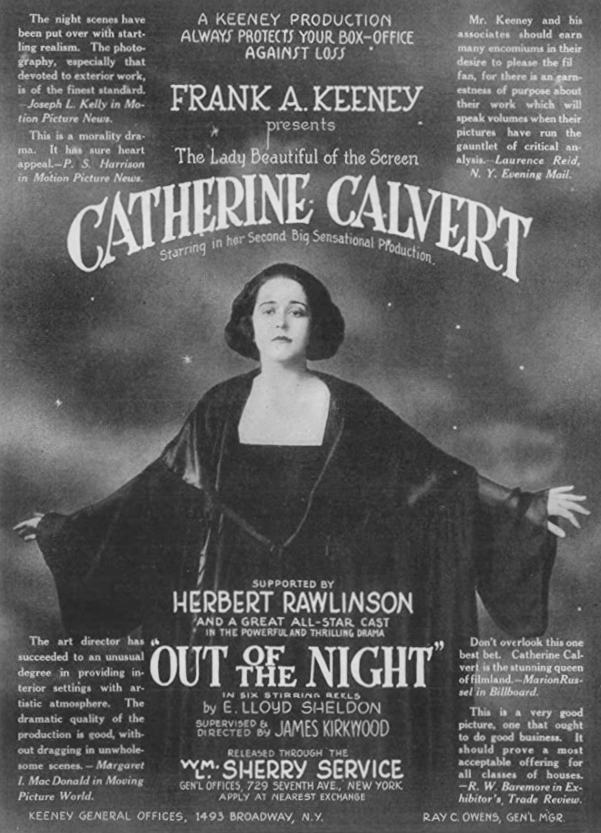
Stepping back into the annals of early cinema, particularly to the silent era, often feels like unearthing a forgotten language. Yet, some films from this period articulate human struggles with a clarity and emotional force that transcends the lack of spoken dialogue. "Out of the Night" (1918), a poignant drama penned by Bennet Musson and E. Lloyd Sheldon, stands as a testament to this power, offering a gripping narrative that delves into the societal injustices and personal redemptions of its time. It’s a film that, despite its vintage, speaks volumes about the enduring human spirit and the insidious nature of systemic exploitation, wrapped in a story that remains as relevant in its core themes as it was over a century ago.
The narrative unfurls with a gut-wrenching premise: Rosalie Lane, portrayed with a compelling blend of vulnerability and nascent strength by Catherine Calvert, faces the ultimate despair. Her sister, a victim of the merciless industrial machine, succumbs to the brutal working conditions prevalent in the Treadwell mills. This isn't just a death; it's an indictment of an era, a stark reminder of the human cost of unchecked capitalism. Rosalie's subsequent plea to the Treadwell company for a modest sum – enough to afford her sister a dignified burial – is met with a bureaucratic brick wall, personified by Richard Storrow, a partner in the very firm responsible for her agony. This initial refusal is not merely a plot point; it's the crucible in which Rosalie's fate is forged, pushing her to the brink of an unthinkable decision.
Desperation, a cruel mistress, drives Rosalie to prostitution. This isn't a choice made lightly or for moral failing, but a stark, harrowing act of survival. The film, in its silent eloquence, portrays this descent with a tragic realism, eschewing sensationalism for a profound exploration of a woman pushed to the absolute edge. It's a theme echoed in other films of the era, such as Outcast, which similarly explores the societal ostracization and difficult choices faced by women in precarious positions. The narrative then takes an unexpected turn, introducing Ralph Evans, an artist who hires Rosalie to pose for a portrait. This portrait, destined for the Magdalene Home for 'fallen women,' becomes a symbolic beacon, an ironic twist that sets the stage for a dramatic confrontation.
The revelation that Harry Treadwell, the owner of the oppressive mills, also owns the Magdalene Home, is a stroke of brilliant, albeit cynical, screenwriting. It exposes the profound hypocrisy of a society that profits from exploitation on one hand, then seeks to 'redeem' its victims on the other. Rosalie's fiery denunciation of Treadwell, a moment of raw, unbridled fury, is overheard by Richard Storrow. This accidental eavesdropping serves as the catalyst for Storrow's internal reckoning. His initial dismissal of Rosalie's pleas now haunts him, igniting a spark of guilt that compels him to act. He offers Rosalie a position as governess to assuage his conscience, a decision that inadvertently plants her squarely in the heart of the very world that wronged her.
The Storrow estate, a gilded cage for Rosalie, becomes the setting for another pivotal relationship. Young Bob Storrow, portrayed by Eldean Steuart, falls deeply in love with Rosalie. His affection is pure, untainted by the societal judgments that have defined her life. In a moment of profound vulnerability, Rosalie reveals her past in a written note, believing this truth will irrevocably sever their burgeoning connection. This act of honesty is a testament to her character, a refusal to build a future on deceit. The ensuing discovery that it was Richard, rather than Harry Treadwell, whose initial refusal directly led to her downfall, adds another layer of tragic irony to Rosalie's already arduous journey. This revelation, a crushing blow, compels her to leave the Storrow estate, burdened by the weight of a past she now understands more fully.
Yet, the narrative, true to the spirit of many silent melodramas that sought to offer a glimmer of hope, does not end in despair. Bob Storrow, refusing to let Rosalie vanish, pursues her, declaring that he knew of her past all along and that his love remains steadfast. This is a powerful moment of unconditional acceptance, a rejection of societal norms that would condemn a woman for her past. It's a progressive stance for a film of its time, echoing the themes of personal integrity and unwavering devotion seen in films like Sacrifice (1918), where characters often make profound personal concessions for love or principle. Richard Storrow, witnessing Bob's unwavering commitment and truly grasping the depth of his own culpability, experiences a profound transformation. His remorse is palpable, culminating in his blessing of the young couple, a symbolic act of redemption not just for Rosalie, but for himself.
Catherine Calvert's performance as Rosalie Lane is the undeniable anchor of "Out of the Night." Her ability to convey a spectrum of emotions – from the crushing despair of destitution to the quiet dignity of survival, and finally, the tentative hope of a new beginning – without uttering a single word, is a masterclass in silent film acting. She imbues Rosalie with an authenticity that makes her plight deeply affecting, allowing the audience to truly empathize with her impossible choices. Her eyes, often downcast in sorrow or blazing with righteous anger, become the windows to her soul, communicating more than any dialogue ever could. Herbert Rawlinson, as Richard Storrow, navigates a complex character arc, evolving from a dismissive, guilt-ridden industrialist to a man humbled by his own actions. His subtle shifts in expression and body language effectively convey his internal struggle and eventual contrition.
The film's visual storytelling, a hallmark of the silent era, is particularly effective in conveying the stark contrasts between the Treadwell mills and the opulent Storrow estate. The grim, almost suffocating atmosphere of the industrial settings underscores the dehumanizing conditions that drive Rosalie's initial desperation. In contrast, the grandeur of the Storrow home, initially a symbol of her oppressor's world, gradually transforms into a space where love and forgiveness might blossom. The use of intertitles is judicious, providing essential plot points and character thoughts without overwhelming the visual narrative. The direction, while not overtly flashy, is competent and serves the story well, allowing the performances and the emotional weight of the narrative to take center stage. It’s a film that understands the power of a well-framed shot and the impact of a lingering close-up, drawing the viewer into Rosalie's interior world.
Beyond the individual performances, "Out of the Night" serves as a potent piece of social commentary. It unflinchingly critiques the industrial practices of its time, highlighting the exploitation of the working class and the indifference of the powerful. The film also tackles the deeply ingrained societal prejudices against women who, through no fault of their own, are forced into prostitution. It challenges the simplistic moral judgments of the era, suggesting that circumstances often dictate choices, and that true morality lies in compassion and understanding, rather than condemnation. This theme of challenging societal norms and class divides is a recurring motif in cinema, seen in films like The Price of Vanity, which explores the pressures on women in a class-conscious society, or even implicitly in comedies like Easy Money, though from a vastly different perspective.
The narrative's focus on redemption, both for Rosalie and, significantly, for Richard Storrow, is another compelling aspect. Rosalie's journey is not about escaping her past, but about finding acceptance and love despite it. Storrow's arc, from an unfeeling businessman to a remorseful individual seeking to right his wrongs, adds a layer of moral complexity to the story. It suggests that even those who contribute to systemic injustice can find a path to atonement, though it requires genuine introspection and a willingness to confront one's own complicity. The film doesn't offer easy answers, but rather a hopeful vision of forgiveness and the possibility of a new beginning, even in the face of profound adversity.
In conclusion, "Out of the Night" is more than just a historical artifact; it's a vibrant, emotionally resonant piece of cinema that continues to speak to contemporary audiences. Its exploration of themes such as social injustice, the plight of the working class, the complexities of moral choice, and the transformative power of love and forgiveness ensures its enduring relevance. The stellar performances, particularly from Catherine Calvert, coupled with a well-crafted narrative, make this silent film a noteworthy entry in the annals of early American cinema. It's a powerful reminder that the struggles for dignity, justice, and acceptance are timeless, and that even in the darkest of times, hope can emerge, quite literally, out of the night.
IMDb —
1917
Community
Log in to comment.