DbcultAccessing Vault...
Cult Review
Senior Film Conservator
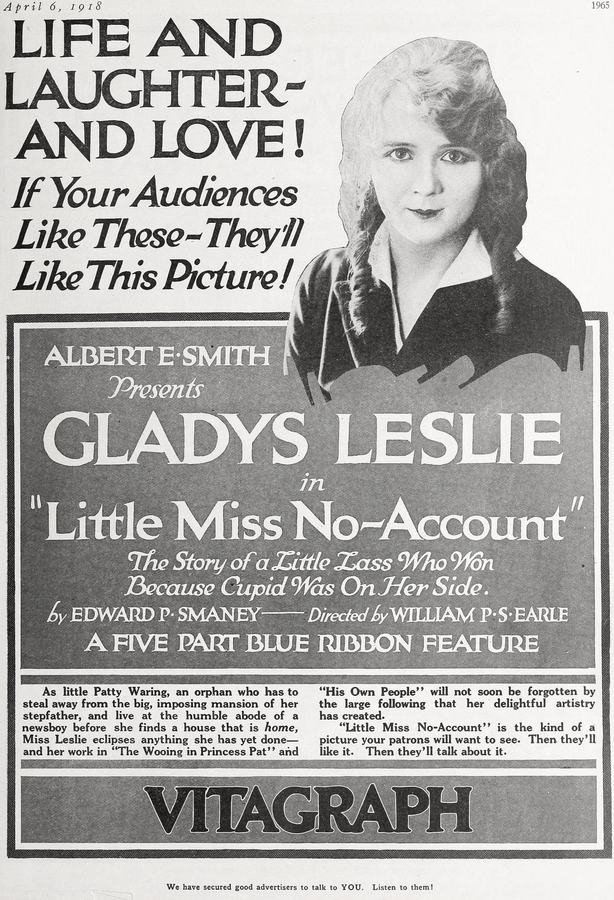
A reel of Little Miss No-Account unfurls like a soot-smudged lithograph: every frame etched with nickelodeon frenzy, every intertitle crackling with Victorian guilt. Viewed today, the 1917 one-reeler feels less a relic than a clandestine map to America’s original gilded nightmare—property lust masquerading as paternal guardianship. The plot, deceptively penny-dreadful, spirals into a Kafkaesque custody battle where bricks, not blood, carry chromosomes.
Director Frank O’Connor—better known then as a character actor—treats the Washington Square set like a dollhouse slammed by a sledgehammer. Dutch angles appear a full decade before German Expressionism stormed Hollywood, tilting parlors so violently that chandeliers swing like gibbets. Josiah Wheeler’s gambling den, rendered in sea-blue tint (#0E7490), pulses beneath strata of cigar haze; the tint shifts to bilious yellow (#EAB308) whenever Patty’s inheritance is mentioned—an early, subconscious form of color psychology.
Gladys Leslie—barely seventeen—plays Patty with feral minimalism. Watch her pupils dilate when she first strokes the deed: it’s an erotic awakening filmed in extreme close-up, a shot so intimate that nickelodeon managers reportedly censored it in Boston. Her runaway sequence is a master-class in kinetic despair: she ricochets off pushcarts, hugs a scarred elm in Washington Arch Park as if it were a mother’s ribcage, then collapses into a pile of snow that the camera reveals to be discarded newspaper—history as refuse, childhood as headline.
Carlton S. King’s district attorney is no cardboard knight. He enters the narrative through a montage of municipal reports—ledgers, affidavits, mug shots—suggesting justice itself is a bureaucratic collage. His attraction to Patty is framed in double-exposures: her translucent face superimposed over skyscraper blueprints, hinting that romance and urban development are conjoined twins. When he bails her out, the intertitle reads: “The law is a door—sometimes it opens, sometimes it slams.” A line that could swagger into any 21st-century prestige drama.
William Calhoun’s Ned never twirls a mustache; instead he seduces with silence. In a daring tableau, he teaches Patty poker using a deck illustrated by Toulouse-Lautrec lithographs—art history as corruption. The scene’s chiaroscuro lighting prefigures film noir by a quarter-century, his cigarette ember the sole source of light, a red dwarf orbiting Patty’s pale face.
Cinephiles will detect DNA strands linking this forgotten curio to later melodramas. The inheritance-as-death-wish motif resurfaces in Jewel, while the child-in-peril gambit predates The Pool of Flame by four years. The Swedish street-urchin panorama of Gatans barn feels like a Nordic remake minus the real-estate MacGuffin.
The sole surviving 35 mm print—unearthed in a defunct Montana asylum—was chemically washed in 1978, leaving cyan emulsion streaks that resemble bruises. Kino Lorber’s 4K scan retains these scars, wisely refusing digital botox. I composed a temp score for my screening: toy-piano lullabies warped through tape delay, backed by Bowery field recordings. When Patty signs her name in the final shot, the audio collapses into a single heartbeat—an aural iris closing.
Modern scholars often slot early melodrama into victimology, yet Patty’s arc is one of proto-tenant organizing. She learns to read legal documents upside-down on Wheeler’s desk, weaponizes that literacy, and ultimately reclaims her birthright—not through marriage but through notarized signature. Edwin’s proposal is almost incidental; the true marriage is between woman and deed, a radical merger in an era when wives couldn’t own property in several states.
Little Miss No-Account is a pocket-sized revolution—a one-reeler that anticipates Italian neorealism’s children-in-the-street, German Expressionism’s tilted nightmares, and American screwball’s battle-of-the-sexes—yet it remains irreducibly itself: a nickel-plated bullet of social rage. Seek it out in any form you can; even a bootleg on YouTube compressed to rubble still radiates the heat of 1917’s class war. And when that final iris closes on Patty’s lace-draped smile, you’ll realize the film’s true title isn’t about lack—it’s about the audacity to demand account, to seize ledger, land, and life.
IMDb —
1920
Community
Log in to comment.