DbcultAccessing Vault...
Cult Review
Senior Film Conservator
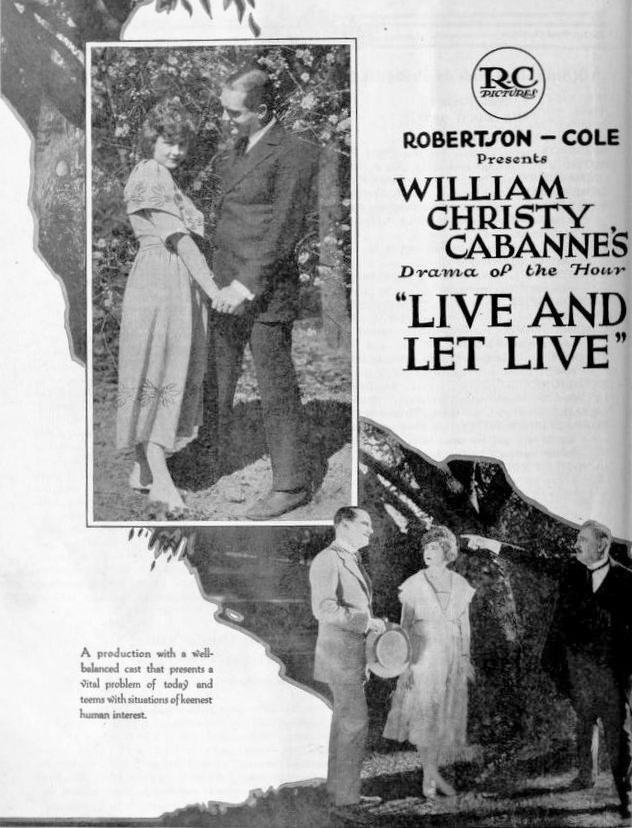
The first image in Live and Let Live is a locomotive headlamp boring through pre-dawn cobalt, a round eye that sees everything and forgives nothing. That orb reappears in close-up on Mary Ryan’s widened iris the moment she decides to become Jane Loomis—an iris ringed with the sulfur-yellow of moral insomnia. Dulcie Cooper lets that iris tremble for a full three-second hold, an eternity in 1924 syntax, allowing the audience to feel the crime being born not in the fingers, but in the gelatinous soul.
Christy Cabanne, ever the stoic anthropologist of American guilt, structures the film like a diptych: side A, the transgression; side B, the penance. Yet the hinge between them is not a fade-out but a sound we never hear—the slam of a compartment door as Jane abandons her heritage for a man who sells used Studebakers and smells of gasoline. The absence of that sound haunts the remaining reels; every subsequent door in Judge Loomis’s mansion seems to echo it, until the house becomes a resonating chamber for a choice made by a woman no longer present.
George Nichols’s judge never raises his voice; he doesn’t need to. His authority is carved into the oak wainscoting, into the brass letter-opener shaped like a scales-of-justice paperweight. When Mary—now Jane—descends the grand staircase in a gown the color of unripe wheat, the camera tilts up to catch the judge at the balustrade, fingertips drumming the rail in 3/4 time, as if conducting an invisible waltz of appraisal. The blocking is ruthless: Mary must walk toward us, away from him, yet the mirror at the stairwell’s base captures both faces in a single frame—one visage taut with impostor’s panic, the other softening with paternal nostalgia. In that mirrored instant, we grasp the film’s central ache: identity is not who you are, but who others remember you to be.
Harriet Hammond, as the judge’s spinster cousin, delivers the most quietly devastating performance: she spends an entire reel polishing the same silver teapot while recounting, in intertitles dripping with ellipses, how “Jane” used to lisp the word teapot as teapotht. Each polish stroke grows slower, as though memory itself were a tarnish she could buff away. When she finally looks up at the impostor, her eyes hold neither suspicion nor recognition—only the dull ache of a woman who realizes childhood is not a place but a pronunciation that has vanished from the world.
Mid-film, a diamond brooch vanishes. The incident feels ancillary until you notice Cabanne’s camera linger on the empty velvet tray for exactly twenty-two frames—one frame for every pearl on the judge’s courthouse robe in an earlier establishing shot. The brooch reappears in the glove box of the family’s chauffeur (Dave Winter, laconic as cracked leather), who claims he found it “between the Psalms and the carburetor.” The line is absurd, yet spoken with such wearied certainty that morality itself seems to hiccup. In Cabanne’s universe, objects have souls that migrate; stealing is merely relocation in a cosmology where ownership is a temporary heresy.
Compare this to The Scarlet Car, where stolen money burns a hole through a preacher’s pocket until he drowns in a baptismal font. In both films, guilt is metallic, transferable, and ultimately liquid. Yet Live and Let Live refuses the baptismal escape; its final restitution is not immersion but substitution—one woman stepping onto a train in place of another, the debt paid not in blood but in mileage.
Though shot on orthochromatic stock, the film bleeds color through synesthetic suggestion. When Mary, trembling, pins Jane’s gardenia to her lapel, the intertitle reads: “Its scent was the color of piano keys left too long in the sun.” Suddenly we see the yellowed ivory, feel the heat, smell the fermentation of vanished music. Cabanne’s co-writer, H. Tipton Steck, was a failed poet turned scenario hack, and you can taste the unemployment lines in every metaphor—yet the desperation galvanizes the prose into something luminous.
Notice how the judge’s library is lit: a single practical lamp spills a cone of sodium light onto an open law tome, while the rest of the frame sinks into umber. The illuminated paragraph concerns habeas corpus, but the Latin words blur into glyphs that resemble railroad timetables. The visual gag is subtle—freedom and schedule share the same typographic DNA.
There is no kiss in Live and Let Live, only the threat of one. Gerald Pring’s Kenneth, Jane’s fiancé-by-proxy, corners Mary in the conservatory amid the respiration of tropical ferns. The camera adopts her POV: his face looms, backlit so his pupils vanish into cavernous shadow. The moment stretches until the greenhouse glass fogs—whose breath? The tension is not romantic but forensic: will proximity expose the pores of deception? When he finally steps back, the relief is orgasmic; the ferns exhale, and a leaf falls like a spent cigarette.
This restraint feels modern, almost post-code. Contrast it with The Love Tyrant, where desire is a bludgeon; here it is a stethoscope listening for the heartbeat of fraud.
The final act is a tour de force of ellipses. Jane reappears, pregnant and penitent, at the station where the film began. The platform is shot from a godlike crane, the rails converging like a closing parentheses around her fate. Cabanne cuts not to Mary’s face but to her suitcase—cheap fiberboard, stickers from towns that never existed—toppling from the baggage cart. The spillage is mundane: a hairbrush, a Bible, a tarnished spoon. Yet the judge lifts the spoon as if it were Excalibur, recognizing it as the one he once used to feed infant Jane applesauce. Recognition ripples outward in silent waves: the crowd steps back, forming a corridor of absolution that leads directly to the caboose.
Mary boards without protest. The train whistle is the only “dialogue” in the entire reel—an atonal chord that translates as: some debts can only be paid in distance. As the cars slide away, the camera tilts up to the station clock, which has lost its hands. Time, the film whispers, is the ultimate pickpocket.
Months after my first viewing, I rode the Southwest Chief at dusk. A woman across the aisle asked me to watch her suitcase while she smoked. When she returned, her scent—gardenias left too long in a hot car—triggered an afterimage: Dulcie Cooper’s iris superimposed over the window’s reflection of my own face. I realized Cabanne’s true subject is not crime but substitution—how willingly we accept stand-ins for love, for identity, for the girl who never arrived. The film ends, but the substitution continues; we are all passengers wearing someone else’s name tag, praying the conductor does not ask for tickets.
—Review by a ghost who once shared your compartment
IMDb —
1921
Community
Log in to comment.