DbcultAccessing Vault...
Cult Review
Senior Film Conservator
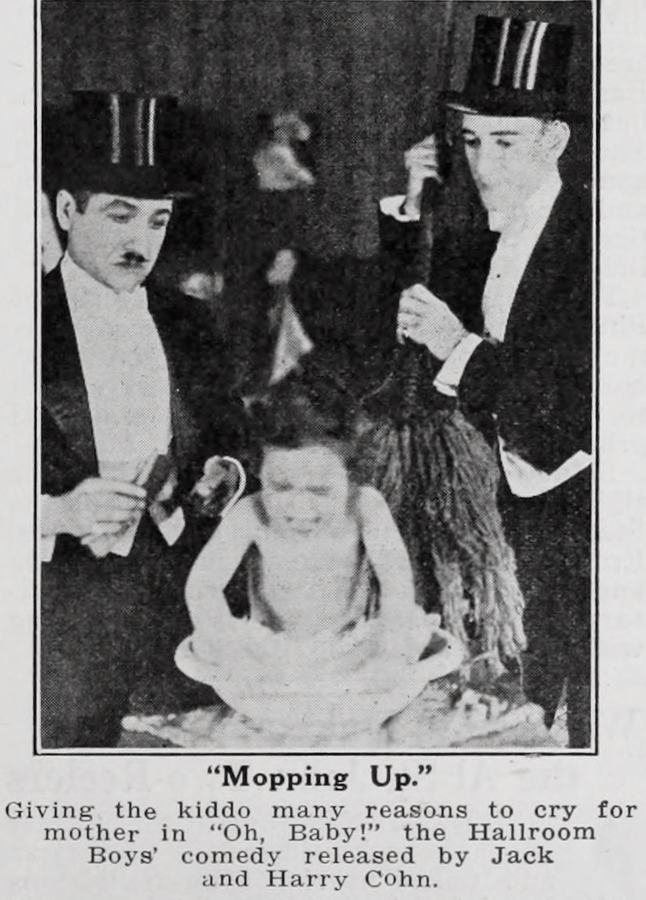
Imagine a world where toys breathe and humans become toys—then remember you don’t have to imagine; you only have to rewind to 1920, when slapstick still nursed a grudge against the upper crust.
Oh, Baby! lands like a custard pie hurled inside a Fabergé egg: exquisite fragility shattered by anarchic goo. The film’s engine is a simple swap—doll for baby—but the reverberations ripple outward like gossip through a dowager’s drawing room. The boys, played with elastic-limbed abandon by Hugh Fay and Neely Edwards, embody the era’s everyman-clown: suspenders strained, bowler hats cocked like question marks. They are both caretakers and saboteurs of domestic order, the same way cinema itself was both babysitter and anarchist to Victorian mores.
The life-size doll—waxen, unblinking, dressed like a diminutive viscount—functions first as trophy, then as passport. Its porcelain sheen refracts the Millionbucks twins’ crystal chandeliers, exposing how wealth hoards beauty in inert forms. When the real infant usurps the doll’s wardrobe, the film stages a coup: flesh over porcelain, noise over silence, need over display. Yet the tuxedo, now stretched around chubby wrists, becomes a straitjacket of inherited etiquette. The gag is silent but deafening: respectability literally does not fit lived reality.
Director (uncredited, as was custom) stages the reception like a slow-motion bullfight. Guests glide across parquet floors, their laughter muffled by velvet drapes; every doorway is a potential guillotine for social climbers. When the boys arrive, baby clutched like contraband, the camera adopts a low angle—suddenly the chandeliers loom like decapitated suns. The ensuing mayhem—misplaced rattles, mistaken identities, a monocle shattered by flying talcum—plays like a dress rehearsal for Hawksian screwball, only with intertitles sharp enough to shave.
The final reveal—that the baby belongs to a fruit-dealer’s wife already drowning in progeny—pivots the farce into social tract. Note the arithmetic: twelve mouths plus one surplus. The woman’s refusal reads less as cruelty than as radical self-preservation. In 1920, before formula and federal aid, a thirteenth child could sink a family like lead ballast. The film dares to let her decline the reward, effectively rejecting capitalism’s moral bribe. For a silent short clocking under twenty minutes, this is a Molotov cocktail wrapped in swaddling clothes.
Obscure today, Oh, Baby! nonetheless anticipates markers that would define decades: the infant-as-macguffin trope later seen in Bachelor’s Children serials; the class-baiting ballroom fiasco that Lubitsch will refine; even the anthropomorphic anxiety of His Musical Sneeze, where objects bully humans. The editing rhythms—long setup, staccato payoff—echo Griffith’s race-to-the-cliff structure, but the emotional payload is closer to Pay Day era Chaplin: laughter rimmed with rust.
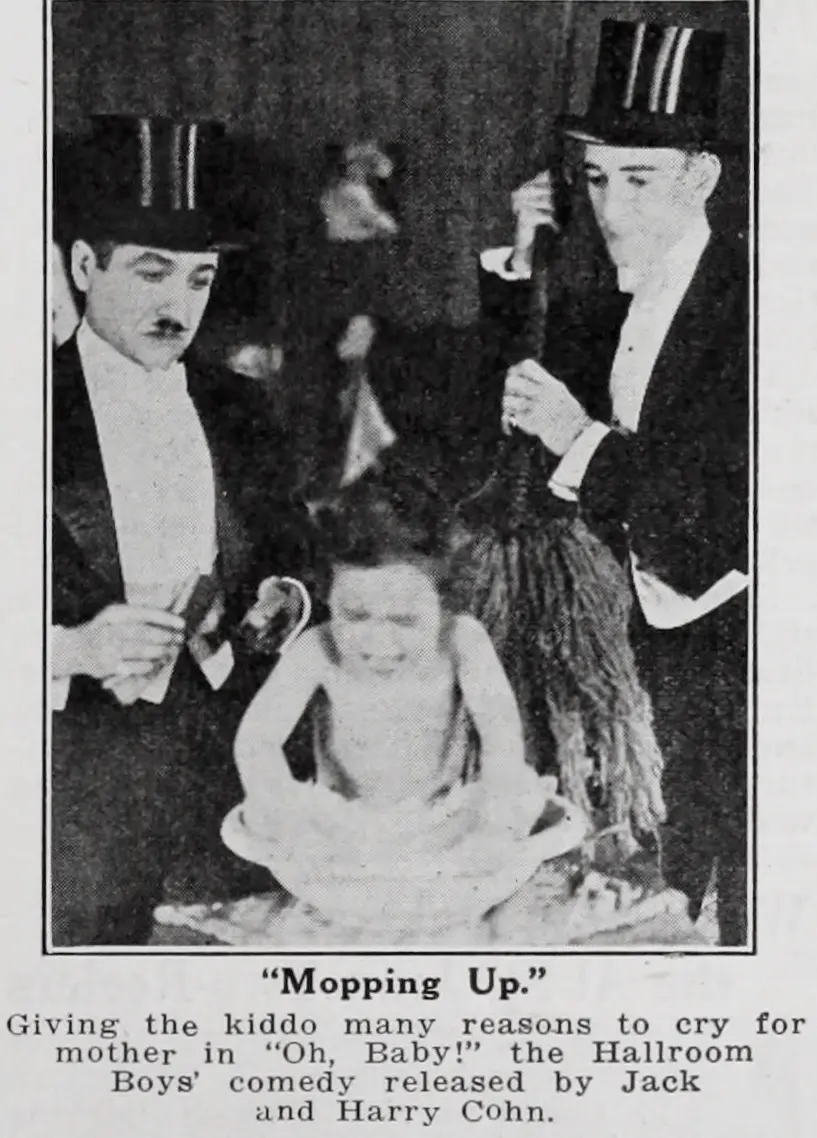
Hugh Fay’s rubber-face contortions feel almost pre-code; watch how he toggles between flabbergasted and faux-dignified within a single iris shot. Neely Edwards supplies kinetic counterpoint—his limbs scissor the frame like a malfunctioning metronome. Together they resurrect commedia archetypes: the gluttonous zanni and the wily servant, only now displaced into a consumerist metropolis. Their interplay with the infant is the film’s soft underbelly; genuine tenderness flashes beneath pratfall grime, proving that even in slapstick, biology trumps bravado.
The Misses Millionbucks—never named beyond their price tag—glide through scenes like couture-sharks. Their demand to “bring the doll” is less invitation than command performance, underscoring how the affluent treat domestic life as curated spectacle. When the baby wails mid-waltz, the twins recoil not from maternal concern but from acoustic disruption. The gag indicts a milieu where children serve as ornamental heirs rather than messy individuals. In this light, the fruit-vendor’s wife—off-screen but pivotal—becomes the film’s moral nucleus: too poor to fetishize offspring, too exhausted to moralize.
Shot largely on cramped indoor sets, the film exploits high-contrast orthochromatic stock: faces bloom like porcelain under carbon-arc glare, while black recesses swallow furniture legs. Notice the courtroom denouement—shadow bars stripe the boys’ bodies, prefiguring prison stripes they narrowly dodge. Such chiaroscuro, indebted to German imports, lends moral weight to what could have been mere knockabout. The camera rarely moves, yet tableau framing teems with layered sight-gags: a butler’s tray reflecting the baby’s rattle, a mirror duplicating the doll’s vacant stare.
Modern viewers might detect DNA strands in everything from Three Men and a Baby to Romanian New Wave parables like It May Be Your Daughter, where parental refusal becomes political revolt. Yet Oh, Baby! lacks the sentimental anesthetic that often sandpapers contemporary comedies. Its refusal to restore the nuclear unit feels downright transgressive; the closing iris closes on the boys still hustling, the baby reclaimed by the state, the doll decapitated—a triptych of custodial failure that chuckles at our hunger for tidy resolution.
Intertitles appear sparingly, but each is a haiku of snark: “Even a borrowed bib can choke a prince.” Read today, the line vibrates with Occupy-era resonance: privilege is not apparel you can shed at will. The film’s silence amplifies such aphorisms; without spoken dialogue, viewers supply their own inner soundtrack—coos, shrieks, the distant clatter of Depression coins. In that lacuna, the movie achieves what many talkies never do: it listens to us.
Film prints languish in European archives—partial 9.5 mm Pathé copies, nitrate whispers. Yet a 2K scan circulated among cine-clubs reveals textures previously smothered: the sheen of doll varnish, the downy hair on the infant’s nape. For streamers hunting fresh silent content, licensing could yield niche gold; the runtime is shareable, the title SEO-friendly, the public-domain status a balm to lawyers. One hopes for a Criterion-channel drop paired with The Vicar of Wakefield as a double bill on mistaken parenthood.
Oh, Baby! is less a relic than a prophecy wearing diapers. It foretells the moment when spectacle culture would auction even infancy, when parenthood becomes performance, when refusal itself is a kind of parenthood reclaimed. That the film canters toward entropy without moral hand-wringing makes it a raucous ancestor to indie nihilism and TikTok prank culture alike. Watch it at 1 a.m. with headphones; let the piano score clatter, let the iris close, and feel the hush that follows—a century-old lullaby that never resolves, only releases.
IMDb —
1925
Community
Log in to comment.