DbcultAccessing Vault...
5.9/10
Senior Film Conservator
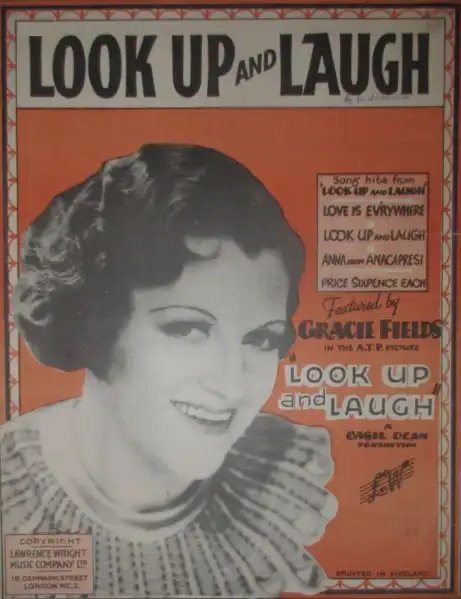
A definitive 5.9/10 rating for a film that redefined the boundaries of cult cinema. Look Up and Laugh remains a cornerstone of transgressive art.
If you like old British comedies where everyone talks at once and there is a lot of singing, you will probably have a good time with this. It is definitely for people who enjoy the music hall style of humor from the 1930s.
If you hate high-pitched singing or movies that feel like a filmed stage play, stay far away from this one. You will find it annoying within ten minutes.
I put this on because I wanted something light, and Look Up and Laugh is about as light as a balloon, even if it gets a bit chaotic at the end. It is one of those movies that feels like it was made on a very busy weekend.
Gracie Fields is the main reason anyone still talks about this movie today. She has this way of walking into a room and just taking over everything, mostly by being louder than everyone else.
In this one, she plays a girl named Gracie (creative, I know) who comes home to find out the Birkenhead Market is being closed down. A big department store wants to turn it into something modern and boring.
She starts rallying the stall-holders, and it feels like a very early version of those save the community center movies from the 80s. There is a lot of finger-wagging and speeches about the common man.
I noticed that when Gracie sings, the camera just sort of stays on her face for a long time. It’s like the director knew that’s what the audience paid for, so he just let her go for it.
Sometimes her voice gets so high it actually makes my ears ring a little bit. But you can't deny she has a lot of charisma.
There is a scene where they are all sitting around a table, and you can see the extras in the background just sort of pretending to talk. One guy is just moving his mouth without making a sound, and he looks like he’s chewing on invisible gum.
It reminded me of the background work in The Street of Illusion where everything feels just a tiny bit fake but charming. You can tell they didn't have much of a budget for retakes.
The market itself looks great, though. It feels like a real place with too much stuff crammed into small corners.
I liked looking at the old signs for tea and soap in the background. It’s like a time capsule of what 1935 England actually looked like, or at least how they wanted us to see it.
The villain of the piece is this guy named Belcher, played by Alfred Drayton. He has this perfectly round, bald head that catches the studio lights in every scene.
He is so obviously the bad guy that you expect him to start twirling a mustache, even though he doesn't have one. He just looks perpetually annoyed by everything Gracie does.
One of the weirdest things about watching this now is seeing Vivien Leigh in a tiny part. This was years before she became a massive star, and here she is just playing a girl named Rose.
She doesn't have much to do, and honestly, if you blinked, you might miss her. It’s funny to think about her going from this to being one of the most famous women in the world.
She looks a bit out of place, actually. She has this very delicate look that doesn't quite fit with the rough-and-tumble market vibe of the rest of the cast.
It’s like she wandered in from a different movie, maybe something like Seed or a serious drama. Seeing her stand next to some of the more comedic characters is pretty jarring.
J.B. Priestley wrote the story for this, which is strange because he usually wrote much more serious things. You can tell he was trying to put a bit of a social message in there about how big business kills local culture.
But that message gets lost because every five minutes someone starts falling over or singing a song. The balance is all over the place.
The movie gets really weird at the end with a gas leak. It goes from being a movie about a market to being a weird action comedy with stuff blowing up.
I won't spoil exactly how it happens, but it feels like the writers didn't know how to end the story, so they just decided to cause a mess. It’s a bit like the sudden shifts you see in High Stakes where the tone just flips.
One second they are talking about a Royal Charter, and the next second there’s smoke everywhere. It’s a very abrupt way to finish a movie.
The movie isn't perfect, and the pacing is kind of clunky. Some scenes go on for way too long, especially the ones with the older men arguing in the market.
But it has this warmth to it that you don't see much anymore. It feels like it was made by people who actually liked each other.
It’s a very noisy film. People are always shouting or laughing or banging things around.
If you’re in the mood for something quiet, this will be a nightmare. But if you want to see what made British audiences happy in the middle of the 1930s, it’s a good choice.
I noticed the music stays in your head for a while after it's over. The title song is especially catchy, even if it's a bit cheesy.
It’s definitely better than some of the other stuff from that era like The Man Trap which can be a bit of a slog. At least Gracie keeps things moving.
Just don't expect a masterpiece. It's just a loud, silly, happy movie about a market girl who won't take no for an answer. 🎬
The editing is a bit rough in places too. There is one cut near the middle where a character seems to teleport from one side of the room to the other.
I kind of love those mistakes though. They make the movie feel more human and less like a product from a machine.
Anyway, give it a look if you're bored. It's better than staring at the wall.
IMDb —
1923
Community
Log in to comment.