DbcultAccessing Vault...
Cult Review
Senior Film Conservator
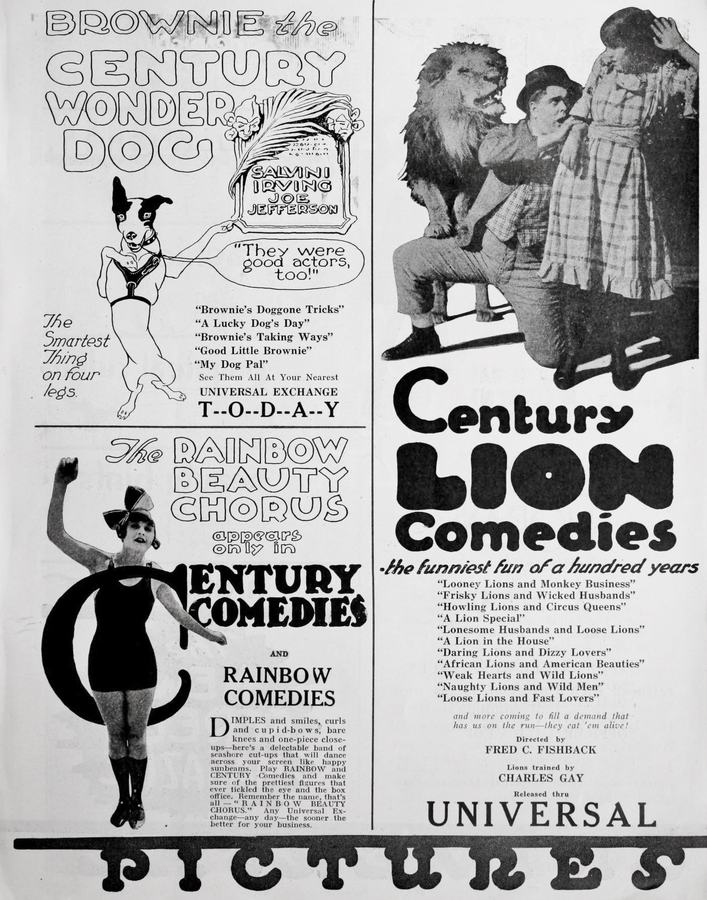
The phrase “they don’t make ’em like this anymore” curdles into cliché unless you’ve actually sat through Fred Hibbard’s Loose Lions and Fast Lovers, a 1924 two-reeler that behaves as though someone spiked the celluloid with bathtub gin and then invited an actual circus to stampede across it.
Picture, if your optic nerves are sturdy enough, a world where matrimony is a blood-sport played inside canvas tents reeking of sawdust, popcorn grease, and animal rut. Bud Jamison—moon-faced, shoulders perpetually hunched in anticipatory apology—plays a bridegroom whose honeymoon itinerary collapses the instant his bride spots her ex-beau, a swaggering charmer whose grin arrives five seconds before the rest of his head. The ex-beau, embodied by Harry Sweet with the slippery elegance of a patent-leather eel, has the bright idea to rent a pair of fully grown lions for the amusement park. Publicity stunt, he claims. Aphrodisiac, he hopes. Disaster, he gets.
Forget the timid symbolism of “the beast within.” Hibbard’s lions are the id with claws, a marital stress-test padded only by the flimsiest of cages. When the latch accidentally springs—courtesy of Jamison’s oafish attempt to hide inside the enclosure—the cats slink into the midway with the languid entitlement of celebrities. Cinematographer Robert Anderson (who doubled as the film’s resourceful lion-wrangler) keeps his hand-cranked camera low, so every paw print lands like a sledgehammer against the dust. Children scatter; trombonists vault over calliopes; corseted matrons levitate in terror, petticoats blooming like parachutes.
Yet for all the claw-trimmed danger, the film’s sharpest bite is social. Dixie Lamont’s character, billed only as “The Girl,” begins as arm-candy but seizes narrative agency with the decisiveness of a switchblade. One moment she’s batting eyelashes at her sugar-daddy fiancé; the next she’s cracking a whip louder than any lion-tamer in the county. Lamont, a vaudeville firecracker with Louise Brooks cheekbones, performs her own whip flourishes—twelve-foot Indiana Jones serpentines that whistle past the camera so close you can count the sonic ripples. The whip becomes a tongue, lashing the hypocrisy of a society that expects women to be both docile and disposable.
Hibbard, a veteran of Mack Sennett’s bath-tub-and-pie laboratories, orchestrates gags like a jazz drummer who suddenly decides the kit needs a flamethrower. Watch the extended sequence inside the Tunnel of Love: a boat glides into darkness, lovers coo, and then—via superimposition—their silhouettes morph into prowling lions. Out in the sunlight, the gag pays off when an actual lioness leaps into the very same boat, now commandeered by the jealous fiancée. The boat capsizes; spectators applaud, assuming it’s part of the carnival show. The silent-era reflex to undercrank the camera—shooting at 16 fps instead of 24—makes every splash, every fur ripple, every corset strap snap look like slapstick ballet.
Compare this kinetic abandon to The Fires of Youth, a moralistic melodrama released the same year, where every dutiful tear feels rationed. Hibbard is busy detonating ration books altogether.
Bud Jamison’s doughy panic is the gravitational center. His double-takes don’t merely register surprise; they implode like dying stars, pupils dilating with the cosmic dread of a man whose marriage license may soon double as death certificate. Watch him attempt to placate a lion with a pocketful of peanuts—each nut lobbed as though it were a Fabergé egg, every miss accompanied by a flinch worthy of communion wine.
Robert Anderson, usually the cinematographer, steps in front of the lens as the carnival barker whose patter is delivered entirely via intertitles. His cards are miniature masterpieces of ballyhoo: “SEE THE EIGHTH WONDER—A WOMAN WHO CAN TURN LIONS INTO PUSSYCATS!” Anderson’s toothy grin is so wide it deserves its own zip code, yet the eyes betray a carny’s weary knowledge that every ticket sold is another promise doomed to break.
Paul Bara and Lois Nelson play the second couple—he a henpecked accountant, she a kleptomaniac flapper—whose subplot exists solely to misplace more lions. Their subplot feels like a dress-rehearsal for the later marital skirmishes in For Husbands Only, but with man-eaters in the marital bed instead of moralizing monologues.
Studio publicity claimed the lions were “as tame as tabby cats.” The truth? One mauled a grip, another devoured three rubber chickens and the better part of a klieg light. Their names—Moxie, Velvet, and Satan—appear onscreen in an intertitle that looks suspiciously like a contract clause demanded by an agent with claws. Moxie’s mane was dyed with henna to distinguish him from Velvet, resulting in a burnt-orange halo that makes him resemble a feline John the Baptist. When Moxie yawns, the camera lingers on a tongue the size of a ballroom slipper, pink and obscene.
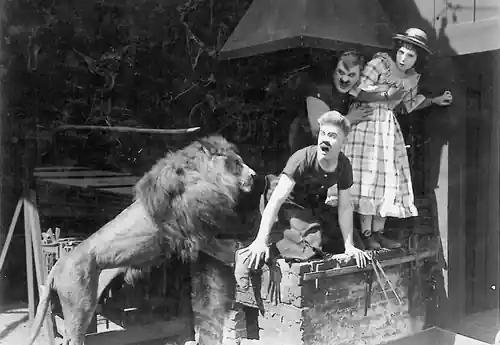
Yet the film respects its animals. No lion is ever ridiculed; they remain majestic, indifferent, more force of nature than villain. The satire is reserved for the humans who believe money can cage appetite of any species.
The surviving print—courtesy of a 2018 MoMA 4K restoration—reveals a grayscale carnival: silvery moonlight on tin roofs, charcoal shadows inside animal wagons, ivory flares of Dixie Lamont’s teeth when she smiles like a switchblade. The tinting alternates between amber for daylight madness and cerulean for nocturnal trysts, giving the film the emotional temperature of a fever chart.
Music? The silent accompaniment on the Kino Blu-ray offers a brand-new score by The Alloy Orchestra: xylophones that skitter like rodents, brass that growls, a musical saw that wails whenever the lions lock eyes with their prey. It’s a soundtrack that refuses nostalgia, instead opting for the immediacy of a panic attack.
Scholars often cherry-pick silent cinema for protofeminist heroines, but Lamont’s role is thornier. She begins as commodity—literally raffled off as “The Bride in the Cake”—and ends as ringmaster. Yet the transformation is not granted; it’s seized, whip in hand, hairpins flying like shrapnel. When she finally kisses Jamison inside the re-caged wagon, the bars frame them like newlyweds posing for a jailhouse portrait. The implication: every marriage is a cage, the trick is choosing the size of your cohabitant.
Compare her arc to the regal suffering in King Charles or the symbolic martyrdom in Fiamma simbolica; Lamont’s triumph is earthier, funnier, and therefore more radical.
Traditional three-act rules are fed to the lions. Instead, the film is a spiral: every escape breeds a deeper entanglement. The 18-minute runtime feels like a pop-culture particle accelerator—each gag collides with the next, producing comic fission. A pie fight? Too quaint. Here we get a lion fight with wedding cake as ammo, white frosting smeared across manes like war-paint. The pacing predates modern ADHD cinema by a century yet feels utterly contemporary; TikTok has nothing on this kinetic blitz.
For decades the picture languished in the shadow of Sennett’s more famous barnyard brawls, but recent restorations have birthed a mini-renaissance. Criterion Channel featured it in their “Silent Summer” lineup; TCM aired a double bill alongside The Fibbers, proving that matrimonial dishonesty pairs well with apex predators. The Blu-ray offers commentary by film historian Lisa Rims, who points out that the lions’ trainer was later eaten—off-camera—by one of his charges, a grisly footnote that lends every onscreen purr a morbid undertone.
Meanwhile, bootleg prints circulate on YouTube, but the image is cropped, the tinting absent, the lions reduced to smudged shadows. Avoid those; seek the restoration. Your nervous system will thank you.
Does the film have flaws? A few gags overstay, and the racial caricature in a fleeting sideshow banner deserves the pause-button of shame. Yet its velocity, its democratic anarchy, its conviction that romance and catastrophe share the same bunk-bed—these qualities make Loose Lions and Fast Lovers a caffeine shot to the heart of silent comedy. It will not comfort you, nor teach you how to love. It will, however, remind you that every relationship contains two hungry cats pacing behind flimsy wire: trust and terror. Keep the latch well-oiled, or learn to run very, very fast.
Verdict: 9/10 — A caffeinated whirlwind of matrimonial mayhem and animal magnetism that makes modern rom-coms look declawed.
IMDb —
1927
Community
Log in to comment.