DbcultAccessing Vault...
6.1/10
Senior Film Conservator
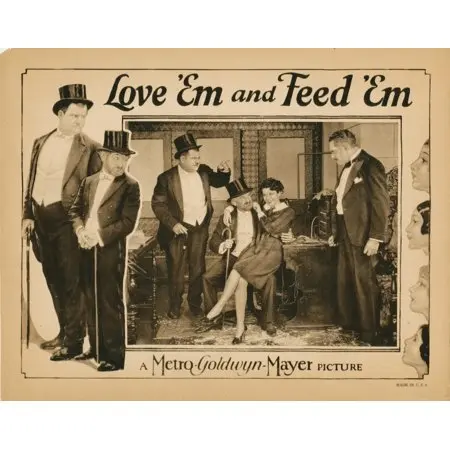
A definitive 6.1/10 rating for a film that redefined the boundaries of cult cinema. Love 'em and Feed 'em remains a cornerstone of transgressive art.
Is Love 'em and Feed 'em worth your time today? Short answer: Yes, but only if you view it as a foundational text of cinematic chaos rather than a narrative masterpiece.
This film is specifically for silent comedy completionists and those fascinated by the evolution of the Hal Roach studio's house style. It is absolutely not for viewers who require modern pacing, high-definition clarity, or a plot that extends beyond a single, albeit explosive, premise.
1) This film works because it understands the inherent comedy of escalating tension within a confined social space, using the dinner table as a battlefield.
2) This film fails because it relies on a very thin narrative skeleton that serves only as a delivery mechanism for the final slapstick payoff.
3) You should watch it if you want to see the early, unrefined comedic DNA of Oliver Hardy and Max Davidson before their personas were fully codified into the icons we know today.
In the world of 1927, cinema was grappling with its own identity, caught between the gritty realism of films like Underworld and the escapist whimsy of the short subject. Love 'em and Feed 'em lands firmly in the latter, yet it carries a surprisingly sharp edge regarding class and social performance. The prospectors are not just miners; they are the 'other,' the unwashed masses attempting to integrate into the structured environment of a hotel dining room. This setup is a classic trope of the era, seen in various forms in films like Tol'able David, where the rugged individual must navigate a world with rules they didn't write.
The direction by the legendary Hal Roach team, including the oversight of Leo McCarey, ensures that the movement within the frame is constant. There is a specific moment where the prospectors first sit down—their discomfort is palpable. Their hands are too big for the silverware, their voices (though unheard) are clearly too loud for the room. It is a beautiful piece of physical acting that precedes the actual violence of the pie fight. This tension is what makes the eventual eruption so satisfying. Without the initial attempt at 'being good,' the subsequent 'being bad' would have no weight.
While many modern audiences associate Oliver Hardy solely with Stan Laurel, his work in the mid-to-late 20s as a versatile character actor is where his true range was forged. In Love 'em and Feed 'em, Hardy displays the early iterations of his 'gentle giant' persona. He isn't just a buffoon; he is a man trying to maintain his dignity in a situation that is rapidly slipping through his fingers. Watch his eyes during the dinner scene. There is a flicker of awareness—a realization that everything is about to go wrong—that is far more sophisticated than the broad comedy surrounding him.
Hardy’s interaction with Max Davidson is particularly noteworthy. Davidson, often cast in roles that played on ethnic caricatures of the time, brings a frantic, nervous energy that perfectly balances Hardy’s more measured movements. In one specific sequence involving a shared plate, the timing between the two is surgical. It isn't just about the food; it's about the territory. They treat the dining table like a map of a minefield, where one wrong move with a fork is an act of war. This is the kind of character-driven slapstick that elevated Roach's productions above the more chaotic, less disciplined output of rival studios.
We have seen pie fights a thousand times, but Love 'em and Feed 'em offers a look at the trope before it became a tired cliché. In 1927, this was high-octane spectacle. The choreography of the fight is surprisingly complex. It isn't just people throwing things at random; it follows a rhythmic pattern of cause and effect. A pie is thrown at 'A', who ducks, causing it to hit 'B', who then retaliates against 'C' by mistake. It is a circular logic of destruction that mirrors the breakdown of social order.
Unlike the stylized violence of a film like The Vamp, the mess here feels real. You can almost smell the custard. The actresses, including Martha Sleeper and Viola Richard, are not merely bystanders; they are active participants in the mayhem, which was a refreshing departure from the 'damsel in distress' roles often seen in contemporary dramas like The Temptress. They throw with as much vigor as the men, breaking down the gendered expectations of the dinner table as thoroughly as the prospectors break the social ones.
If you are asking if this film provides a deep, soul-searching experience, the answer is a resounding no. It is a comedy short, designed for the quick consumption of a 1920s audience. However, if you are asking if it remains a viable piece of entertainment, the answer is yes. The physical comedy is universal. A pie to the face requires no translation, no historical footnotes, and no cultural context to be understood as a moment of pure, unadulterated release.
In a world where comedy has become increasingly verbal and meta, there is something deeply refreshing about the honesty of Love 'em and Feed 'em. It doesn't try to be clever. It tries to be funny. It succeeds. It works. But it’s flawed. The pacing in the middle section drags slightly as the film tries to establish subplots that it has no intention of resolving. But once the first pie leaves a hand, all is forgiven.
When placed alongside other works of the year, such as the experimental Kino-pravda no. 21, Love 'em and Feed 'em seems almost primitive. But that is its strength. While European cinema was exploring the limits of the lens, Roach and his team were exploring the limits of the human body. They were obsessed with the 'gag'—the self-contained unit of humor that could make an entire theater erupt in laughter. This film is a collection of such gags, strung together with a thread so thin it's nearly invisible.
It lacks the sophisticated satire of Forbidden Fruit or the thematic weight of The Bar Sinister, but it possesses a raw energy that those films lack. It is a reminder that cinema started as an attraction—a 'cinema of attractions' as Tom Gunning famously put it. We aren't here to see the prospectors find gold; we are here to see them fail at eating dinner. The failure is the attraction.
Love 'em and Feed 'em is a loud, messy, and ultimately joyful piece of silent history. It doesn't ask much of its audience, and in return, it provides a masterclass in the mechanics of physical humor. While it may not rank among the greatest films of the silent era, it is an essential piece of the puzzle for anyone wanting to understand how the language of comedy was written. It is a chaotic, crust-filled delight that proves that sometimes, the best way to resolve a conflict is simply to throw a dessert at it.
"A fascinating relic of a time when the only thing more valuable than gold was a well-timed custard pie to the face."
IMDb —
1920
Community
Log in to comment.