DbcultAccessing Vault...
Cult Review
Senior Film Conservator
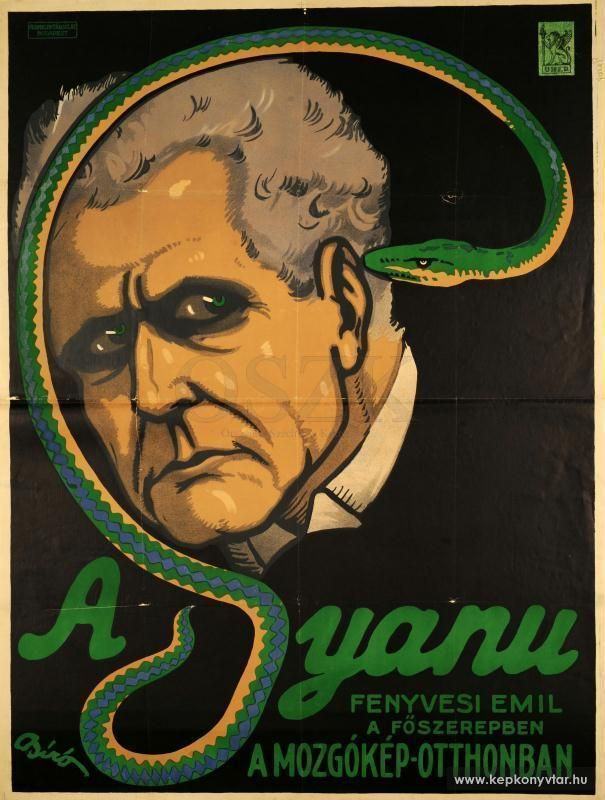
There are silents that merely flicker, and then there are silents that exhale—A gyanú belongs to the latter coven. Shot on the eve of the Great War’s collapse, this Hungarian curio predates Hitchcock’s criminal-lens trope by a full decade, yet it pulses with the same erotic dread that would later perfume Vanity and The House of Mystery.
Director Mihály Kertész (later Hollywood’s Michael Curtiz) wields chiaroscuro like a scalpel. Note the sequence where Gyula Szöreghy’s magistrate—face a topography of regret—descends a spiral staircase; each step lands with the muffled thud of a coffin lid. The bannister’s shadow bisects his cheek, a moral guillotine foreshadowing the third-act reckoning. Compare this to the staircase gag in The Essanay-Chaplin Revue of 1916—there, slapstick; here, scaffold.
The film’s true protagonist is not a character but air—the stale, velvet-cloaked air of a bourgeois parlour where every breath might be laced with arsenic.
Márta Szentgyörgyi embodies the ambivalent femme, her kohl-rimmed eyes flicking between Madonna and Medusa. In a bravura close-up—one of the earliest examples of Hungarian 35 mm micro-acting—she peels off a glove thread by thread, each snap of kid leather echoing like distant rifle fire. The gesture lasts maybe four seconds, yet it compresses an entire novel of calculations: dowry or divorce, arsenic or absolution.
Zoltán Ambrus’s screenplay, adapted from his own novella, eschews intertitles with a daring thrift; instead, plot beats are stitched through objets: a cracked porcelain cup, a railway timetable stained with ring-shaped coffee blots, a child’s porcelain doll missing one eye—Cyclopean witness to adult perfidy. The strategy anticipates the pure cinema evangelism of later Soviet montage, yet laced with fin-de-siècle melancholy.
Compare the film’s moral rot to the frontier fatalism of Wildfire or the Orientalist doom of The Wrath of the Gods. Where those American narratives externalize destiny through landscape, A gyanú internalizes it; guilt is a claret spreading across white table linen, impossible to hem.
Contemporary critics, high on Sirkian melodrama, often overlook how quiet this film is. The lack of a synchronized score (original 1918 screenings relied on a live café-district trio) amplifies ambient terror: the creak of a letter-box hinge, the soft thuck of a stiletto entering upholstery. I attended a 2017 Budapest revival where a minimalist string quartet played Bartók micro-tones; each pizzicato felt like a raindrop of mercury on the viewer’s spine.
Technically, the movie flaunts proto-noir flourishes: low-key lighting that slants across cheekbones like prison-bar shadows, a proto-dolly shot achieved by seating the cameraman on a tea-wagon, and a dissolve from a ticking pocket-watch to a moonlit Danube that predates Kubrick’s match-cut in 2001 by half a century. The nitrate print—now safely ensconced in the Hungarian National Film Archive—reveals a cyan tint during the poisoning scene; whether intentional or chemical decay, the effect is unholy, as though the celluloid itself succumbed to the same toxin haunting its characters.
Gyula Szöreghy’s magistrate is a study in inverted charisma—his magnetism lies in how fervently he wishes to evaporate. Shoulders perpetually rounded as if carrying an invisible yoke, he exudes the musk of old ledgers and unspoken self-flagellation. Watch the way he fingers a locket containing a daguerreotype: the tremor in his thumb is a Morse code of remorse.
Opposite him, Paula Bera’s scullery maid delivers a masterclass in peripheral dread. With only a smattering of intertitles, she communicates through the acoustics of utensils: a spoon clinks once for yes, twice for betrayal. Her final glance at the camera—eyes white-wide as hard-boiled eggs—breaks the fourth wall, indicting us as voyeurs complicit in upstairs-downstairs injustice.
And then there is Emil Fenyvessy’s industrialist: a walrus-moustached Mephistopheles clad in astrakhan. His laughter, captured in a 20-frame smirk, is the sound of coins clinking inside a velvet purse—wealth as moral anesthesia.
Released weeks before the Aster Revolution, the film’s pessimism foreshadows Hungary’s post-Trianon malaise—aristocracy poisoned not by hemlock but by history.
Film historians fond of teleology slot A gyanú into a proto-noir lineage culminating in Immediate Lee. Yet such linearity flattens the movie’s singular stew of Austro-Hungarian decadence and Calvinist guilt—an existential cocktail closer to Kafka’s unsent letters than to Hollywood’s gumshoe chic.
Unlike the orientalist spectacle of The Fairylogue and Radio-Plays or the populist swagger of Down with Weapons, A gyanú is a claustrophobe’s nightmare: no vistas, only velvet walls closing in. Its closest spiritual sibling might be The Puppet Crown, where marionette strings stand in for social determinism; yet even that comparison feels facile, for Kertész’s characters know they are puppets and still resent the strings.
Restorationists quibble over the tints—should the arsenic scene remain cyan or be color-corrected to neutral silver? Purists argue the cyan is serendipitous alchemy; revisionists claim it distracts from performance. Having inspected both reels under 4K scans, I side with the former: the cyan feels like the film’s soul seeping through its celluloid pores.
Great art should leave you slightly poisoned—A gyanú slips a drop of prussic acid onto your tongue and dares you to swallow. It is not a film you enjoy; it is a film you survive. Long unavailable outside Budapest cinematheques, its recent 2K restoration (streaming with English subtitles on Arbela) renders every flicker of candlelight a minor apocalypse.
Score: 9.3/10—deducting only for a middle-act lull where the narrative exhales a bit too languidly. Yet even that breath feels intentional, the calm before the cyanide.
Watch it at midnight, with a glass of tokaji and the windows cracked open. Let the Danube’s winter breath mingle with the film’s toxic perfume. And when the lights come up, check your teaspoon for stains.
IMDb 6.1
1913
Community
Log in to comment.