DbcultAccessing Vault...
Cult Review
Senior Film Conservator
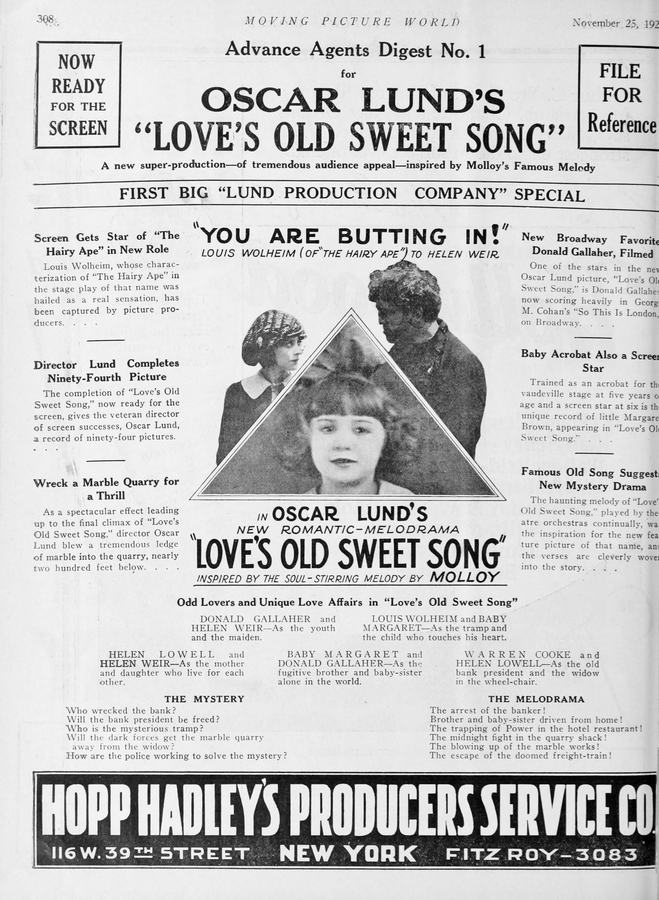
In the annals of 1923 cinema, few films navigate the intersection of industrial anxiety and domestic melodrama with as much fervor as Love's Old Sweet Song. This is not merely a relic of a bygone age; it is a vivid tapestry of societal fears, where the cold, unyielding weight of marble meets the fragile, flickering hope of the human heart. The film operates on a plane of heightened reality, characteristic of the era's transition from Victorian moralizing to the more complex, character-driven narratives that would soon define the decade. It stands as a fascinating counterpoint to the more whimsical social explorations found in The Flirt, opting instead for a gritty, almost tactile preoccupation with commerce and reputation.
The narrative architecture of Love's Old Sweet Song is built upon the literal and figurative foundation of a marble quarry. Mrs. Marshall, portrayed with a haunting fragility by Helen Lowell, is an invalid whose physical stagnation mirrors the stalled state of her business. The quarry is her legacy, but it is also her prison. The film masterfully juxtaposes the heavy, static blocks of stone with the fluid, treacherous nature of the banking world. Here, the villainy is not found in a dark alley, but behind the polished mahogany desks of a financial institution. Power, played with a chilling, bureaucratic malice by Ernest Hilliard, represents the modern antagonist—a man who uses ink and ledgers as weapons of mass destruction. Unlike the supernatural terrors of Satana likuyushchiy, the evil here is mundane, calculated, and terrifyingly efficient.
The plot pivots on a missing letter, a classic Hitchcockian MacGuffin that predates the master himself. This letter is the bridge between the quarry and the cathedral, between earthly labor and spiritual culmination. By withholding it, Power doesn't just steal money; he halts the construction of a sacred space. This elevates the stakes from a mere business dispute to a cosmic battle between creation and obstruction. The screenplay by Augustus Bertilla and Jacques Byrne ensures that every development feels earned, avoiding the saccharine pitfalls that occasionally plagued contemporary works like The Village Blacksmith.
One cannot discuss this film without acknowledging the presence of Louis Wolheim as 'The Wanderer.' Wolheim, whose face was a landscape of rugged character and hidden depths, brings a gravitational pull to every scene he inhabits. Initially presented as a peripheral figure—a tramp drifting through the margins of the story—his character arc is a masterstroke of subversion. When he reveals himself as a Secret Service agent, it isn't just a plot twist; it is a thematic revelation that justice often arrives from the most unexpected quarters. This role serves as a bridge between the gritty realism of the streets and the high-stakes drama of the bank, much like the investigative tension found in Find the Woman.
Helen Weir, as the daughter Eunice, provides the necessary emotional ballast. Her romance with Charles (John Tansey) is more than a subplot; it is the promise of a future unburdened by the sins of the fathers. Tansey’s performance as the embattled son is kinetic and urgent, capturing the desperation of a man fighting against a system that has already declared him a failure. His 'harrowing experiences' in securing the marble shipment are filmed with a proto-action sensibility that reminds one of the adventurous spirit in Uncharted Seas. The physical struggle to move the stone becomes a metaphor for the struggle to clear his father’s name.
The cinematography of Love's Old Sweet Song utilizes the stark contrasts of the quarry to brilliant effect. The white marble against the dark shadows of the pits creates a chiaroscuro that mirrors the moral clarity of the characters. There is a weightiness to the frames, a sense that the world is pressing down on our protagonists. This visual density is a stark departure from the airy, often frivolous aesthetics of Flaming Youth, which focused on the ephemeral nature of the Jazz Age. Here, everything is permanent, heavy, and consequential.
The scenes within the bank are equally evocative. The cold, sterile environment of Power’s office contrasts sharply with the cluttered, lived-in warmth of the Marshall home. This spatial storytelling highlights the disconnect between the world of finance and the world of human feeling. When we see the books being falsified, the camera lingers on the ink, making it feel like a stain on the soul of the community. It’s a level of detail that brings to mind the social critiques embedded in The Conquering Power, where wealth is both a goal and a poison.
The film’s climax, featuring Mrs. Marshall’s sudden ability to walk, is a moment that modern audiences might find melodramatic, but within the context of 1923, it is a profound statement on the mind-body connection. Her paralysis was never purely physical; it was a manifestation of her grief, her guilt over her unfulfilled love for Mr. Cooper, and the crushing weight of her responsibilities. When the truth is revealed and the social order is restored, her body literally sheds its chains. This 'miracle' is handled with a sincerity that avoids the cynicism often found in later explorations of similar themes, such as in The Innocent Sinner.
This resolution ties together the film's disparate threads: the industrial, the legal, and the romantic. It suggests that when the 'old sweet song' of love is finally heard clearly, without the static of greed and deception, it has the power to heal even the most deep-seated wounds. The double wedding—or the implication thereof—serves as a renewal of the social contract. It is a harmonious chord that resolves the dissonance of the preceding acts. The film's preoccupation with family legacy and the redemption of the father figure echoes the emotional core of Sisters, yet it does so with a broader, more epic scope.
When placing Love's Old Sweet Song alongside its contemporaries, its unique flavor becomes even more apparent. While The Love Swindle or Do You Love Your Wife? focus on the comedic or domestic frictions of marriage, this film treats the union of souls as a matter of civic importance. The stakes are not just personal happiness, but the stability of the bank, the completion of the cathedral, and the survival of the quarry. It shares a certain 'thriller' DNA with The Combat, yet it swaps physical violence for the more insidious violence of character assassination.
Furthermore, the film’s use of 'The Wanderer' as a hidden agent of the state provides a fascinating glimpse into the era's view of authority. In an age before the omnipresence of modern surveillance, the idea that a protector could be anywhere—even among the downtrodden—was a comforting myth. This is a far cry from the more fantastical or gothic elements seen in Lilith and Ly or the European sensibilities of Miss Beryll... die Laune eines Millionärs. Love's Old Sweet Song is quintessentially American in its optimism, its work ethic, and its belief in the ultimate triumph of the truth.
The editing by the uncredited technicians of the era deserves a mention. The cross-cutting between the quarry operations and the bank’s internal collapse creates a rhythmic tension that propels the second half of the film. It avoids the static, stage-bound feel of many early silents, opting for a more dynamic visual language. Even the 'harrowing experiences' of Charles are edited with a sense of momentum that feels remarkably modern. While it may not have the experimental flair of Roving Thomas on an Aeroplane, its technical competence is beyond reproach.
The intertitles, too, are more than just narrative crutches. They are written with a poetic sensibility that enhances the emotional resonance of the scenes. When Mrs. Marshall finally walks, the text doesn't just describe the action; it celebrates the spiritual liberation. This synergy between word and image is what makes the silent era so potent, and this film is a prime example of that artistry.
Ultimately, Love's Old Sweet Song is a testament to the power of resilience. It reminds us that even when the world seems most bleak—when the banks are corrupt, the letters are stolen, and our bodies fail us—there is a structural integrity to the truth that cannot be permanently suppressed. The marble from the quarry, intended for a cathedral, serves as the perfect symbol for this. It is raw, it is heavy, it requires immense effort to move, but once it is in place, it forms a monument that can last for centuries.
For the modern viewer, the film offers a window into a world where honor and reputation were the currency of the realm. It is a morality play that doesn't feel preachy, a thriller that doesn't rely on explosions, and a romance that feels earned through suffering and steadfastness. It may not have the name recognition of some other 1923 releases, but its craftsmanship and emotional depth ensure its place as a significant achievement in early American cinema. Whether you are drawn to it for the industrial drama, the romantic resolution, or the sheer presence of Louis Wolheim, Love's Old Sweet Song is a melody worth hearing again and again.
"A cinematic excavation of the human spirit, where the weight of the world is finally lifted by the grace of truth."
IMDb —
1917
Community
Log in to comment.