DbcultAccessing Vault...
Cult Review
Senior Film Conservator
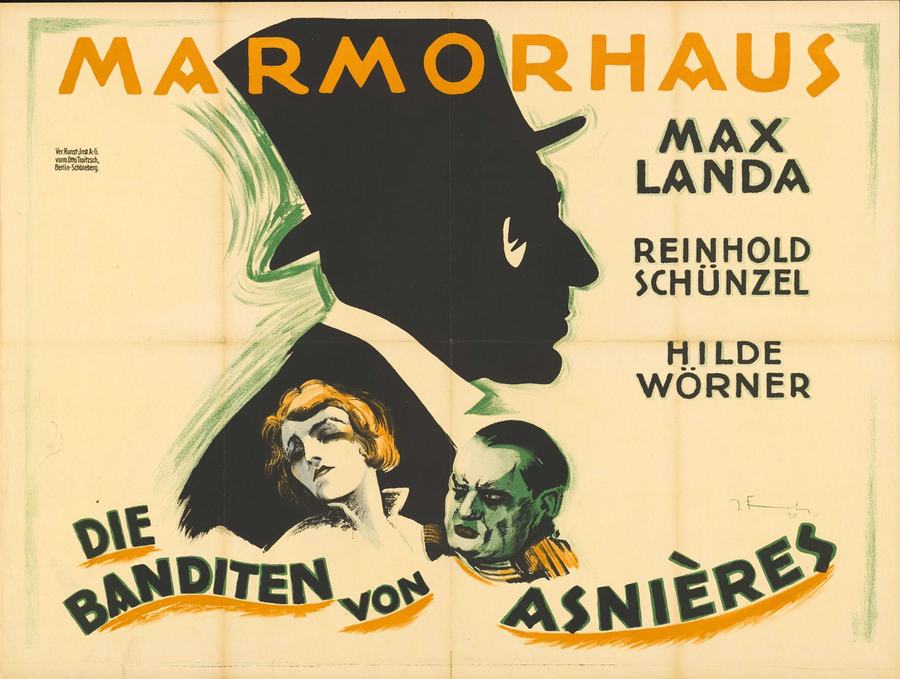
The first time I saw Die Banditen von Asnières I walked out convinced I had inhaled coal dust—my lungs felt scorched by the film’s soot-streaked cinematography, its shadows so dense they seemed to leave residue on the emulsion itself. Released in Germany in November 1920 yet set on the frayed periphery of Belle-Époque Paris, this obscure jewel of Weimar noir feels like a negative image of the city marketed by railway posters: here the Seine is a sludge canal, the Eiffel Tower a distant spike of indifference, and every cobblestone hides a confidence trick.
Director Carl Wilhelm—best known to silents junkies for society farces—abandons drawing-room wit for something far more feral. He borrows the crime aesthetics of Her Fatal Shot but strips away that film’s operatic flourish, replacing it with reportage grime. The camera crouches at ankle-height during getaway chases; it lingers on a rat gnawing a discarded corset while, in soft focus, a murder is committed in a mirrored boudoir. The juxtaposition is clinical, almost medical, as though the lens were dissecting a social organism infected by capital.
Story-wise the film pretends, for roughly ten minutes, to be a conventional heist caper: a freight wagon trundles through Asnières rail yards at civil dawn; inside, crates stamped with Arabic calligraphy hold museum-bound sarcophagi. Within seconds, railway bandits uncouple the car, reroute it onto an abandoned siding, and vanish with one crate. Simple. Except the screenplay—adapted by Carlo Emerich from a newspaper serial by Norwegian crime writer Sven Elvestad—immediately splinters into multiple unreliable strands.
We meet Georges Ravel (Max Landa), a disgraced orchestra maestro who now plays piano in a dockside bordello. Landa, usually cast as jovial bourgeois buffoons, here looks hollowed-out: cheekbones sharp enough to slice title cards, eyes flicking toward exits even while he smiles. The ex-conductor is nursing two secrets: he forged the shipping manifest that rerouted the sarcophagi, and he keeps a pressed violet in his waistcoat—the relic of an affair with Woerner’s chanteuse Claire Delorme. The violet reappears whenever guilt cramps his lungs, an economical visual semaphore that replaces pages of intertitles.
Meanwhile Maître Paul Kestner (Reinhold Schünzel) prowls parquet courtrooms like a panther in wingtips. Kestner’s racket: defend criminals, then blackmail them with evidence he pretends to suppress. Schünzel—who would later direct Nazi-era comedies—gives the lawyer a reptilian grace: every bowtie adjustment signals a fresh trap being sprung. He wants the antiquities not for profit but for leverage; inside the sarcophagus lies a coded ledger listing every magistrate he owns. The film’s genius is never showing that ledger—its existence stays rumor, a MacGuffin worthy of Hitchcock.
Thread three belongs to Lucien Mercier (Ferdinand von Alten), a would-be anarchist whose pamphlets denounce wage slavery yet who funds his politics by selling cocaine to the same workers. With opium pupils dilated like lunar craters, Lucien plots to bomb the Préfecture but needs capital for dynamite; the sarcophagi theft becomes his piggy bank. Von Alten’s performance is all tics and tremors, as though electricity were leaking from his nervous system.
Cinematographer Carl Hoffmann—future lensman on Der Letzte Mann—lights interiors with single-source lamps that turn faces into topographical maps: every pockmark, every bead of pomade gleams like forensic evidence. When Claire sings in the Café des Amis, Hoffmann positions the camera behind the bar’s brass rail so that the singers’ silhouettes ripple through rows of absinthe glasses; the green liquid becomes a prism warping moral clarity.
Exteriors were filmed in Lankwitz and on the Spree riverbanks, doubling for the Seine because French locations were impossible in 1920. Yet the art department—led by a young Otto Hunte—builds facades pitted with posters that peel like diseased skin, trolley tracks that hiss rain back into fog. The cumulative effect is a Paris imagined by someone who has read Zola by candlelight while nursing a absinthe hangover.
Compare this to The Mate of the Sally Ann whose pastoral glow softens moral transgressions; here transgressions are photographed like dermatological conditions—nothing pastoral, only raw.
Max Landa’s career had drifted into comic supporting roles by 1920; Banditen hands him a tragic center and he responds with a performance calibrated at the molecular level. Watch his hands: at the piano they flutter, confident; when blackmailed they stiffen, thumbs twitching like hooked fish. In a bravura close-up lasting maybe four seconds, Landa cycles through recognition, terror, and resignation without a single intertitle—pure silent-era telepathy.
Reinhold Schünzel, conversely, externalizes menace. His Kestner never raises his voice; instead he lowers his eyelids halfway, as if viewing humanity through a microscope slide. In one chilling scene he adjusts a flower in his lapel while dictating a death warrant; the gesture is more frightening than any shouted threat.
Hilde Woerner’s Claire could have slid into femme-fatale cliché, yet she plays the chanteuse as someone who weaponizes vulnerability only to discover the weapon recoils. Her final scene—singing “La Bande d’Asnières” while a gendarme’s shadow lengthens behind her—ranks among the great tragic curtain calls of Weimar cinema.
No original score survives, but archival programs suggest a live orchestra mixed xylophones, snare drum, and accordion. Modern restorations often commission new works; the 2018 Munich Film Museum print toured with a trio using prepared piano and bowed saw, producing drones that feel like fog solidifying into guilt. I caught that version at Brooklyn’s Spectacle Theater and the saw’s wail synced so precisely with Claire’s vibrato my sternum vibrated.
The film’s tempo mirrors a metronome gone rogue: long static passages suddenly rupture by intercut chases—feet splashing through puddles shot from gutter level—then slam back to glacial two-shots where characters negotiate betrayals over cold coffee. This arrhythmia keeps viewers perpetually off-balance, as though the film itself were picking your pocket.
Though set in 1906, the movie reeks of 1920 despair: reparations, street clashes, the Freikorps. The sarcophagi—stolen North-African artifacts—function as colonial guilt made concrete. Georges’ forged manifest literalizes Germany’s forged war guilt clause; Kestner’s judicial corruption mirrors the Weimar courts that acquitted right-wing saboteurs. Even the anarchist’s bomb plot evokes the March 1920 Berlin uprising. The film smuggles contemporary rage into period dress, much like Küzdelem a Létért channels post-Trianon bitterness through agrarian fable.
“We are all bandits of Asnières,” Lucien scribbles on a wall, “stealing futures from ourselves.” The intertitle was cut by Berlin censors; only the graffiti remains.
Claire’s body is the film’s unofficial currency—traded for alibis, for sheet music, for survival. Yet the screenplay grants her interior monologue via handwritten diaries that we glimpse but never read, a clever device denying the male gaze full ownership. When she ultimately betrays Georges, it is not out of malice but a recognition that affection itself has been devalued by inflation. In a poignant insert, she burns a love letter using a candle held by the very policeman investigating her—an image that distills the film’s thesis: intimacy and indictment share the same wick.
Place it beside Impossible Catherine and you see how Hollywood polished crime into screwball sparkle; place it next to Europäisches Sklavenleben and you appreciate how exploitation can still harbor poetry. Banditen is bleaker than Haunting Shadows yet more compassionate than Kitsch, whose nihilism feels performative. Only Alraune und der Golem matches its fusion of supernatural dread and social critique, though Banditen keeps its monsters resolutely human.
Contemporary critics praised the “Parisian atmosphere” but decried its “moral gloom.” Lichtbild-Bühne complained it made audiences “long for a bath in the Seine.” The film vanished after 1924, its negative rumored melted for silver halide recovery. A 35 mm nitrate print surfaced in 1991 inside a Slovenian monastery wall—alongside reels of My Old Dutch—allowing restoration. Today cinephiles rank it among the missing links between German Strassenfilm and French poetic realism; without it, the bridge from Caligari to Carné is half-built.
As of 2024 no DCP exists on major streamers; the rights sit tangled between French, German, and Slovenian archives. The Munich Film Museum sells a region-free Blu-ray with German and English intertitles, sourced from the 2018 2K scan. Be warned: the disc is region-zero yet PAL-encoded, so North-American buyers need a player that converts. Bonus features include a 48-minute video essay on Weimar crime cycles and a PDF of Elvestad’s original serial.
Because history is a forged manifest, because love letters burn faster than warrants, because every era needs its shadow atlas. Die Banditen von Asnières offers no redemption, only recognition: we are all petty smugglers trafficking in someone else’s artifacts, hoping the ledger stays shut. To sit in its flicker is to feel the accordion of fate squeeze your ribs; when the lights rise you’ll check your pockets, certain something is missing—maybe a moral compass, maybe just loose change.
Seek it out, preferably at midnight, preferably in a theater that smells of mildew and espresso. Let the saw-blade score saw your certainties in half. And when you stagger back into the neon night, remember: the bandits are not on-screen—they are the reflection in the lobby mirror, collar turned up, eyes scanning for the next easy mark.
IMDb 6.2
1916
Community
Log in to comment.