DbcultAccessing Vault...
6.3/10
Senior Film Conservator
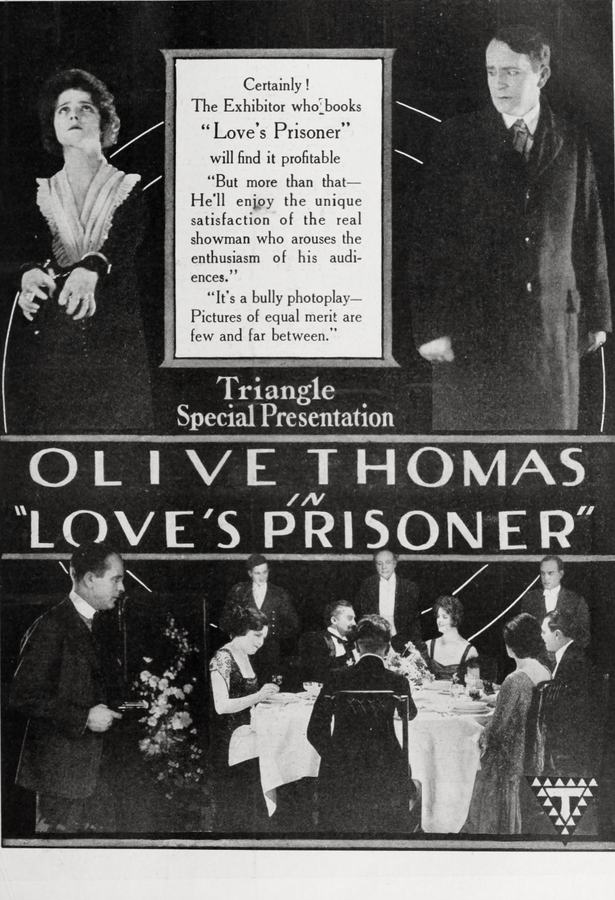
A definitive 6.3/10 rating for a film that redefined the boundaries of cult cinema. Love's Prisoner remains a cornerstone of transgressive art.
To witness Love's Prisoner (1919) is to step into a time capsule of post-war anxiety and burgeoning social mobility. At the center of this swirling vortex is Olive Thomas, an actress whose screen presence was so incandescent it seemed to vibrate against the very grain of the celluloid. In this particular outing, Thomas portrays Nancy, a character who embodies the restless spirit of an era trying to redefine itself. Unlike the more straightforward moral tales of the decade, such as The Light in Darkness, this film dares to linger in the gray spaces of survival and ambition.
The cinematography, though constrained by the technical limitations of 1919, manages to evoke a palpable sense of atmosphere. We see the stark contrast between the claustrophobic tenement life and the sprawling, cold elegance of the wealthy. Nancy’s disdain for the law isn't merely a character quirk; it is a philosophical stance born from the gutter. When she rises to society, it isn't through a stroke of luck but through a calculated performance of class. This performative nature of her existence becomes literal when she assumes the mantle of 'The Bird.' As a thief, she is more than a criminal; she is a ghost haunting the excesses of the Gilded Age.
E. Magnus Ingleton’s screenplay is a fascinating study in contradiction. It treats Nancy’s burglaries with a certain romanticism, yet it never fully abandons the era’s demand for moral equilibrium. Compared to the more cynical explorations of greed found in Money Madness, Love's Prisoner is far more interested in the psychological impetus behind the crime. Why does a woman who has finally achieved her dreams risk everything to steal? The answer lies in the precariousness of her position—a theme that resonates even today in our era of economic volatility.
The supporting cast provides a sturdy framework for Thomas’s luminosity. William V. Mong and Jean Hersholt bring a level of gravitas that prevents the film from drifting into pure melodrama. Hersholt, in particular, demonstrates the burgeoning talent that would later make him a titan of the industry. The interaction between the detective and Nancy is a masterclass in silent tension. Every gaze is heavy with subtext, every gesture a negotiation between duty and desire. It lacks the whimsical charm of Aladdin and the Wonderful Lamp, opting instead for a gritty, emotional realism that was quite progressive for its time.
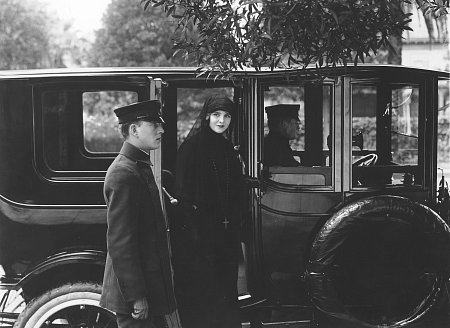
The visual metaphor of 'The Bird' is expertly woven throughout the narrative. Birds in cinema often represent freedom or fragility, but here, the bird is a predator—albeit a graceful one. Nancy flits through the windows of the rich, taking what she needs to maintain her plumage. The costume design, though we only see it in shades of silver and black, suggests a tactile richness. When she is eventually captured, the metaphor shifts; she becomes the titular prisoner, her wings clipped by the very system she sought to outmaneuver.
One cannot help but compare this narrative arc to Sapho or Her Debt of Honor, where the female protagonist's social standing is always at the mercy of her past. However, Love's Prisoner offers a more proactive heroine. Nancy is not a passive victim of circumstance; she is an architect of her own fate, even when that fate leads her to a prison cell. The choice to confess is presented not as a defeat, but as an act of supreme agency. She clears her conscience to make room for a future that isn't built on lies.
The detective, played with a stoic intensity by Joe King, serves as the audience’s surrogate. Initially, he represents the cold, unyielding hand of the law—the very thing Nancy hates. But as he peels back the layers of 'The Bird,' he finds a mirror of his own loneliness and ambition. Their romance is less about 'love at first sight' and more about a mutual recognition of soul. It is a far more sophisticated dynamic than the one seen in A Broadway Scandal, where the stakes feel significantly lower.
In the final act, the film takes a turn toward the redemptive. The scenes of Nancy’s incarceration are handled with a surprising lack of sensationalism. There is a quiet dignity in her penance. This segment of the film serves as a bridge to the resolution, ensuring that her eventual marriage doesn't feel like an easy escape, but rather a hard-won peace. It echoes the themes of societal reintegration found in The Dupe, though with a much more satisfying emotional payoff.
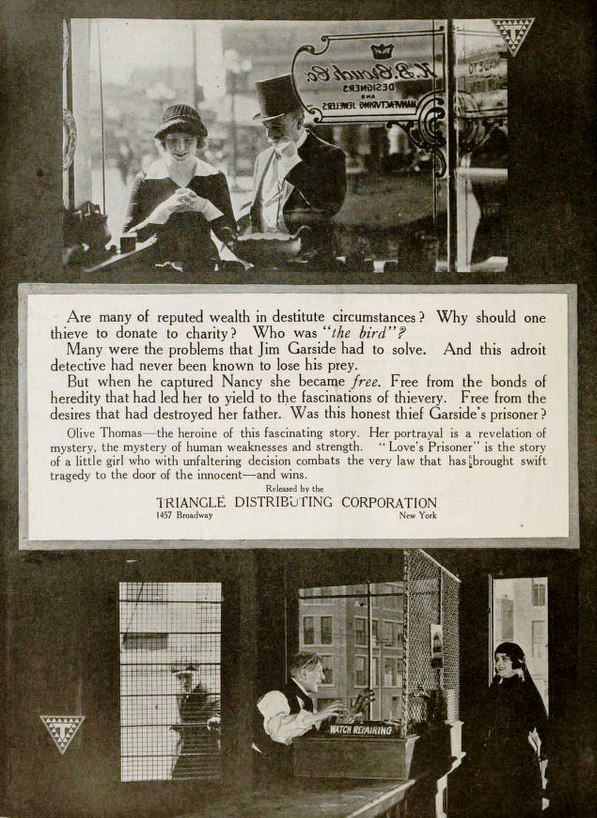
It is impossible to discuss Love's Prisoner without acknowledging the tragic aura that now surrounds Olive Thomas. Her death shortly after the film's release adds a layer of unintended melancholy to every scene. When she looks into the camera, there is a haunting quality, as if she knows her time in the spotlight is fleeting. This film stands as one of the best examples of her range, moving from the grit of the tenements to the artifice of the ballroom with seamless ease. She possessed a modern sensibility that felt out of place in the more rigid acting styles of her contemporaries in films like Tender Memories.
Technically, the film utilizes lighting to great effect, particularly in the burglary sequences. The use of shadows to hide and then reveal Nancy’s face creates a suspense that feels surprisingly contemporary. The pacing is brisk, avoiding the sluggishness that often plagues silent dramas of this length. It has the kinetic energy of An American Live Wire, but tempered with a much deeper emotional core. The director understands that the audience isn't just there for the 'heist'—they are there for the woman behind the mask.
As we look back at the landscape of 1919 cinema, Love's Prisoner occupies a unique niche. It isn't quite a crime thriller, nor is it a pure romance. It is a character study of a woman caught between two worlds, belonging to neither. It lacks the overt western ruggedness of One Shot Ross or the frontier morality of Captain Starlight, choosing instead to explore the urban frontier of the soul. The film’s conclusion, while traditional in its 'happily ever after' structure, feels earned because of the weight of the journey that preceded it.
For those interested in the evolution of the 'femme fatale' or the 'gentleman thief' (or in this case, the lady thief), this film is essential viewing. It showcases a moment in time when cinema was beginning to realize its power to humanize the marginalized. Nancy is a 'prisoner' long before she enters a jail cell—prisoner to her class, prisoner to her secrets, and finally, a prisoner to a love that demands her total honesty. In the end, the film suggests that the only way to truly be free is to stop running. It is a message that remains as potent now as it was a century ago, delivered through the luminous, unforgettable eyes of Olive Thomas.
Reviewer's Note: While some prints of this era have suffered the ravages of time, the emotional clarity of Love's Prisoner remains unscathed. It is a testament to the power of silent storytelling and the enduring magnetism of its lead actress.
IMDb —
1930
Community
Log in to comment.