DbcultAccessing Vault...
Cult Review
Senior Film Conservator
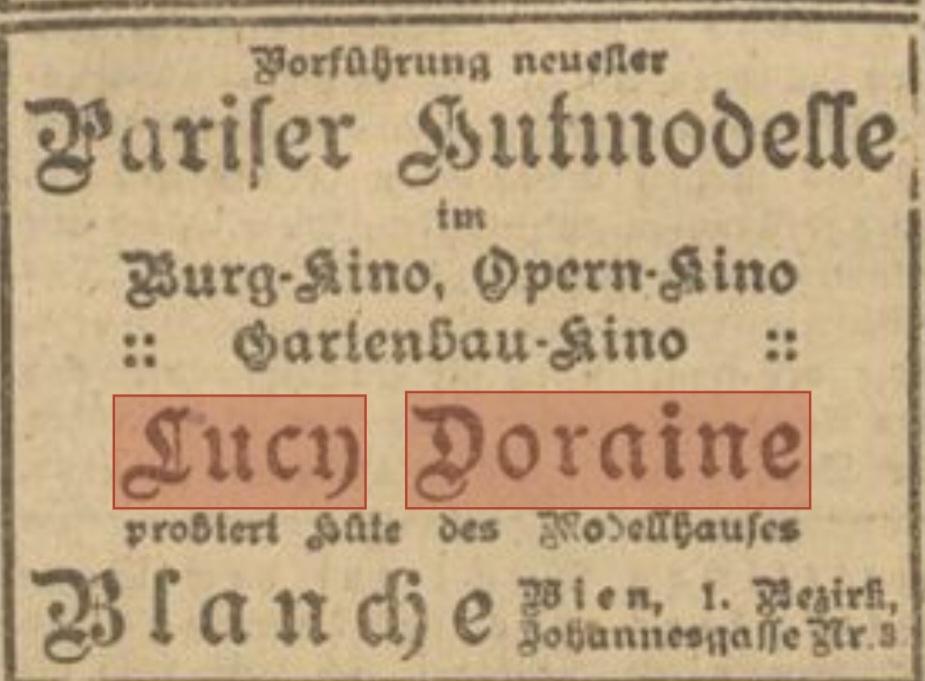
Imagine a film negative left to molder in a seam-stressed trunk on the Rue de Provence, its emulsion fretted by moth wings and time. Now imagine that strip unfurling in your palm: Lucy Doraine probiert neueste Pariser Modelle bei Blanche is the ghost you meet there—eleven minutes of couture delirium shot weeks before the lamps went out across Europe. No surviving intertitles, no director credited, only the pulsing fact of Lucy Doraine’s shoulder blades as she negotiates the chasm between garment and skin.
The provenance is itself a thriller: a single 35 mm nitrate roll, misfiled under “Lustige Witwe” in the Bundesarchiv, rescued by a grad student hunting for Madame Butterfly (1915) outtakes. The reel arrived at the lab curled like a dead fern; technicians froze it, rehumidified it, coaxed back the silver until Paris glimmered again. What emerged is less a fashion reel than a séance: couture as premonition, mirrors as trenches.
Each gown functions like a chapter heading in a novel that never settles on genre. First, a peach-colored tea dress with leg-of-mutton sleeves—its hem grazes Lucy’s calves the way nostalgia grazes memory, never quite touching ground. The camera circles, predatory; fabric billows, exposing a lace garter that winks like a Morse signal. Cut to a steel-blue evening coat weighted with bugle beads that clack together like shell casings when she spins. You cannot watch without recalling Strife, where machinery and flesh share the same metallic breath.
Blanche, the atelier’s eponymous puppetmaster, appears only as gloved hands and a chromium sheen of scissors. Her face remains off-frame, a deliberate lacuna that turns every snip into an act of violence. Halfway through, she slices a muslin mock-up down the spine; the sound is amplified, cartoonish, yet it lands like a bayonet. We are reminded that fashion, like cinema, is predicated on cutting—on dismembering the continuum of time into wearable fragments.
The salon’s walls are paneled with cheval mirrors positioned at obtuse angles, spawning an endless regiment of Lucys that diminish into grainy oblivion. The cinematographer—possibly Gaumont’s forgotten contract lensman Franz Kuntze—tilts the camera 15 degrees off axis, so every reflection slips out of sync. The effect presumes what theorists would later term mise en abyme, yet here it feels carnal: a woman witnessing her own erasure in real time.
Compare this to Tempest and Sunshine, where mirrors merely double the melodrama. In Lucy Doraine, they fracture identity until the notion of a stable self becomes risible. When she lifts a champagne coupe, hundreds of phantom arms lift too, but a split-second delay ripples across the gallery of glass, as if the entire room doubts the authenticity of the gesture.
Though shot on orthochromatic stock, the surviving print bears hand-tinted accents applied in Hamburg circa 1916. The lab used carbon-based carmine for the inner hem of a negligee, so when Lucy climbs a small stepladder to reach a hatbox, the fabric flares like a fresh wound against the monochrome skin. Elsewhere, stannic yellow gilds the tassels of a lamé shawl, conjuring the last gasp of fin-de-siècle opulence before mustard gas redefined yellow forever.
These pigments are volatile; they bloom and fade within seconds. Scholars of Desert Gold’s tinting will recognize the same unstable chemistry, but whereas that Western used color to mythologize landscape, here it weaponizes intimacy. Each flicker of crimson feels like a papercut on the retina.
No musical cue sheets survive, and archival policy forbids anachronistic scores, so festival screenings proceed in absolute hush. The absence is surgical: every rustle of taffeta, every metallic exhalation of a gas lamp becomes amplified by imagination. In the vacuum, you swear you hear the tick-tick-tick of a Jaeger couture pin box, the susurrus of a satin slipper across parquet. Silence turns spectators into accomplices; our breath mingles with Lucy’s, fogging the fourth wall.
This acoustic void rhymes eerily with Look Out Below, where slapstick falls are funnier sans score. Yet here the silence is not comedic but mortuary: the hush before mobilization posters hit the cobblestones.
Most cinephiles know Doraine from Robert Wiene’s phantasmagoric operettas, her eyebrows arched like circumflex accents. In this reel she abandons expressionist kabuki for something nearer to Baudelairean ennui. Watch her fingers hesitate at a row of silk-covered buttons: the tremor is not scripted, it is the micro-expression of an actress who has read the newspapers, who knows that within months the boulevards will be renamed after victories not yet won.
Her discipline is feline. She never rushes a gesture, yet every tilt of the head forecasts catastrophe. When she finally regards us—yes, the camera dares a close-up so near her pupils become eclipses—the glance carries the same pre-traumatic glaze soldiers wore in Trooper 44. The difference: Lucy’s war is fought with needles and notions, not bayonets.
Average shot length hovers around 3.8 seconds, frenetic for 1914. Yet within that brevity lurks a languor achieved through overlapping dissolves: a chiffon train fades out while Lucy’s silhouette fades in, creating a palimpsest of fabric and flesh. The technique anticipates the lap-dissolves of Lawless Love, but stripped of narrative causality. Here, form is content: the dissolve literalizes the way fashion consumes its wearer, leaving only a ghost of stitched air.
One gown incorporates Javanese batik allegedly sourced at the 1900 Exposition Universelle. When Lucy swivels, the candle soot caught in the wax-resist patterns flares like trench flares over Ypres. The textile’s colonial pedigree is never acknowledged; it is simply there, a silent witness to Europe’s habit of wearing empire on its back. The omission feels louder than any title card, presaging the critique of commodity fetish sewn into the seams of Fires of Rebellion.
At minute nine, the screen blossoms into a negative image: whites become ink, blacks become snow. Lucy stands in this reversed cosmos holding a sable stole that now resembles a streak of lightning against her solar-black dress. The inversion lasts exactly 23 seconds—long enough for the viewer to sense history flipping into its own photographic opposite. Then the positive asserts itself again, but something has cooled inside the grain. She exits frame left; the camera lingers on an empty gown suspended from a ceiling hook, revolving slowly like a hanged man. Fade.
Premiered in July 1914 at Berlin’s UT Kurfürstendamm as pre-feature filler, the short was met with bemused applause—fashion reels were common, but none so macabre-chic. Herwarth Walden championed it in Der Sturm as “a cubist confession,” while Louise Brooks later claimed the film haunted her dreams during her own Boots era. Today, cineclubs post GIFs of Lucy’s final gown-spin, captioning it #Mood or #OOTD1914, proving that fashion’s ephemerality loops forever on the feed.
The Fondation Jérôme Seydoux insisted on digital harvest at 8K, yet kept the gate weave and photochemical scratches intact. The ethics: to erase decay would be to Photoshop history. Thus, emulsion damage flares like artillery flash whenever Lucy bends toward the mirror, a reminder that celluloid itself is mortal flesh.
Modern runways fetishize speed—blink and the look is gone. This 1914 time-capsule argues the opposite: slowness as sedition. Watch Blanche’s assistants kneel for entire seconds to adjust a pleat; the act becomes liturgy, not labor. In an age of fast fashion, the short feels like a breath held until the lungs bruise.
There are films you watch and there are films that watch you. Lucy Doraine bei Blanche belongs to the latter caste: a séance in silk, a newsreel from a future that never arrived. Seek it on the festival circuit before the nitrate decides to finish what the war began. Bring no snacks; the film will devour you instead.
If you crave more excavations of sartorial celluloid, chase down Les travailleurs de la mer for its knitted Guernsey sweaters battered by salt, or De forældreløse for orphan collars that speak louder than dialogue. None, though, cut as close to the nerve as Lucy’s final twirl into the dark.
Community
Log in to comment.