DbcultAccessing Vault...
Cult Review
Senior Film Conservator
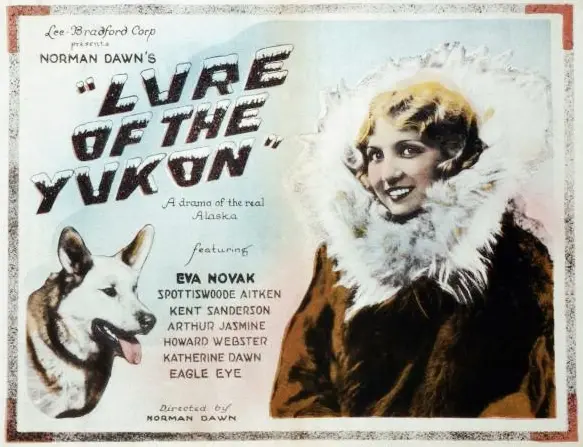
In the annals of silent cinema, few directors possessed the topographical audacity of Norman Dawn. While his contemporaries were often content to simulate the world within the controlled environments of Hollywood backlots, Dawn was a pioneer of the 'on-location' ethos, a man who understood that the camera could detect the difference between a painted backdrop and the genuine, biting air of the Arctic. His 1924 magnum opus, Lure of the Yukon, stands as a testament to this commitment, offering a raw, unvarnished glimpse into the Alaskan gold rush that remains as visually arresting today as it was a century ago.
The film’s primary strength lies in its atmospheric density. Unlike the melodramatic staginess found in The Price They Pay, which relied heavily on theatrical conventions, Lure of the Yukon breathes with the rhythm of the wilderness. The snow is not bleached flour; it is a treacherous, shifting character in its own right. When we see Buddy Roosevelt (appearing here as Kent Sanderson, though billed as Bob Force) navigating the jagged terrain, there is a palpable sense of physical stakes. Roosevelt, a former rodeo star, brings a level of athleticism to the role that predates the modern action hero, moving with a grace that contrasts sharply with the jagged ice floes.
The plot, while ostensibly a tale of hero versus villain, serves as a scaffolding for Dawn’s visual experimentation. We follow Sue McCraig, played with a blend of vulnerability and steely resolve by Eva Novak. Novak, who often portrayed characters caught in social upheavals—much like her work in The Loves of Letty—finds herself here at the mercy of Dan Baird, a man whose soul has been hollowed out by the prospect of gold. Howard Webster’s portrayal of Baird is a masterclass in silent-era villainy; he doesn't merely twirl a mustache; he radiates a cold, calculating malice that mirrors the sub-zero temperatures of the setting.
Norman Dawn is widely credited with the invention of the glass shot and the refinement of the matte painting, techniques that allowed filmmakers to blend reality with artistry. In Lure of the Yukon, these technical flourishes are used with a restraint that enhances rather than distracts. The way the horizon stretches into infinity, or the manner in which the light hits the crystalline surfaces of the glaciers, suggests a level of technical sophistication that was far ahead of its time. While a film like The Speed Maniac focused on the frantic energy of the machine age, Dawn focuses on the timeless, terrifying stillness of nature.
The inclusion of Ilak the Wolf Dog is not merely a sentimental nod to the 'man’s best friend' trope. Ilak represents the bridge between the domestic and the wild. In several key sequences, the dog’s reactions provide a more honest emotional barometer than the human actors, grounding the high-stakes drama in a primal reality. This use of animals to heighten the sense of place was a hallmark of the 'Northwestern' genre, yet rarely was it executed with such narrative integration.
When comparing this film to other contemporary works, one notices a distinct shift in moral weight. For instance, The Black Stork dealt with heavy-handed eugenics and social engineering, whereas Lure of the Yukon deals with the more ancient, elemental conflict of man against nature and man against his own shadow. There is a purity here that is absent in the urban cynicism of The Auction Block. Dawn’s Alaska is a purgatory where characters are stripped of their societal pretenses and forced to reveal their true essence.
The pacing of the film is also noteworthy. While many silents from this period can feel episodic or disjointed—consider the narrative staccato of Turning the Tables—Lure of the Yukon maintains a steady, propulsive momentum. The stakes are established early and escalated with a rhythmic precision. The rescue of Sue McCraig is not just a climax; it is a catharsis, a release of the tension that has been building through every frost-bitten frame.
Spottiswoode Aitken, a veteran of the D.W. Griffith school of acting, provides a gravitas that anchors the film’s more frantic moments. His presence reminds the viewer of the lineage of silent cinema, bridging the gap between the Victorian sensibilities of The Courtship of Myles Standish and the more modern, kinetic style Roosevelt employs. It is this collision of acting styles—Aitken’s theatricality versus Roosevelt’s physical realism—that creates a fascinating subtext about the changing nature of the American hero.
Furthermore, the film’s treatment of the indigenous characters and the 'Eagle Eye' role suggests a nuanced, if still period-typical, acknowledgement of the diverse tapestry of the Yukon. Unlike the caricatures often found in On the Night Stage, there is an attempt here to portray the inhabitants of the North as integral parts of the ecosystem rather than mere background dressing.
Reflecting on Lure of the Yukon today, one cannot help but admire the sheer physical labor involved in its production. In an era before CGI, before portable heaters, and before high-speed film stocks, Dawn and his crew ventured into the heart of darkness to bring back images of light. The film serves as a precursor to the survivalist cinema of the late 20th century, echoing the themes of isolation found in films far removed from the silent era.
The film also challenges the notion that silent cinema was primitive. The sophisticated use of cross-cutting during the final pursuit, the nuanced lighting that highlights the exhaustion on Novak’s face, and the rhythmic editing that mimics the pounding of a dog team’s paws all point to a medium that had reached full maturity. It shares a certain aesthetic DNA with The Winning Stroke in its celebration of physical prowess, yet it transcends the sports-drama genre by imbuing its action with existential dread.
Even when the plot leans into the tropes of the era—the mustache-twirling villainy, the damsel in distress—the setting acts as a corrective. The sheer scale of the Alaskan landscape makes human petty squabbles seem insignificant, a theme that would later be explored in more psychological depth in films like The Law Decides. In the Yukon, the only law is survival, and Norman Dawn captures that law with an unflinching eye.
Ultimately, Lure of the Yukon is more than a historical curiosity. It is a vibrant, breathing piece of cinema that demands to be viewed on its own terms. It lacks the whimsical artifice of Cupid Camouflaged or the domestic melodrama of The Girl and the Judge. Instead, it offers a stark, beautiful, and often terrifying vision of the American frontier. For those willing to look past the scratches on the celluloid, there is a profound beauty to be found in these flickering images of a world long gone, but forever preserved in the permafrost of Norman Dawn’s imagination.
Whether it is the haunting silhouette of a dog sled against a setting sun or the desperate glint in a gold-seeker’s eye, the film remains a powerful exploration of what humans will endure when driven by desire. It is a work of high lexical diversity in its visual language, speaking in tones of white, grey, and shadow. As we look back from our modern vantage point, Lure of the Yukon reminds us that the greatest special effect will always be the raw, untamed reality of the world we inhabit.
In the pantheon of 1920s cinema, this film deserves a place alongside the greats. It is as haunting as Die Gespensterstunde and as psychologically complex as Scratch My Back, yet it possesses a ruggedness that is uniquely its own. It is the lure of the unknown, the lure of the wild, and most importantly, the lure of the cinematic image in its most honest form.
IMDb 5.5
1931
Community
Log in to comment.