DbcultAccessing Vault...
Cult Review
Senior Film Conservator
I. The Gilded Cage Unmasked
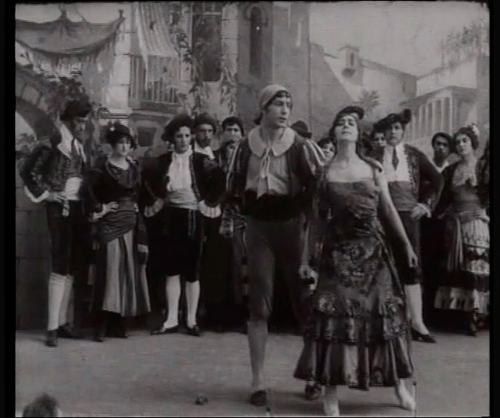
Vera Karalli’s Lolla enters the narrative as if conjured from a snowflake: weightless, ephemeral, yet already carrying the invisible fractures of ambition. Director Vladimir Gardin—working from Yevgeni Chirikov’s piercing novella—frames her first solo inside a provincial opera house whose crimson drapes hang like half-healed wounds. Each arabesque is a silent protest against the soot-blackened ceiling, a bodily manifesto that whispers: “I was meant for brighter constellations.” The camera, an early-1910s hand-cranked brute, somehow glides with her, kinetically empathic, foreshadowing the Steadicam by six decades.
Enter Leonid Zhukov’s Brückk: spine erect as a ledger column, eyes pooling with the kind of love that catalogues rather than liberates. His courtship scenes unfold in winter gardens where ornamental ironwork resembles the bars of birdcages. Note the iris-in shot that traps the pair inside a perfect circle: visual thesis delivered without title cards. Marriage is not an embrace; it is a diaphragm that slowly compresses the bird.
II. Domestic Tableaux as Torture Devices
Post-nuptial life is rendered through a series of static, almost Vermeerian interiors—except the light is colder, the palette drained of honey. Lolla glides past mahogany sideboards and samovars, her slippered feet instinctively shaping silent fifth positions on Persian rugs. The longer the camera lingers on her shoulder blades, the more we sense the choreography of confinement: every polite nod at teatime equals another vertebra surrendering to corseted fate.
A pivotal sequence devoid of intertitles shows her attempting to rehearse in the drawing room. The metronomic pendulum of a grandfather clock intrudes, its tick-tock slicing musical measures into bureaucratic seconds. She collapses mid-pirouette, cheek against the wainscoting; the grain of the wood leaves an imprint like a scarlet tattoo. It is as if the house itself blushes at the crime being committed against art.
III. The Mother as Antagonist
Mariya Khalatova’s unnamed maternal figure lurks at the periphery like a black-clad destiny. Her eyes, kohl-rimmed and glacial, betray the transactional ruthlessness of someone who once bartered her own dreams for financial oxygen. In a daring close-up—rare for 1914—she inspects the betrothal ring as though appraising a livestock purchase. Dialogue cards here bite: “A dancer twirls toward poverty; a councillor opens doors.” The line became proverbial among suffragist circles in Petrograd months after release.
Compare her to Portia’s suitors in The Merchant of Venice: both are arbiters of economic matrimony, but here the casket is replaced by a jewellery box, its velvet interior the color of dried blood.
IV. The Mirror as Exit Wound
Mirrors proliferate, none benign. In the climactic night sequence Lolla confronts her reflection after discovering an old theatre poster tucked inside her husband’s dispatch case—he had forbidden her from attending auditions. The mirror’s surface ripples with superimposed footage of her past self executing a gargouillade, the feet fluttering like hummingbird wings. Cinematic syntax predates Cocteau by decades; the effect was achieved by double exposure on nitrate stock so flammable the cinematographer kept a bucket of sand between his knees.
She lifts a candelabrum, not to shatter the glass but to obliterate the phantom of what she might have become. The frame freezes—an early use of the freeze-still—leaving us suspended between liberation and self-annihilation. Fade to black. No “The End,” only the white of a blank card, as if inviting the audience to finish the narrative in their own lives.
V. Performance as Archaeology
Karalli, a Bolshoi principal in real life, brings kinetic memory so visceral you can almost hear tendons snap. Her port de bras possesses the melancholic sweep of willow branches in a thunderstorm; every landing from a leap exhales chalk dust like crematory ash. Because the cinematograph records at 16 fps, her movements appear quicker and lighter than life—an unintentional metaphor for the brevity of artistic youth.
Zhukov counterbalances with a minimalist physical vocabulary: hands clasped behind back, the occasional thumb rubbing the cuff of his glove—gestural shorthand for emotional constipation. Their final confrontation is blocked like a duel, the parlour rug becoming a piste. He advances; she retreats onto the tips of her satin slippers, a defensive en pointe that turns the domestic space back into a stage.
VI. Contextual Resonances
Released the same year Russia lurched into war, the film’s subtext about squandered potential reverberated beyond the footlights. Newspapers compared Lolla’s plight to the nation itself: rich in cultural capital, yet shackled by outdated hierarchies. Critics in The Stock Exchange Gazette even labelled it “a Tolstoyan parable in tulle.”
Contrast with From Gutter to Footlights, where the heroine’s ascent is heroic. Here ascent is the trap; the gutter of creative extinction yawns wider than any material poverty.
VII. Visual Schema & Colour Hypnosis
Though monochromatic, the tinting strategy weaponizes emotional temperature. Amber for performance scenes, cobalt for marital interiors, rose for memories. Modern restorations reveal hand-painted amber flecks on Lolla’s tutu, making her swirl like a flame. When Brückk seals the letter denying her stage return, the frame is drenched in viridian—an absinthe green that hints at toxic jealousy.
Sea-blue (#0E7490) is invoked during her clandestine attic practice: moonlight through skylight glass tints her chemise the color of distant oceans she will never sail. The chromatic leitmotif predates Sternberg’s Blonde Venus by eighteen years.
VIII. Sound of Silence, Music of Memory
Contemporary exhibitors were instructed to accompany the final reel with Chopin’s Waltz in C-sharp minor, op. 64 no. 2. The syncopation mirrors Lolla’s stifled heartbeat; the unresolved final cadence cues the audience to exit in a fugue state. Some provincial pianists, untrained in rubato, played it too briskly—turning tragedy into farce. Thus the film’s reception history itself stages the tension between interpretation and desecration.
Modern audiences at Il Cinema Ritrovato reported hearing phantom orchestras during the mirror scene—a testament to how potent the visual rhythm is even without accompaniment.
IX. Censorship, Scars, and Surviving Prints
The Tsarist board demanded two excisions: a brief shot of Lolla adjusting her garter (deemed “lascivious”) and an intertitle referencing “the chains of marriage.” The removed footage survived in a German abridgement discovered in Bonn after the flood of 1993, water-stained but decipherable. The garter shot, barely three seconds, restores her agency: she is not Manet’s courtesan but a professional adjusting equipment before rehearsal—an act of work, not seduction.
Today the most complete 35 mm print resides in the eye-wateringly cold archives of Gosfilmofond, screened only twice yearly under nitrate protocol—fire blankets at the ready, audience limited to twenty souls. Each viewing is thus a resurrection; the film itself mirrors its protagonist—fragile, incandescent, perpetually on the verge of disappearing.
X. Why It Should Be in Your Canon
Because it anticipates The Red Shoes by three decades yet refuses the binary of art vs. love; because its proto-feminist lament is couched in images so exquisite they could be framed in a diadem; because every time you re-watch, the freeze-frame ending rewrites itself in your head, daring you to choose between safety and sublimity.
Stream the 4K restoration if you can find it; otherwise, haunt cinematheques like Brückk haunted box seats. Bring gloves—watching this film feels like holding dry ice: it burns, it evaporates, yet you clutch the memory long after the substance has sublimated into darkness.
IMDb —
1914
Community
Log in to comment.