DbcultAccessing Vault...
7.6/10
Senior Film Conservator
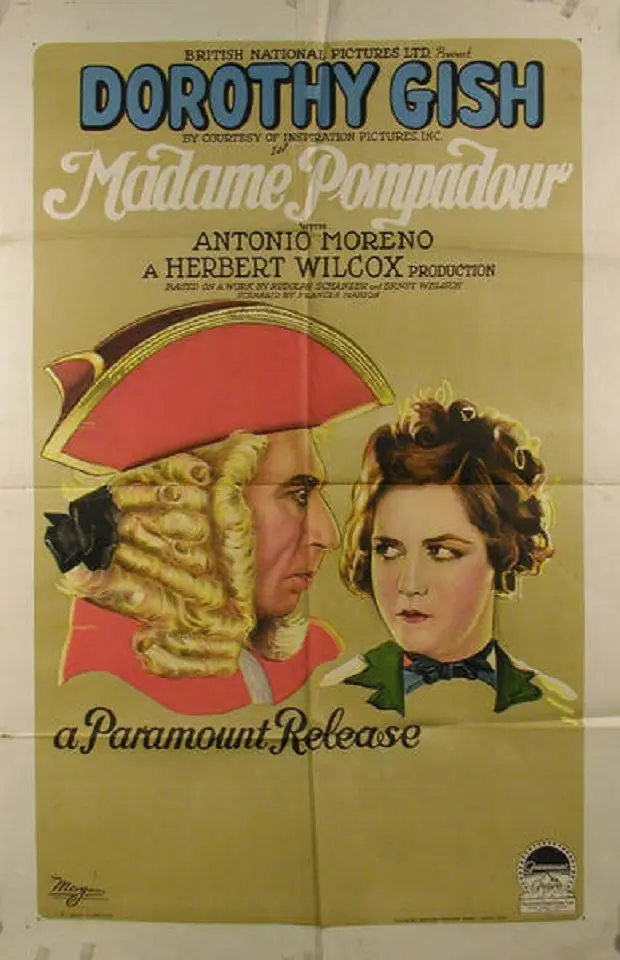
A definitive 7.6/10 rating for a film that redefined the boundaries of cult cinema. Madame Pompadour remains a cornerstone of transgressive art.
Is Madame Pompadour (1927) worth your time today? Short answer: Yes, but only if you appreciate the calculated artifice of silent-era melodrama over the gritty realism of modern historical epics.
This film is for the cinephile who finds beauty in the slow burn of a gaze and the intricate politics of a royal court. It is NOT for those who require rapid-fire action or a strictly factual retelling of French history. This is a romanticized, highly stylized vision of power that prioritizes emotional truth over chronological accuracy.
1) This film works because Dorothy Gish delivers a performance that is both regal and vulnerable, carrying the weight of the entire production on her shoulders.
2) This film fails because the middle act becomes bogged down in repetitive courtly rituals that stall the narrative momentum established in the opening scenes.
3) You should watch it if you want to see how the legendary screenwriter Frances Marion could transform a standard costume drama into a nuanced study of female agency.
Dorothy Gish has long lived in the shadow of her sister Lillian, but in Madame Pompadour, she proves herself to be the more grounded, perhaps even more modern, performer. While Lillian often specialized in ethereal suffering, Dorothy brings a sharp, calculating intelligence to the role of Jeanne Antoinette Poisson. From the moment she appears on screen, there is a sense that she is the smartest person in the room. This isn't just about beauty; it’s about the architecture of influence.
Consider the scene where she first revisits René in his cell. The lighting, heavily influenced by director Ewald André Dupont’s European sensibilities, casts long, expressionistic shadows that mirror her internal conflict. Gish doesn't lean into histrionics. Instead, she uses small, precise movements of her hands—clutching her silk cloak, then releasing it—to signal her transition from the King’s possession back to a woman in love. It is a masterclass in silent storytelling that rivals the emotional depth seen in contemporary works like The Rag Man.
Her chemistry with Antonio Moreno is palpable, if a bit lopsided. Moreno, who often played the dashing lead in films like Mile-a-Minute Romeo, brings a rugged, almost out-of-place energy to the refined French court. He feels like a man of action trapped in a world of lace, which works perfectly for a character who has been forcibly removed from the world of the living and placed into a gilded cage as a bodyguard.
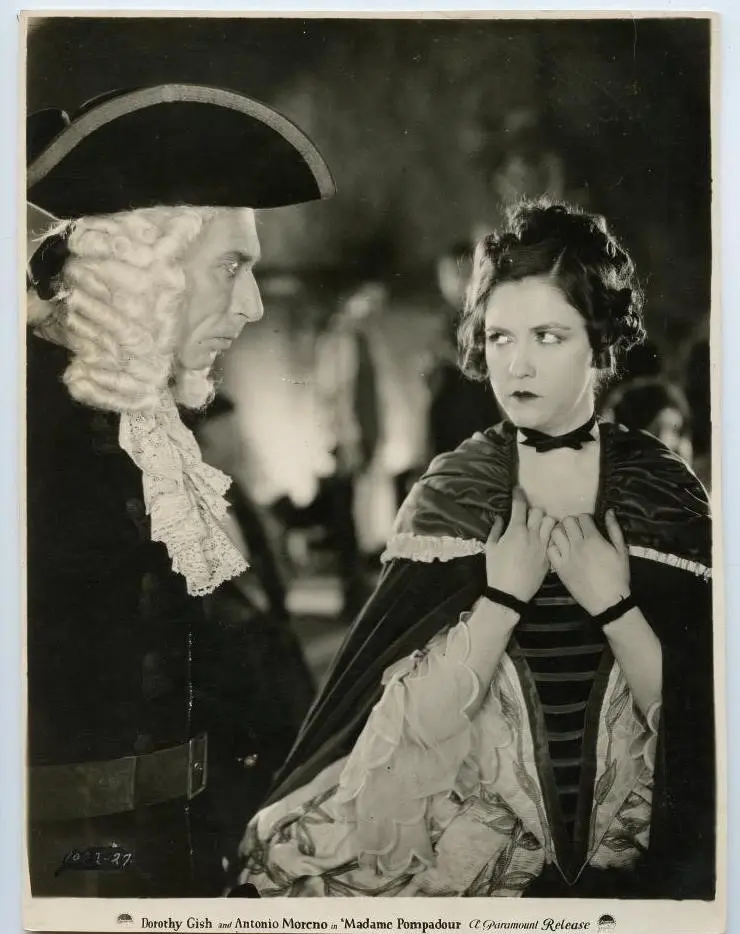
E.A. Dupont is a director who understood that the camera is a character. In Madame Pompadour, he moves away from the static, stage-like presentations common in earlier silent films. He uses the vast sets of Versailles not just as backdrops, but as obstacles. The hallways are long and intimidating; the ceilings are so high they seem to swallow the characters whole. This visual strategy emphasizes the isolation of the titular character. She is surrounded by people, yet she is entirely alone in her strategy.
The cinematography here is far more sophisticated than what one might find in a standard adventure flick like The Man from Hell's River. Dupont employs a soft-focus technique during the romantic interludes that contrasts sharply with the high-contrast, almost noir-like shadows of the prison sequences. This visual duality keeps the viewer off-balance, reflecting the precarious nature of Pompadour’s position. One slip, one wrong word to the King, and she could end up in the very darkness she rescued René from.
"The film treats the French court not as a place of luxury, but as a battlefield where the primary weapons are whispers and glances."
It works. But it’s flawed. The pacing is the primary culprit. There are sequences involving the King’s advisors that feel like they belong in a much drier political documentary. While these scenes are meant to build the stakes, they often feel like they are checking boxes in a script rather than driving the heart of the story forward. Compared to the tight editing of Dupont’s other work, like Die Flucht in die Nacht, Pompadour occasionally feels bloated.
The writing team, led by the incomparable Frances Marion, avoids the trap of making Pompadour a simple villain or a tragic victim. In the 1920s, the "mistress" character was often used as a cautionary tale—a "vamp" to be extinguished, as seen in films like Exit the Vamp. However, Marion imbues Pompadour with a sense of duty and survival. She isn't just looking for love; she’s looking for a way to maintain her autonomy in a world that views her as a decorative object.
This is a bold stance for a 1927 production. The film suggests that her manipulation of the King is a necessary evil, a form of labor required to stay alive. This thematic depth elevates the movie above its peers. It isn't just a costume drama; it's a proto-feminist text hidden beneath layers of crinoline and powdered wigs. Even the minor characters, like those played by Marie Ault and Nelson Keys, are given moments of humanity that prevent them from becoming mere caricatures of the aristocracy.
Is Madame Pompadour (1927) a high-quality cinematic experience? Yes, the film is a high-quality production that showcases the peak of silent film craftsmanship. The combination of E.A. Dupont's visual flair and Dorothy Gish's nuanced acting makes it a standout of its era. While it may feel slow by modern standards, its exploration of power and gender remains surprisingly relevant.
Pros:
- Dorothy Gish’s career-defining performance.
- Exceptional costume and set design that rivals Ferragus in its opulence.
- Sophisticated lighting that creates a moody, atmospheric tone.
- A script that treats its female lead with dignity and complexity.
Cons:
- The 1500-word-equivalent runtime feels longer due to pacing issues.
- Antonio Moreno is occasionally too stolid for the high-stakes drama.
- Some supporting characters are underdeveloped compared to the leads.
Madame Pompadour is a fascinating relic that manages to feel vibrant despite its age. It is a film of contradictions: grand yet intimate, political yet deeply personal. While it lacks the raw experimental energy of Es werde Licht! 1. Teil, it makes up for it with sheer polished professionalism. Dorothy Gish proves that she was a titan of the screen, capable of conveying more with a tilt of her head than most modern actors can with a five-minute monologue. It is a lush, gorgeous, and occasionally frustrating experience that demands your full attention. If you give it that attention, you will find a story that is as much about the present as it is about the past. It isn't perfect, but it is essential.
IMDb —
1924
Community
Log in to comment.