DbcultAccessing Vault...
Cult Review
Senior Film Conservator
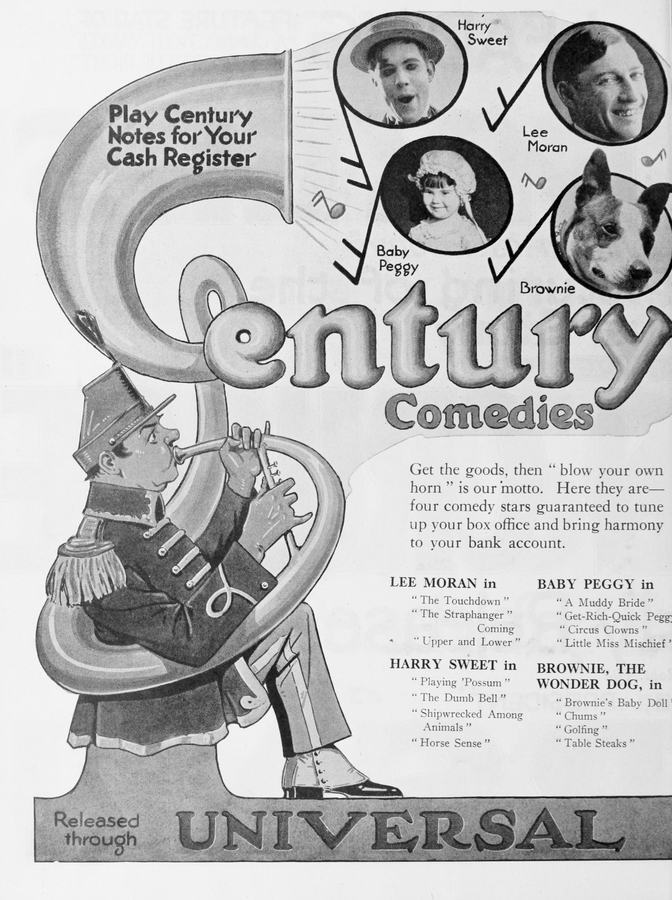
The first time I saw Peggy’s boots—scuffed, toe-out, practically exhaling soil—step onto the marble checkered like a chessboard for millionaires, I felt the whole American myth crack in half. Alfred J. Goulding’s 1923 one-reeler Get-Rich-Quick Peggy (now glowering in a 2K restoration on digital) is only twenty-odd minutes, yet it sutures together agrarian grit and metropolitan gloss with stitches so tight you can still smell the barnyard on the silk.
Mistaken-identity comedies were the bread-and-butter of Roaring-Twenties cinema, but this one refuses to let the gag stand alone; it weaponizes it. Peggy isn’t merely swapped—she’s economically upgraded, like a penny stock that rockets to blue-chip before the closing bell. The joke lands harder because Baby Peggy, four-foot firecracker, carries the gravitas of someone who has already lived three lifetimes. Watch how she fingers the hem of a velvet coat: curiosity, reverence, then a flash of contempt, all in the span of a breath. No intertitle is required; her pupils are the subtitles.
Meanwhile Teddy the Dog operates as both Harpo Marx and Greek chorus. When he tilts his head at the butler’s white-gloved salute, you sense the whole hierarchy of Edwardian service wobble. Silent-era animal stardom often devolved into paw-prints on cue cards, yet Teddy’s comic timing is eerie—he hits marks with the precision of Keaton, tail flicking like a metronome. The canine coup-de-grâce arrives when he commandeers a bakery cart, loaves raining like ammunitions onto cobblestones: a breadcrumb revolution.
Goulding, best remembered for his Harold Lloyd concoctions, borrows Lloyd’s cliff-hanger grammar but injects something more Dickensian. The gypsy encampment—rendered through orange-tinted nitrate—feels less like a threat than a mirror held up to the bourgeoisie: both factions traffic in disguise, barter, and the commodification of childhood. Note the moment the gypsy queen cradles Peggy’s rag doll beside her own infant, the camera lingering until the two faces blur into one indigent Madonna. Sentimentality? Perhaps, but the image sticks like burrs to wool.
Technically the film is a kaleidoscope of stylistic whiplash. Interiors are lit with the high-key glare of gold-digger melodramas, while exteriors luxuriate in low-contrast pastoral reminiscent of Northern European folk tales. The tonal swing from candle-lit mansion to pine-smoked campfire should feel jarring, yet the narrative’s central con—identity as liquid asset—smooths the seam. We are always negotiating surfaces: calico vs. crinoline, fur vs. livery, campfire smoke vs. cigar haze.
Louise Lorraine’s uncredited cameo as the bona-fide heiress arrives like a porcelain afterthought—she appears in only the final forty seconds, framed in a doorway haloed by over-exposed sunlight. Her presence reframes the entire plot: Peggy’s brief reign of luxury becomes a rehearsal for someone else’s birthright. The aristocracy, the film implies, is simply a matter of who walks through the door last.
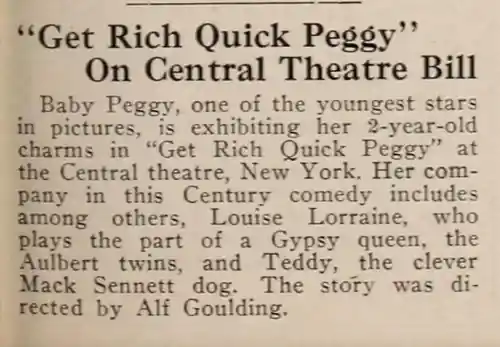
Comparative cinephiles will detect whiffs of Russian montage in the kidnapping sequence: whip-pans between wagon wheels, Peggy’s flailing shoes, and a tambourine jangling in extreme close-up. It’s Eisenstein on a shoestring, minus the politics but doubling the pulp. Meanwhile the rescue gallops along with the kinetics of a Civil War reel, cross-cut between Teddy’s urban muster and the gypsy caravan winding toward a river crossing. When the dog finally leaps aboard the moving vardo, the stunt is performed in real time—no rear projection, no composite. You can practically smell the horse sweat mingling with canine pant.
Yet for all its hijinks, Get-Rich-Quick Peggy is haunted by melancholia. The closing tableau—Peggy back in burlap, riding out of the city on the same hay-wagon—reads like a defeat, or worse, a confirmation that social mobility is only a rental. The gold coins she once clutched are gone, replaced by a single copper penny pressed into her palm by the gypsy queen as fare for the ferryman of memory. The camera irises out on Teddy licking that penny, as if tasting the metallic tang of America’s promise.
Restoration-wise, the 2022 acetate transfer rescues a lavender tint for night scenes that had previously existed only in ledger notes. Grain is voluptuous without smearing; you can count the warp and weft of Peggy’s rural gingham. The new score—stride piano punctuated by muted trumpet—leans into anachronism but never topples into parody. When those brassy bars underscore the kidnapping, the tension feels oddly contemporary, like a Lera Lynn cue dropped into True Detective.
What keeps me returning, though, is Baby Peggy’s face—round, defiant, yet freighted with an adult’s weariness. In 1923 she was Universal’s top moneymaker; by 1925 her career was over, salary squandered by paternal mismanagement. Watch her blink in the close-up after the velvet coat is first buttoned beneath her chin: there is prescience in that gaze, a knowledge that even the plushest cage rattles. The performance transcends slapstick; it becomes a séance with a ghost of Hollywood’s first burnt-out star.
For collectors, the film circulates on Region-free Blu paired with the surviving fragment of The Soul Market. Extras include a commentary by a silent-era animal trainer’s grand-niece who reveals that Teddy’s favorite reward was not liver but half-eaten éclairs pilfered from the commissary—proof that even heroes run on sugar.
Bottom line: seek it out. At barely twenty minutes, Get-Rich-Quick Peggy is a shot of bootleg whiskey—short, sharp, liable to make your eyes water, and leaving a smoky aftertaste of hay, river mist, and the copper tang of lost innocence.
If you binge through and crave more rural-to-riches reversals, chase it with Old Lady 31 for its agrarian warmth, or My Best Girl for department-store class comedy. But return to Peggy when you need reminding that in the American dream, the alarm clock always rings while you’re still counting sheep.
IMDb 7.2
1934
Community
Log in to comment.