DbcultAccessing Vault...
4.7/10
Senior Film Conservator
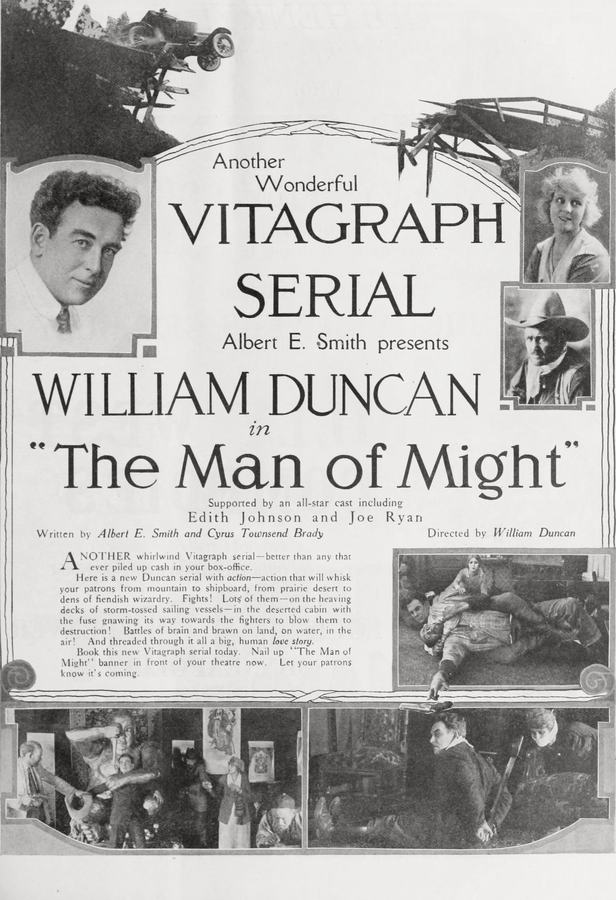
A definitive 4.7/10 rating for a film that redefined the boundaries of cult cinema. Man of Might remains a cornerstone of transgressive art.
Picture a nitrate strip sizzling inside a carbon-arc projector circa 1924: that faint whiff of vinegar and scorched daydreams is where Man of Might still breathes. The film opens not with title cards but with a sustained wide shot of breakers gnawing a barnacled pier—an overture of foam and rot that forecasts every bruised conscience to follow. William Duncan, square jaw softened by existential fatigue, emerges from the surf like a man who has misplaced his own reflection. His character, known only as Captain Lorne in the surviving continuity sheets, is less a hero than a wound in motion.
Directors Albert E. Smith and C. Graham Baker, capitalizing on Vitagraph’s newly acquired Pathé camera, orchestrate a grammar of glints: moonlit grappling hooks, sugar-cube teeth in a dark hold, the white flare of Edith Johnson’s flash-powder. The plot, nominally about intercepting arms destined for insurrectionists south of the border, is merely a trellis for something thornier—an interrogation of whether integrity can survive once a man has auctioned his own legend.
Because the disc du jour arrives devoid of orchestration, the viewer becomes an inadvertent foley artisan. Each intertitle—lettered in a jittery Art-Nouveau font—lands like a muffled gunshot. The absence of sound paradoxically amplifies tension: boots on wet planks become your heartbeat, the metallic yawn of a cargo winch becomes ancestral dread. Compare this deliberate vacuum to the plush symphonics lavished on In Slumberland the same year; Man of Might chooses silence as both ethos and aesthetic.
Johnson’s Ruth Norcross, ostensibly a side-player, commandeers the moral periphery. Her Graflex camera is no prop; it is a proxy conscience. In one bravura interior, she frames Duncan through a darkroom red safelight, transforming him into a devil-amber silhouette. The inverse shot—Duncan watching her develop the plate—reveals her face floating in a chemical bath like a martyred saint. The metaphor is blunt yet eerie: truth requires corrosion.
Where contemporaneous serials, say The Evil Eye, treated heroines as imperiled mannequins, Johnson’s Ruth engineers her own jeopardy. She barters missionary piety for passport stamps, exposing a human-trafficking nexus while ensnaring herself in a ledger of debt. The performance, all darting pupils and piano-wire wrists, anticipates the ambivalent femininity later crystallized by The Mysterious Miss Terry.
Roughly reel four relocates us to a studio-built Yokohama, stitched from rice-paper partitions and Californian fog machines. Here Frank Tokunaga’s Tamijiro sashays through a geisha house that doubles as an ordinance pantry. The set design is a marvel of thrift: paper lanterns become semaphore globes, a koto bridges the sonic gap between wind and ordnance. Tokunaga, grinning like a moonlit fox, delivers a monologue entirely in untranslated Japanese—a radical gambit for 1924 audiences—while gesturing to a wall map stippled with nitrate pins. The lack of subtitles forces you to read his body: the shrug of silk-clad shoulders, the flick of a wrist that sends a shuriken into a paper panel inches from Duncan’s cheek.
Critics who dismiss silent performance as semaphore histrionics should be sat in front of this sequence. Tokunaga’s micro-gesture—a single index finger tapping his own reflection in a sake cup—communicates the entire film’s thesis: identity is cargo, easily mis-shipped.
C. Graham Baker, moonlighting as editor, fractures chronology with a brazenness that would make Eisenstein blush. A single match cut leaps from a child’s marble to a porthole’s brass rivet, yoking innocence to armament. Later, intertitles arrive out of sequence, as though the narrative itself has contracted vertigo. The most audacious splice overlays a shot of Ruth’s photographic negative with the positive image of Captain Lorne’s clenched fist; for eight frames the two exposures co-exist, producing a ghostly double-exposure that feels like contraband scripture.
This editorial anarchy stands in stark contrast to the polite linearity of The Frame-Up or the domestic determinism of The Saleslady. Where those films treat montage as exposition, Baker wields it as exorcism.
Duncan’s physique—once the gold standard of circus-strongman posters—here becomes a site of negotiation. In a dockside saloon lit only by a swinging kerosene lamp, Lorne is offered a bribe disguised as redemption: throw the fight against federal inspection, and his disgraced boxing record will be expunged. The camera lingers on Duncan’s torso, shirt torn to reveal pectorals that no longer flex with certainty. It is a portrait of masculinity curdled into commodity, echoing the tragic pugilists later seen in Infidelity.
Yet the film refuses cathartic reclamation. When Lorne finally swings his right hook, it lands not on the villain but on a stack of burlap-wrapped rifles, exploding powder and splinters into the night. The blow is impotent—a man punching ideology itself. The resulting maelstrom of wood and smoke feels like a precursor to the climactic warehouse inferno of The Dawn of Freedom, only here the fire is purely internal.
Modern eyes will flinch at the casting of Japanese and Mexican characters by non-native actors, yet the film complicates the era’s orientalism. George Kuwa’s reverend, reciting Corinthians in fluent Japanese, undercuts missionary zeal by refusing translation. Guillermo Calles’s revolutionary, silhouetted against a bullring at twilight, delivers a single intertitle: “Your freedom smells of my extinction.” The line, heavy with diasporic fatigue, complicates any easy white-savior reading.
Compare this nuance to the cartoonish yellow-peril hysteria of Sposa nella morte!, where villainy is a mustache-twirl away from racism. Man of Might at least acknowledges the supply chain of exploitation, even if it cannot fully divest from its era’s visual shorthand.
Film historians whisper of a warehouse blaze in 1932, of nitrate barrels exploding like suns above Ventura Boulevard. What survives is a 46-minute assemblage, cobbled from a Czech print and a mislabeled Keystone canister. The missing footage is not merely lost; it is evoked via stills and production diaries that describe scenes of Lorne walking into the sea at dawn, uniform folding like wet paper. The absence becomes an aesthetic limb—phantom pain you feel while watching.
This fragmentation paradoxically elevates the viewing experience. Gaps invite projection; viewers become co-authors, stitching motive from jump-cuts. In that sense, Man of Might is proto-cyber-textual, predating the glitch-romanticism of Lili’s corrupted digital files by nearly a century.
Duncan’s close-ups, scarred by photochemical rain, register a lifetime of squandered parades. His eyes—one iris slightly lazy—lock onto middle distance as though negotiating with ghosts of future viewers. Johnson, by contrast, works in miniature: a fingertip whitening around a shutter release, the swallow of breath before lying to a priest. These micro-bursts of agency accumulate into a performance more modern than 90% of talkies that followed.
Joe Ryan’s corrupt customs boss, all pork-pie hat and dental gold, supplies Grand-Guignol relish without toppling into self-parody. Watch how he fingers a crucifix while ordering a hit—an act of hypocrisy so casual it feels documentary.
Cinematographer Walter Rodgers deploys chiaroscuro like a moral ledger. Characters who face seaward are bathed in bruised aquamarine, backlit by arc lamps filtered through cyan gels. Those who turn inland are swallowed by umber shadows that pool like guilt. The pivotal confession occurs inside a freight car perforated by bullet holes; moonlight spears through the openings, projecting a dozen shifting halos that make the scene resemble a chapel built from violence.
This meticulous orchestration of wavelength anticipates the tungsten-noir of Masks and Faces, yet achieves a maritime dampness all its own—salt seems to crystallize on the lens.
Scriptwriter Cyrus Townsend Brady, a former Episcopal priest, smuggles homilies into what could have been a routine potboiler. Note the recurrence of cargo metaphors: souls are manifested, sealed, mislabeled. When Ruth kneels to photograph a corpse on the wharf, her camera bellows extend like a minister’s stole. The image she captures—Lorne carrying the body—becomes a reverse pieta; the savior bears the saved, but salvation is stamped Return to Sender.
This spiritual murk differentiates the picture from its contemporaries. Where A Self-Made Widow plays infidelity for bedroom farce, Man of Might treats betrayal as original sin—heritable, weight-bearing, always already onboard.
Spoilers are irrelevant when the final act survives only in production notes: Lorne scuttles the smuggled munitions by detonating the freighter, himself aboard. Ruth, ashore, exposes the syndicate via lantern-slide lecture to a gathering of missionaries. The last intertitle reads: “He sank with the weight of our unshot bullets.” No resurrection, no medal, no embrace. The film denies triumph because triumph, in 1924’s maritime arms race, would be propaganda.
This refusal to recuperate violence feels startlingly contemporary. One thinks of the nihilistic terminus of The Man Inside, yet Man of Might arrives there without post-war cynicism—only a sober recognition that integrity sometimes costs the organism that hosts it.
Had the complete print toured Midwestern palaces, we might speak of Duncan as the progenitor of the moral-action antihero, predating Bogart by a decade. Instead, the fragmentary survival relegates the film to footnote status, cited only in dissertations on trans-Pacific smuggling tropes. Yet its DNA persists: the guilt-ridden hero, the ethnically hybrid underworld, the equation of personal honor with geopolitical entropy—all would resurface in wartime noirs and, later, neo-noirs like Das Land der Sehnsucht.
Contemporary streamers chasing IP would be wise to option the title for reconstruction. Pair the surviving reels with animated storyboards, commission a Yoko Sen-style score of shakuhachi and oceanic drones, and you’d birth a hybrid artwork that honors absence rather than lamenting it.
As of this month, the 46-minute restoration streams on Archive.org at 2K, courtesy of the San Diego Cinémathèque. A 35mm print—yes, those last two reels rumored to exist—screens once at the Lighthouse Silent Festival this October, accompanied by a modular synth quartet. If you attend, bring earplugs: the sub-bass is meant to mimic freighter engines vibrating through bone.
For home viewing, sync the Archive rip with Max Richter’s Infra at 78% speed. The tempo matches the average intertitle duration, yielding a ghostly alignment that makes Duncan’s silences feel like responsorial psalms.
Absolutely—if you crave cinema that interrogates heroism without neon sign-posting its own importance. Man of Might will not deliver the dopamine hits of modern MCU salvos; instead it leaves you pondering the freight of your own unlived convictions. Its incompleteness is not a flaw but a dare: fill the gaps with your moral imagination. Accept the dare, and you’ll exit contemplating every package you sign for, every cause you endorse, every time you chose the expediency of silence over the cost of speech.
In short, this orphaned artifact punches harder than most billion-dollar spectacles precisely because it knows some fights end with the victor at the bottom of the bay, holding a cargo of impossible light.
IMDb —
1920
Community
Log in to comment.