DbcultAccessing Vault...
Cult Review
Senior Film Conservator

A yacht cleaves the cobalt like a scalpel, its prow flashing the same arrogant silver as Barker’s cigarette case—an image Karl Grune freezes in the very first reel and then haunts for the remaining five, as though the celluloid itself were gambling on which man will capsize first.
If you arrive expecting a quaint maritime love triangle, Mann über Bord will drown you in darker brine. The film’s German intertitles, florid even by 1920 standards, translate into something closer to a fever ledger: every kiss is chalked up as collateral, every glance accrues compound interest. If Over the Top hurled its trench-dirt at the viewer’s face, Grune’s picture opts for salt-spray that stings long after the frame evaporates.
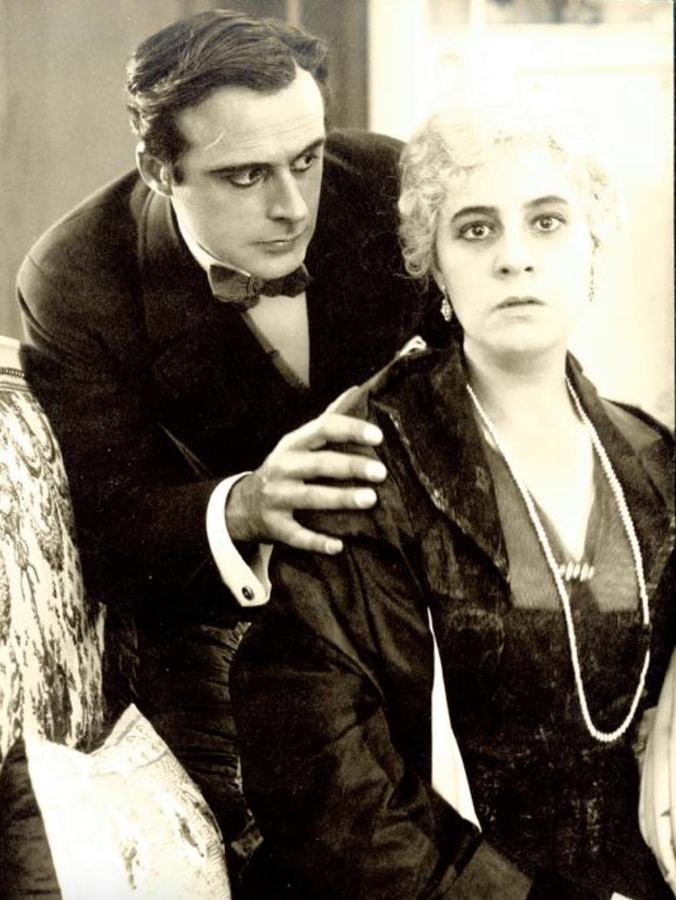
The narrative engine is a simple wager dressed in epaulettes: Barker (Max Wogritsch) bets his entire inheritance on a single race, confident that the same wind that once lifted his childhood sailboat will now loft him into Ethel’s future. Wogritsch plays the role with a gambler’s slouch, shoulders forever half a second ahead of his feet; you sense he’s already rehearsing the fall. Opposite him, Alfred Abel’s Graham watches from the deck of a mahogany cruiser that looks borrowed from a pharaoh—white flannels immaculate, eyes ticking like a bursar’s abacus. Abel, later the puppet-master of For the Freedom of the World, here perfects the smile that calculates grief in advance.
Grit Hegesa’s Ethel arrives in a hat the size of a minor continent, its plumage quivering every time she swallows the urge to scream. Hegesa, once the erotic lightning rod of Sapho, strips away vampish residue to reveal something rawer: a woman who realizes—frame by frame—that affection can be repossessed like furniture. When Barker’s marker slides across the casino table to Graham, the camera dollies into her pupils until the reflection of overhead chandeliers resembles handcuffs snapping shut.
What shocks the modern ear is how Grune weaponizes silence. No score survives, so the projector’s rattle becomes the very creak of yardarms; the hush between intertitles swells like a mainsail catching remorse. In one bravura passage, the yacht’s bell tolls off-screen while the screen stays resolutely black for four beats—enough time for the audience to imagine debt piling up in an ledger we never see. Compare that to Chase Me Charlie, where every gag is underlined by honky-tonk mayhem; Grune trusts the void to do its own thudding.
Cinematographer Willy Gaebel tilts the horizon until the ocean becomes a slanted stage: masts diagonal like prison bars, faces sliding across the diagonal as if gravity itself were a creditor collecting its due. The image of Barker kneeling on wet decking while Graham’s shadow eclipses him prefigures noir by at least two decades, yet the palette is all tropic—sepias soaked in nicotine, moonlight bleached to arsenic white.
Georg Franck’s script delights in transactional cruelty. When Ethel finally consents to marry Graham, the wedding scene is staged inside the hydroplane hangar that doubles as his boardroom: a bishop in gold-rimmed spectacles recites vows over the roar of seaplane engines. The ring is slid on just as a propeller backfires; the cut intertitle reads, “Two contracts signed before the wind shifts.” One almost expects a notary to stamp her cheek.
Yet the film refuses to grant the victor serenity. Abel lets Graham’s smile erode once the guests depart; he fondles the wedding certificate like a foreclosure notice. Meanwhile, Barker, now penniless, signs on as a lowly seaman aboard a freighter whose hull is scarred with rust resembling dried blood—a visual rhyme with his own corroded luck. The class reversal feels almost Marxian, though Grune’s sympathies remain lashed to neither man; the sea itself is the only proletariat here, worked overtime by every character’s appetite.
Mid-film, a subplot drifts in like flotsam: Loni Nest, maybe eight years old, plays a stowaway who claims she can whistle up fair winds. The regatta crews tolerate her because superstition trims faster than any sail. Nest’s lullaby—hummed rather than titled—becomes the film’s secret spine. When Barker, drunk on denatured rum, curls inside a rope locker, her voice filters through the grating, a ghost of innocence he no longer owns. Grune cuts to a close-up of Wogritsch’s eyes filling with tears that never quite fall; the restraint is more lacerating than any sob. The moment rhymes with I de unge Aar, where youth is likewise something auctioned off to adult folly.

Just when you assume the melodrama has exhausted its rigging, Grune stages a second regatta—this time at night, lanterns strung from masts like constellations wagering on themselves. Barker, now a deckhand, watches from the rail as Graham steers Ethel’s honeymoon yacht. The race is a pretext for a duel of silhouettes: every jibe reveals a face half-lit, half-eclipsed by guilt. The editing accelerates into Soviet-style montage—six frames of sail, four of Ethel’s veil snapping in the wind, three of debt notes burning in a brazier—until the images themselves seem to owe each money.
Then comes the spill. A sudden white squall hits; the camera tilts ninety degrees so the ocean becomes a wall. Amid the confusion, a man goes overboard. Grune withholds identity for nearly three minutes of screen time—an eternity in 1920. We see only a gloved hand slipping beneath a foam-flecked surface, the same glove earlier worn by both rivals. When the storm passes, Graham scans the black water with a searchlight whose aperture narrows until it resembles a ledger column. No body surfaces. Ethel’s mouth opens in a scream drowned by the wind; the intertitle reads simply, “The balance is paid.”
The surviving print’s final reel bears nitrate lesions that eat away corners of the frame—damage serendipitously mimicking erasure. Characters literally dissolve into white voids, as though the film itself were being repossessed. In this half-decayed state, the closing sequence feels even more spectral: Ethel alone on a deserted quay at dawn, holding the child’s whistle that once summoned wind. She raises it to her lips but produces no sound; Grune cuts to seagulls wheeling overhead, their cry substituting for her own. The last intertitle, half-burned, is legible only in fragments: “…and the sea keeps the account.”
Viewers expecting catharsis will taste brine. Unlike The Three Musketeers, where blades restore honor, or Secret Love, where passion finds a loophole, Mann über Bord insists that every transaction leaves someone water-logged. The title’s double meaning—man overboard, but also man off the board (as in struck from the ledger)—lingers like a salt stain you keep tasting between teeth.
Grune and Gaebel coin images that pirouette between documentary and nightmare: a champagne cork bobbing among jellyfish, a close-up of rope fibers fraying like nerves, a ledger page superimposed over a storm cloud so numbers appear to rain into the sea. These flourishes predate the expressionist fever of Bánk bán, yet they root the hysteria in salt-stung reality. Compare that to Sporting Life, where decorum stays buttoned up; here, collars wilt under the sheer humidity of avarice.
The only known 35 mm print languished for decades in a Croatian monastery—its nitrate reels mislabeled as “Meditation on Fishermen.” A 2022 4K restoration by the Deutsche Kinemathek salvaged roughly 78 % of the original runtime; the gaps are bridged with stills and explanatory intertitles in pale yellow to distinguish them from 1920 originals. The tinting follows archival notes: amber for daylight scenes, cyan for night, rose for interiors lit by paraffin—colors that look positively Martian against today’s digital palettes. Streaming rights are fragmentary, but occasional DCP tours surface at cinematheques; catch it on celluloid if you can, because the jitter of mechanical projection is part of the film’s pulse.
The DNA of Mann über Bord resurfaces wherever filmmakers equate love with liquidity. The yachting climax of The Talented Mr. Ripley owes its class-sick glamour here; the debt-driven despair of uncut gems finds its prototype in Barker’s final roll. Even Hitchcock’s Rich and Strange revisits the notion that a cruise can be a mobile bankruptcy court, though with sardonic humor Grune never permits.
In an era when relationships are swipe-right contracts and solvency is gamified, the film’s central metaphor—human hearts as negotiable securities—feels chillingly current. Grune doesn’t sermonize; he simply lets the ledger stay open, the wake stay white, the whistle stay silent. Long after the lights rise, you’ll taste salt at the back of your throat and wonder which of your own affections might be called in by morning.
So if you spot a rare screening listed under the innocuous German title, cancel your evening plans. Bring a coat; the cinema will feel colder by several fathoms. And when the final searchlight sweeps across an empty ocean, remember: somewhere beneath the celluloid, the accounts are still accruing interest.
IMDb —
1921
Community
Log in to comment.