DbcultAccessing Vault...
5.6/10
Senior Film Conservator
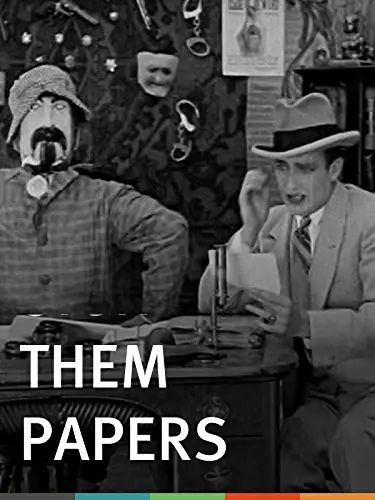
A definitive 5.6/10 rating for a film that redefined the boundaries of cult cinema. Sign Them Papers remains a cornerstone of transgressive art.
Is 'Sign Them Papers' worth watching today? Short answer: yes, but with significant caveats that demand a specific kind of viewer. This film is an absolute must-see for ardent historians of early cinema and those with a deep appreciation for the foundational tropes of serial storytelling, yet it will undoubtedly test the patience of anyone expecting modern narrative pacing or sophisticated character development.
It's a relic, certainly, but one that still holds a curious charm. This isn't a film for the casual viewer seeking a quick thrill; it's a deep dive into the nascent stages of cinematic escapism. You won't find the psychological depth of Downfall here, nor the intricate social commentary of films like The Living Image, or the Lady of Petrograd. Instead, 'Sign Them Papers' offers a different kind of value.
The immediate question for any classic film is its contemporary relevance. For 'Sign Them Papers,' the answer is nuanced. Its value is predominantly historical, serving as a fascinating document of early 20th-century popular entertainment.
However, to dismiss it solely as a historical artifact would be a disservice. There’s an undeniable, almost innocent, ingenuity to its construction that can still entertain, provided your expectations are properly calibrated.
This film works because it offers an invaluable window into the birth of cinematic suspense and the unique charm of its pioneering special effects. The sheer audacity of its villainy and the straightforward heroism are compelling in their simplicity.
This film fails because its episodic nature and reliance on simplistic, repetitive villainy can feel anachronistic and tedious to contemporary audiences. The lack of character nuance is also a significant hurdle for modern sensibilities.
You should watch it if you are fascinated by the evolution of film language, appreciate overt theatricality, and enjoy watching heroes outsmart villains with simple, yet ingenious, solutions. It’s a foundational text for understanding the serialized narrative.
'Sign Them Papers' is, at its heart, a distillation of the classic damsel-in-distress trope elevated to an art form of repetitive peril. The plot, as dictated by C.W. Kahles' original comic strip, is a relentless cycle of abduction, threat, and heroic rescue. Beautiful Belinda's refusal to sign over her gold mine is the central MacGuffin, a simple, clear motivation that drives every subsequent outlandish scenario.
What makes these perils compelling, even today, is their sheer, unbridled creativity. We're not talking about subtle psychological torture; we're witnessing a woman threatened with a 'free bath' in boiling oil, a phrase that itself drips with a peculiar, dark humor. The image of a giant papier-mâché boulder dangling precariously from a burning rope is both ludicrous and undeniably effective as a visual threat.
These are the cinematic ancestors of every Bond villain's elaborate death trap. The film revels in its own theatricality, pushing the boundaries of what could be depicted on screen with the technology of the era. The stakes are always clear, the villain's intent always transparent, and the hero's mission always righteous. It's a formula that worked then, and for a certain mindset, it still works now.
The acting in 'Sign Them Papers' is a masterclass in early cinematic performance, which is to say it’s broad, expressive, and often verges on pantomime. Perry Murdock, John J. Richardson, Earl McCarthy, Fred Lancaster, and Erin La Rue, all deliver performances perfectly suited to the serial format.
Earl McCarthy, as Hairbreadth Harry, embodies the stoic, resolute hero. His actions speak louder than any dialogue, his earnest brow furrowing with concern, his stance always upright and determined. He’s the archetypal good guy, unwavering in his pursuit of justice and the rescue of his beloved. There's a subtle charm in his earnestness, a complete lack of irony that feels refreshing in our cynical age.
Erin La Rue's Beautiful Belinda, despite being described as an 'up-to-date sports model,' is largely defined by her reactions to peril. Her wide-eyed distress, her defiant chin lifts when refusing Rudolph's demands, are all delivered with a clarity that ensures the audience understands her plight. Belinda's 'modern spirit' is more a textual declaration than a visual reality, but La Rue sells the terror and defiance with conviction.
John J. Richardson as Relentless Rudolph is a standout. He's not just a bad apple; he’s the whole orchard, rotten to the core. Richardson chews scenery with relish, his sneers and menacing gestures perfectly communicating pure, unadulterated villainy. Every movement is designed to project menace, every glare to instill fear. It’s a performance that might seem over-the-top today, but it was precisely what audiences expected, and indeed relished, from their antagonists.
The ensemble works in concert, each actor understanding their role within the larger, often exaggerated, narrative. It’s a style that demands a certain suspension of disbelief from modern viewers, but one that is undeniably effective in its own context.
The directorial approach in 'Sign Them Papers' is pragmatic and direct, typical of serials designed for maximum impact and minimal fuss. The camera work is functional, focusing on clearly establishing the scene, the characters, and the imminent danger. There’s a distinct lack of the elaborate tracking shots or complex compositions that would define later eras of filmmaking.
Instead, the visual storytelling relies heavily on tableau vivants, clear framing of action, and the expressive physicality of the actors. When Belinda is threatened with boiling oil, the shot frames her in stark relief against the ominous vat, allowing the audience to fully grasp the horror of her predicament. The simplicity isn't a flaw; it's a deliberate choice that prioritizes narrative clarity above all else.
The special effects, while primitive by today's standards, possess a certain handmade charm. The papier-mâché boulder, for instance, is clearly not a real rock, but its presence and the implied danger are enough to serve the story. This adherence to practical, tangible effects, no matter how rudimentary, grounds the fantastical scenarios in a physical reality that CGI often struggles to replicate. It forces the audience to engage with the illusion directly.
The pacing of 'Sign Them Papers' is inherently tied to its serial format. Each chapter is designed to end on a cliffhanger, leaving audiences eager for the next installment. This structure, while effective for its original exhibition, can feel jarring when viewed as a single, continuous film. The repetitive cycle of capture and rescue, while central to the genre's appeal, can become predictable.
The tone is unashamedly melodramatic. There are no shades of grey here; good is good, evil is evil, and the stakes are always life or death. This unwavering commitment to a heightened reality is part of its charm. It's a world where heroes always triumph, and villains always get their comeuppance, even if it takes several chapters to get there.
For those accustomed to the rapid-fire editing and complex subplots of modern cinema, the pacing might feel slow, even ponderous. But for those willing to adjust their viewing rhythm, there's a meditative quality to its unhurried progression. It allows for a deeper appreciation of the individual stunts and the actors' reactions, rather than a blur of constant action. It's a stark contrast to the relentless pace of a film like Savage Love, which aims for a more contemporary, visceral impact.
The most surprising and arguably most ingenious sequence in 'Sign Them Papers' is the man-sized 'shell game.' This scene is a true highlight.
It's a moment of pure, unadulterated cinematic trickery. Harry must outwit the villains. He hides under one of several oversized shells or containers. The villains shuffle them around. Harry's escape relies on clever misdirection and quick thinking.
This sequence works on multiple levels. It breaks the pattern of physical peril. It introduces a mental chess match. It's simple. It works. The humor is palpable. It showcases Harry's intelligence. It’s a genuine moment of surprise. This scene, frankly, is more ingenious than many modern blockbusters allow themselves to be, relying on wit over explosions.
While 'Sign Them Papers' is undeniably a product of its time, it stands as a delightful, if somewhat demanding, piece of cinematic history. It's a film that asks for patience and an appreciation for the foundational elements of popular storytelling. It’s not a masterpiece in the modern sense, nor does it strive for the profound artistic statements of films like Ikeru Shikabane. Instead, it’s a robust example of pure, unadulterated entertainment from an era when cinema was still finding its voice. Its value lies not just in its historical context, but in its ability to transport viewers back to a simpler time of heroes, villains, and outrageous perils. Watch it not for a flawless narrative, but for a fascinating glimpse into the very origins of cinematic adventure. It's a journey worth taking for the right audience.
IMDb 5.8
1933
Community
Log in to comment.