DbcultAccessing Vault...
Cult Review
Senior Film Conservator
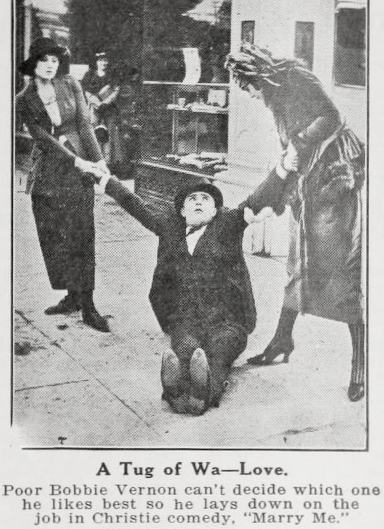
The year 1918 represented a pivotal juncture in the evolution of cinematic comedy, a period where the primitive slapstick of the previous decade began to coalesce into more sophisticated, character-driven narratives. At the heart of this transition was the Christie Film Company, an outfit that prioritized a certain 'polite' comedy over the more visceral mayhem of Keystone. In Marry Me, we witness the zenith of this approach, featuring the quintessential duo of Bobby Vernon and Vera Steadman. The film is not merely a relic of a bygone era but a sharp, albeit lighthearted, interrogation of the gendered protocols governing courtship and the performative nature of romantic interest.
The premise of Marry Me hinges upon a psychological gambit. Bobby, a character defined by a specific brand of diminutive bravado, scoffs at the very idea of a woman taking the matrimonial lead. This dismissal is not merely a personal preference but a declaration of social hierarchy. Vernon, whose screen persona often navigated the line between the adolescent and the dandy, plays this arrogance with a delightful lack of self-awareness. It is a performance that mirrors the thematic concerns found in His Turning Point, where the protagonist must undergo a radical shift in perspective to achieve emotional maturity.
When his friends decide to puncture this balloon of vanity, they choose Vera as their instrument. Vera Steadman, often remembered for her athletic prowess as one of the 'Bathing Beauties,' brings a grounded, sensible energy to the screen that contrasts sharply with Vernon's more frantic movements. The scheme is simple: Vera will propose to Bobby, forcing him to confront the very scenario he mocked. This setup allows the film to explore the artifice of social interaction—how much of our romantic life is a performance dictated by the expectations of our peers?
The 'Leap Year' motif was a staple of early 20th-century humor, providing a safe, temporary space for the subversion of traditional male-female dynamics. In Marry Me, this trope is utilized to create a double-layered narrative. First, there is the staged proposal from Vera, which exists as a satire of the concept. However, the film takes a turn into more genuine territory when a third party—another woman—actually attempts to utilize the Leap Year tradition to secure Bobby’s hand. This intrusion of reality into the prank serves as the film’s 'inciting incident' for Vera’s emotional growth.
Suddenly, the joke isn't funny anymore. The prospect of losing Bobby to another woman shifts Vera’s perspective from that of a detached prankster to a woman of action. This transition is handled with a subtle grace by Steadman, who manages to convey a shift from mockery to sincere desire without the benefit of spoken dialogue. This exploration of shifting loyalties and the sudden realization of value can be compared to the thematic depth of The Question, where the core of the drama lies in the uncertainty of intent.
The direction of Marry Me is a testament to the streamlined efficiency of the Christie studio. Every frame is utilized to maximize the comedic timing, with a focus on medium shots that allow the actors' body language to tell the story. Unlike the more epic scale of Godless Men or the exoticism of Kismet, Marry Me finds its strength in the domestic and the everyday. The sets are crisp, the lighting is high-key, and the pacing is relentless.
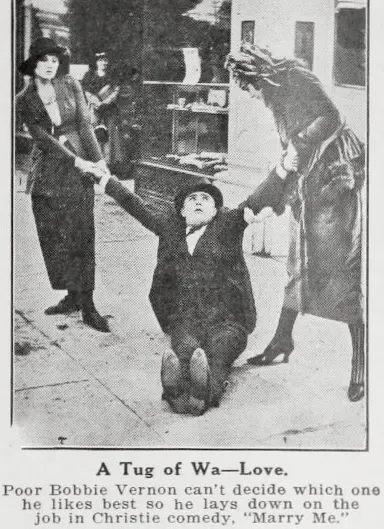
The interplay between Vernon and Steadman is magnetic. Vernon’s physicality—his ability to express shock through a sudden stiffening of the spine or a wide-eyed stare—complements Steadman’s more fluid, expressive facial work. They represent a quintessential screen pairing of the era, one that relied on a chemistry that felt both aspirational and relatable to the audiences of the time. This film, along with others like Easy to Make Money, showcases the burgeoning talent that would eventually lead to the feature-length comedies of the 1920s.
To truly appreciate Marry Me, one must view it within the broader context of its contemporaries. While films like Kilmeny or The Scarlet Shadow leaned heavily into melodrama and moralizing, the Christie Comedies offered a breath of fresh air, prioritizing wit and situational irony. Even when compared to international works like Livets Omskiftelser, which often dealt with the heavier ironies of fate, Marry Me remains steadfastly focused on the lighthearted skirmishes of the sexes.
The film also avoids the darker undertones of a production like A Bird of Prey or the espionage-laden tension of The False Faces. Instead, it occupies a space similar to The Heart of a Child, celebrating the innocence and eventual triumph of genuine emotion over cynical manipulation. Even the adventurous spirit of My Lady Robin Hood or the urgency of What's Your Hurry? feels distant from the intimate, parlor-room comedy that Marry Me executes so flawlessly.
What remains most striking about Marry Me is its refusal to rely on the cruel humor that often permeated early cinema. The prank, while deceptive, is born of a desire to teach a lesson rather than to inflict harm. When the resolution arrives, it feels earned. The film concludes not with a punchline, but with a synthesis of the two leads' desires, suggesting that while the rules of courtship may be arbitrary, the feelings they provoke are anything but. This nuanced approach to romantic comedy would go on to influence the 'screwball' genre of the 1930s, where rapid-fire dialogue would replace the physical gags of the silent era.
For the modern viewer, Marry Me offers a window into the social anxieties of the post-WWI world. As women entered the workforce and the public sphere in unprecedented numbers, the traditional roles of the 'pursuer' and the 'pursued' were being renegotiated. This film captures that moment of flux with a wink and a smile, suggesting that even in a world where women can propose, the ultimate goal remains the same: a partnership of equals. It is a far cry from the high-stakes drama of In Treason's Grasp or the mystical allure of Azra, yet it is no less significant in its contribution to the tapestry of early film history.
In the final analysis, Marry Me is a triumph of character over caricature. It utilizes the specific talents of Bobby Vernon and Vera Steadman to tell a story that is as much about the discovery of self as it is about the discovery of a partner. In the silent flicker of the frame, we see the sparks of a modern sensibility, a comedy that understands that the most effective way to change a man's mind is to first engage his heart. It remains a sparkling example of the Christie brand, a film that deserves to be remembered for its wit, its charm, and its gentle subversion of the status quo.
IMDb 7.3
1932
Community
Log in to comment.