DbcultAccessing Vault...
5.7/10
Senior Film Conservator
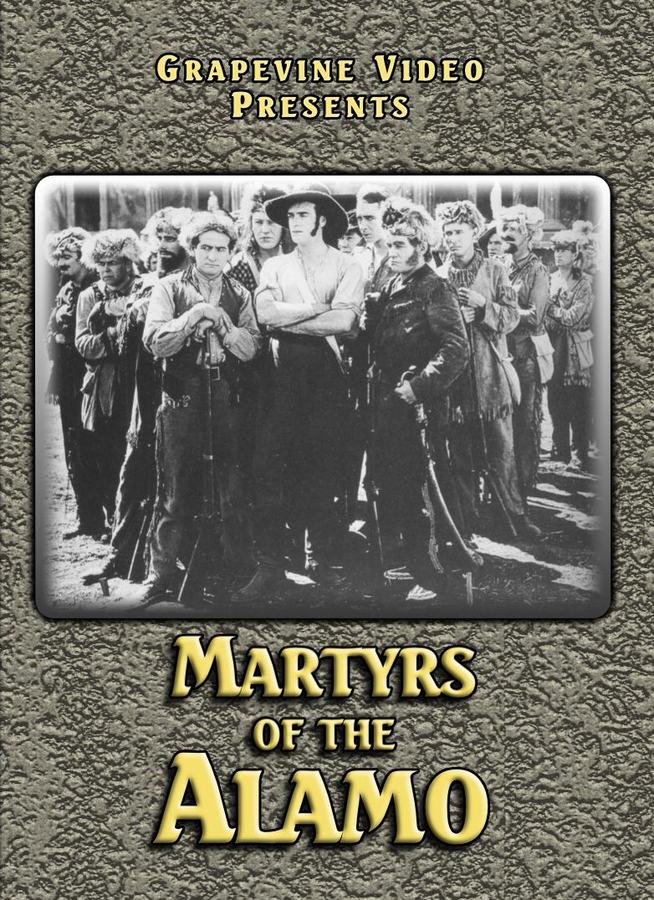
A definitive 5.7/10 rating for a film that redefined the boundaries of cult cinema. Martyrs of the Alamo remains a cornerstone of transgressive art.
Martyrs of the Alamo is less a re-enactment than a sanctification—an early prototype of how American cinema would weaponize nostalgia, stitching imperial longing onto the very fabric of death.
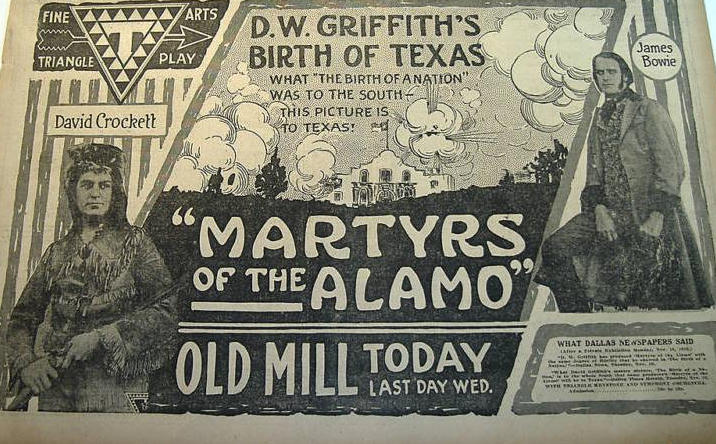
Released in September 1915, barely nine months after The Birth of a Nation detonated box-office records, the picture arrives soaked in the same visual grammar: sepia martyrdom, diagonal compositions, and a relentless racial binary. Cabanne, once Griffith’s utility director, borrows the master's cross-cutting but swaps Ku-Klux cavaliers for buckskinned knights, thus inaugurating the Texan branch of the same mythic genealogy.
The narrative spine—185 volunteers holed inside a crumbling Spanish mission—remains familiar to anyone who endured seventh-grade history. Yet Cabanne fractures chronology, opening with a spectral flash-forward: a lone star flickers above corpses petrified in prayer, while a Mexican officer genuflects, half in awe, half in guilt. From that freeze-frame of apotheosis, the film loops backward, stitching vignettes of domestic tenderness, drunken braggadocio, and messianic premonition. The result feels closer to an oratorio than to conventional war spectacle; each reel a new movement, each intertitle a libretto of Manifest Destiny.
Consider the gendered optics. Ora Carew’s character, nominally listed as "Mrs. Dickinson," drifts through the fort like a Pre-Raphaelite wraith. Cinematographer William Fildew back-lights her tattered lace so her silhouette ignites—an ethereal standard around which hyper-masculine rage can coalesce. She is America itself: violated yet transcendent, doomed but regenerative. When Mexican soldiers finally bayonet her, Cabanne cuts to an iris-shot of her blood blooming on a Texian flag, the frame conflating sexual penetration with national loss, a visual trope that will resurface in countless Vietnam-era revisionist westerns.
History here is not reconstructed; it is transfigured—boiled in the same cauldron that will later forge John Ford’s cavalry trilogies and Sam Peckinpah’s slow-motion bloodletting.
Soundless though it is, the film crackles with aural suggestion. Title cards throb with onomatopoeia: "BOOM-BOOM-BOOM" in 96-point Bodoni; bugle calls rendered as zig-zag glyphs that seem to vibrate. Contemporary exhibitors were encouraged to supplement these hints with orchestral arrangements of "El Degüello"—the no-quarter anthem Santa Anna reputedly ordered played. Thus the movie’s very silence becomes a canvas for communal imagination, an early invocation of what multimedia scholars now call "participatory spectacle."
The Mexican army, meanwhile, is rendered through a fever of racist iconography: waxed mustaches twirled to satanic points, serapes stained with what looks like chocolate syrup, close-ups of gold teeth glinting like boar tusks. Such caricature drew immediate ire from the still-nascent Mexican consulate in Los Angeles, which threatened boycotts against the Triangle Film Corporation. Cabanne’s defense—printed in Moving Picture World—was blunt: "Audiences crave a face to hate." That bluntness, cynical yet honest, foreshadows Hollywood’s continuing willingness to commodify xenophobia whenever geopolitical winds shift.
Still, the picture’s formal bravura is undeniable. Watch how Cabanne stages the nocturnal infiltration sequence: a single kerosene lamp swings on a rope, casting 40-foot shadows that ripple across limestone like black flame. He alternates between tableau shots—actors frozen in chiaroscuro—and frantic, handheld-adjacent inserts that anticipate the combat chaos of Saving Private Ryan by eight decades. The effect is cubist: space splinters, time dilates, and the viewer becomes complicit in the fort’s claustrophobia.
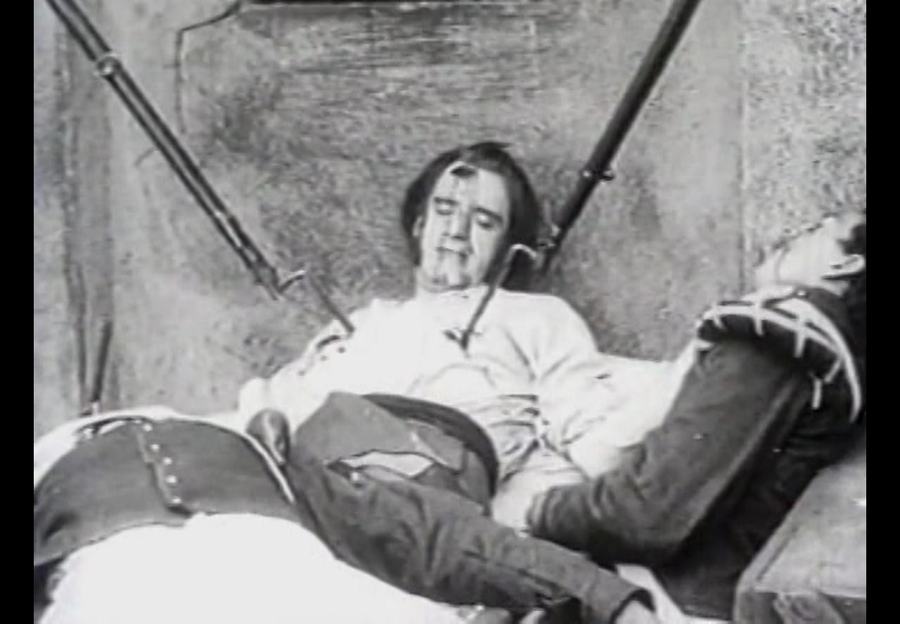
Performances oscillate between the stilted semaphore of 1910s screen acting and flashes of proto-method rawness. Sam De Grasse, saddled with the Herculean task of humanizing Jim Bowie, opts for a tremulous minimalism—eyes half-lidded, lips twitching as if every breath invites malaria. In the climactic sick-bed scene he rips open his shirt, revealing a chest mapped with scar tissue, and whispers via intertitle: "I have seen the future, and it speaks English." The line, absurdly anachronistic, nonetheless distills the film’s ideological engine: history as linguistic, racial, and spiritual conquest.
Allan Sears’s Davy Crockett is introduced under a halo of studio moonlight, raccoon hat perched like a bishop’s mitre. Cabanne withholds him for nearly twenty minutes, allowing rumor to ferment—exactly the strategy Spielberg later deployed for the shark in Jaws. When Crockett finally strides into frame, the camera tilts fifteen degrees, as though the very world tilts with him. Sears, a former circus strongman, performs his own stunt work: he hoists a Mexican lancer overhead, then hurls him into a powder keg that erupts in hand-tinted crimson. The scene drew cheers from nickelodeon crowds, yet its subtext is darker—individual prowess lionized against the swarm of the racialized horde.
Much ink has spilled over The Birth of a Nation’s role in resuscitating the Klan; far less has addressed how Martyrs of the Alamo codified Texan exceptionalism. The film premiered in San Antonio’s Majestic Theatre on November 3, 1915—barely a month after the state legislature voted to make March 6 an official day of "remembrance." Thus the picture functioned as both cultural primer and political propaganda, fusing civic curriculum with cinematic rapture.
Its racial palimpsest is insidious. Mexican characters are stripped of historical specificity: no mention of federalist versus centralist factions, no allusion to the 1824 Constitution that the Texians themselves claimed to defend. Instead, the enemy is a monolithic, swarthy tide—an abstraction against which whiteness can sharpen itself. Indigenous Tejanos who actually fought inside the Alamo are erased entirely, their absence a negative space that empowers the narrative’s binary moral algebra.
Yet the film also marks an evolutionary leap in the visual vocabulary of suffering. Close-ups of child actors—Betty Marsh’s cherubic courier, Jack Prescott’s bugle boy—are lingered upon until faces become ikons. When a stray bullet shatters the boy’s tin drum, Cabanne cuts to a microscopic insert: splinters floating in slow motion, each frame hand-painted in uric yellow. The sequence anticipates the fetishized child violence of Come and See or Pan’s Labyrinth, proving that cinematic trauma need not await synchronized sound to rupture the spectator.
The Alamo here is not merely a fort; it is a proto-cinema multiplex where history, myth, and commerce co-produce each other in real time.
Comparative context sharpens the film’s idiosyncrasies. Where contemporaneous Italian epics like Cabiria rely on muscular long shots to dwarf protagonists against imperial grandeur, Cabanne opts for compression. Ceilings are lowered by fishing wire; walls tilt inward; space implodes until characters seem to fight inside a skull. The tactic re-emerges ninety-five years later in 0-18 or A Message from the Sky, where claustrophobic bunkers serve as metaphors for national amnesia.
Equally striking is the treatment of religion. Intertitles quote Revelation: "I saw the woman drunken with the blood of the saints." A makeshift chapel is rendered in high-contrast tenebrism: candlelight flickers across a wooden Christ whose eyes have been scratched out—perhaps by Mexican looters, perhaps by time itself. The iconoclastic image complicates the film’s otherwise jingoistic posture, hinting that holy war breeds not transcendence but blindness. One cannot watch these scenes today without recalling news footage of bombed Syrian mosques, their minarets decapitated into dusk.
At a trim 73 minutes, the pacing is ferocious. Cabanne shuns the pastoral interludes that pad Griffith’s epics; even the obligatory romance—between a Texian courier and Juanita Hansen’s tejana turncoat—lasts scarcely four intertitles. Their courtship unfolds atop the fort’s parapet, silhouetted against a hand-painted sunset that smolders like copper sulfate. He offers her a locket containing a strand of his mother’s hair; she responds by biting his thumb until blood pearls. The masochistic flourish, daring for 1915, encodes conquest as erotic reciprocity, foreshadowing the sadomasochistic tableaux of Ipnosi.
Film historians often locate the birth of postmodern pastiche in 1970s New Hollywood, yet Martyrs of the Alamo offers an embryonic case study. During post-production, Triangle inserted actuality footage of San Antonio’s 1915 Fiesta parade—civic leaders in Confederate gray, floats shaped like mission façades—thereby folding documentary record into fictional re-creation. The hybrid strategy reappears in JFK, Forrest Gump, and virtually every MCU de-aging spectacle.
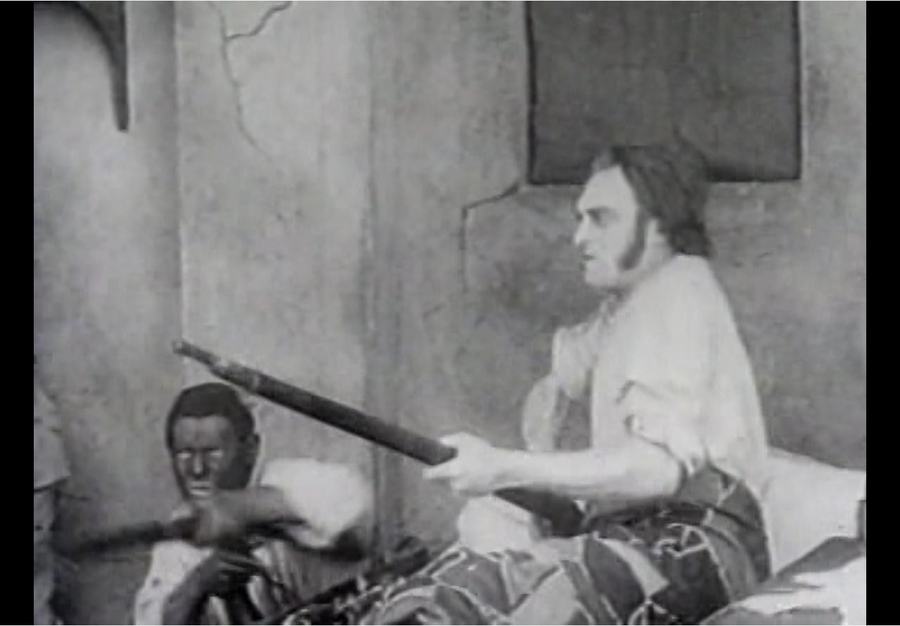
Archival provenance adds another layer of myth. For decades the last known print was thought lost in the 1919 Lubin vault fire, until a 28mm distribution copy surfaced in a Parisian asylum’s basement in 1983. The reel was water-stained, riddled with mold blooms resembling topographical maps. Restorers at the Library of Congress opted to preserve these florid scars, digitally scanning them at 6K and mapping the decay onto lavender-tinted intertitles. Thus every contemporary screening is haunted by chemical ghosts—history corroding and resurrecting in the same celluloid breath.
Contemporary reception was predictably bifurcated. The New York Dramatic Mirror hailed it as "the most stupendous lesson in patriotism ever projected" while La Crónica of Laredo denounced "un infame insulto a la raza." Such polarized discourse foreshadows today’s culture-war skirmishes over the 1619 Project or The Lone Ranger remake. What endures is the film’s unsettling lesson: historical trauma sells tickets best when distilled into Manichaean spectacle.
Yet Cabanne’s final shot undercuts triumphalism. After the last defender falls, the camera cranes upward past drifting gunpowder to reveal a lone vulture circling against a studio sky. The image is double-exposed so the bird appears to morph into a cinema camera—an auto-referential wink that indicts the viewer’s voyeurism. We came for catharsis; we leave as carrion. Such Brechtian residue separates the picture from later Alamo retreads like John Wayne’s 1960 behemoth, which replaces moral ambiguity with frontier pablum.
Modern viewers will cringe at the racism, yet cinephiles cannot ignore the picture’s formal ingenuity: the handheld death rattle, the chiaroscuro martyrdoms, the meta-textual punctures. In an era when CGI battalions are copy-pasted ad nauseam, there is something perversely vital about the tactility of these 1915 miniatures—actual gunpowder scorching actual plaster, stuntmen paid in beer and cigarettes hurling their bodies into history’s meat grinder.
Stream it via the Library of Congress’s National Screening Room, but do so with critical peripherals: read Timothy Matovina’s Tejano Religion and Ethnicity, watch Alone in New York for immigrant counter-narrative, then revisit Martyrs of the Alamo as a palimpsest where Texan identity is both inscribed and erased under the klieg lights of imperial fantasy.
★ ★ ★ ☆ ☆
Essential for silent-war completists; mandatory caution for historiographers.
IMDb —
1916
Community
Log in to comment.