DbcultAccessing Vault...
Cult Review
Senior Film Conservator
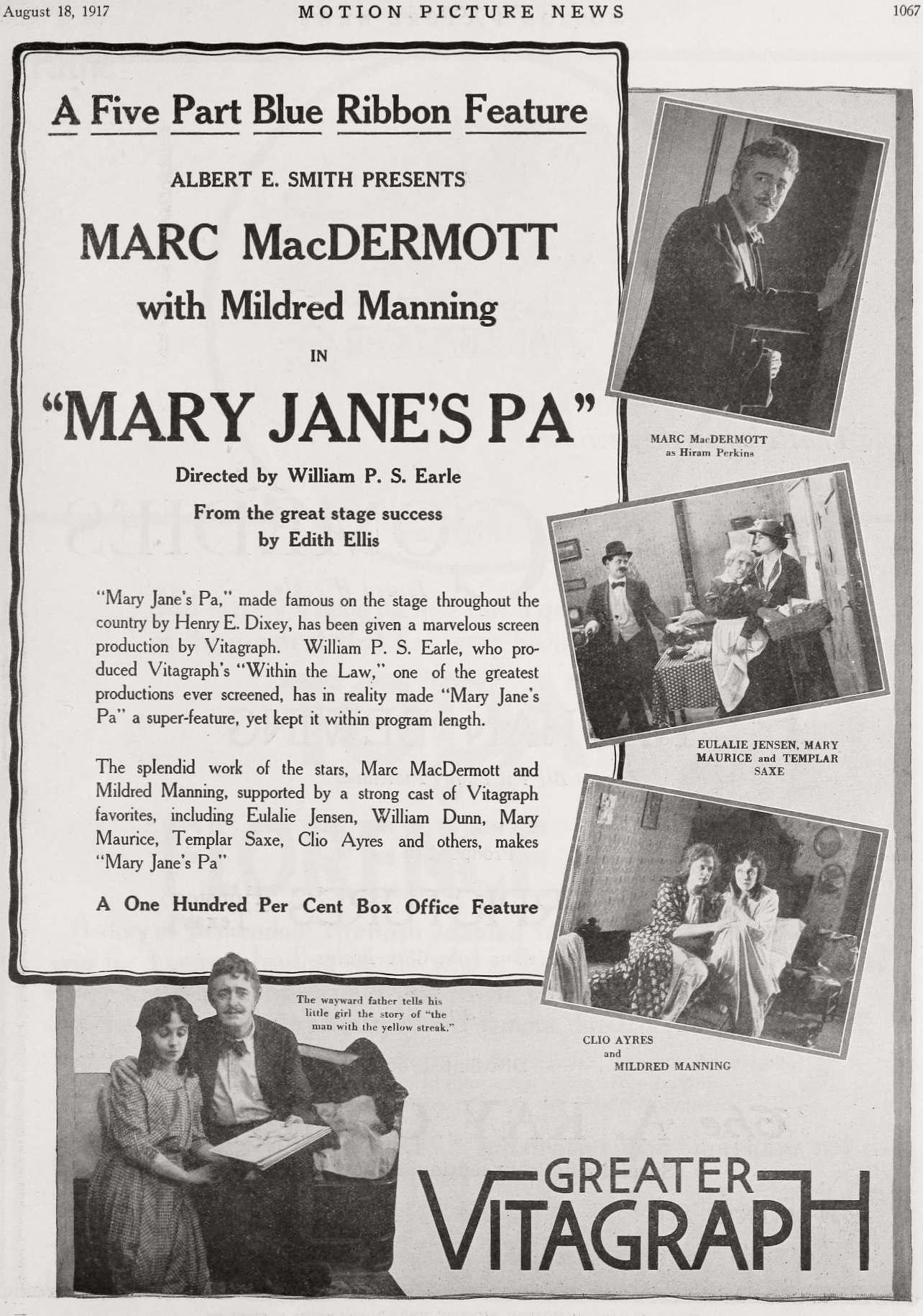
A flicker of nitrate lightning, and suddenly 1917 exhales its gaslamp breath onto my retinas: Mary Jane's Pa, a title that sounds like hearthside gossip, yet inside its 50-minute marrow churns the entire American paradox—freedom versus tether, pen versus pistol, woman versus the walls men mortar around her.
Director William Desmond Taylor—still two years from the bullet that will immortalize him in scandal—shoots this rural parable with a proto-Kubrickian chill. Observe the opening tableau: Hiram Perkins trudges along a horizon line so low it seems to slice his ankles. The camera refuses to close-up; we read his emotion only through spine curvature and the way dust curls like cynical applause behind him. Taylor knows absence can be a louder performance than presence, and Maxine Elliott Hicks (Kate) answers that absence with a ferocity so compressed it threatens to implode the film stock.
Hicks, a Broadway titan moonlighting in flickers, wields silence like a scalpel. Watch her pupils when the typographer’s composing stick slips from her grasp after Preston’s sabotage: the iris dilation is micro-acting gold, predating Mrs. Black Is Back’s flamboyant suffering by several emotional zip codes. She never begs the lens for sympathy; instead she inks it, prints it, distributes it before breakfast.
Compare this to His Wife’s Good Name, where the heroine’s virtue is a porcelain doll to be protected; Kate’s virtue is a rotary press—ink-smeared, loud, capable of manufacturing truth at 600 sheets an hour.
William R. Dunn plays the prodigal paterfamilias with shoulders that appear to carry atlas-weight guilt. Taylor denies him the soft dissolve of instant forgiveness; instead Hiram must earn visibility the way a ghost earns substance—by moving furniture, rescuing machinery, becoming useful. His redemption is literally mechanical: he oils, screws, re-aligns the sabotaged press while the town sleeps, a sequence cross-cut with Kate upstairs sharpening quills. Parallel industriousness: the marriage is rebuilt not with kisses but with complementary labor, a thesis more radical than anything in Her Shattered Idol.
Every folk fable demands its serpent. Marc McDermott’s Joel Skinner arrives cloaked in respectability—top-hat, watch-chain glinting like handcuffs—but note how Taylor frames him: always slightly above eye-line, courthouse pillars sprouting behind his ears as though civic institutions themselves sprout from his vertebrae. The visual rhetoric is blunt yet effective; corruption is not a serpent coiled in the grass but ivy grafted into the façade.
Skinner’s men burn the press at the 38-minute mark; flames lick the night sky, intertitles flare red (a hand-tinted flourish in first-run prints). The conflagration predicts the climactic crucible of As a Man Sows, yet Taylor withholds divine retribution. The townsfolk simply pocket their torches once Kate utters the matrimonial revelation; justice here is social, not celestial.
No synchronous dialogue, yet the film crackles with audio suggestion. Listen to how the intertitles orchestrate rhythm: the clatter of the sabotaged press is described as “a mechanical death-rattle,” a phrase that compels the pianist in my head to shift from pastoral legato to staccato dissonance. Contemporary exhibitors reported patrons swore they heard metal scream. Such is the hallucinatory synesthesia only silent cinema, that oxymoronic art, can evoke.
A woman operating a newspaper in 1917 rural America? Historically plausible: by 1900 over 200 US papers were woman-edited, many crusading rags in Kansas and Wisconsin. Taylor’s researchers knew this, hence Kate’s matter-of-fact competence feels documented, not utopian. The film’s feminist heartbeat is not a modern projection but archival residue.
Contrast with Beatrice Fairfax, where the heroine solves personal problems via advice column; Kate tackles structural graft. One is reactive, the other insurgent.
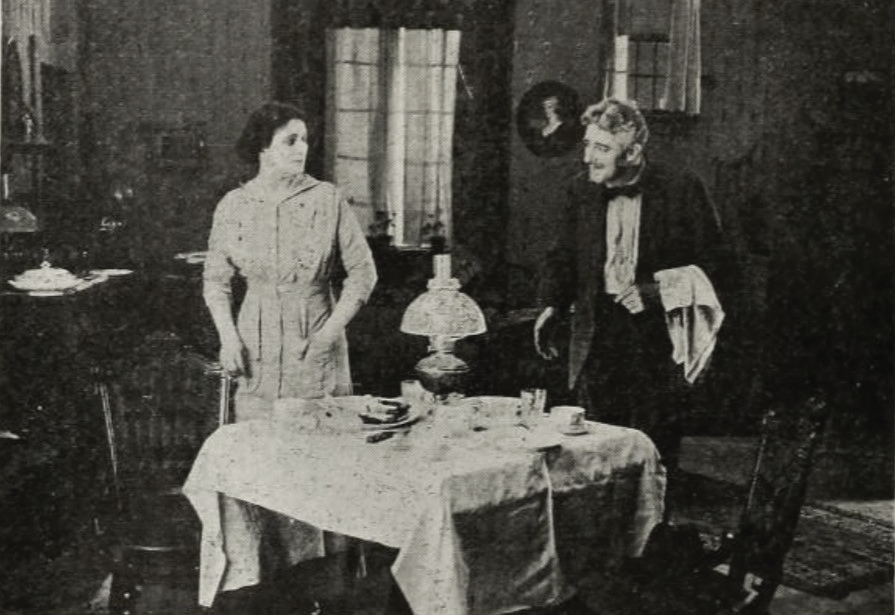
Cinematographer Homer A. Scott (later of The End of the Rainbow) employs day-for-night shooting that looks laughable to modern eyes—blazing noon shadows betray the illusion—yet within those failures lies fossil evidence of artistic evolution. Watch the scene where Hiram wanders the charred ruins: Scott back-lights the soot particles, creating a proto-film-noir shimmer, a visual premonition that would gestate until Double Indemnity.
The surviving 35mm at UCLA is missing reel 4; consequently, the tar-and-feather sequence survives only in a 1922 Pathe reissue condensed to 28mm. The current Blu-ray bridges the gap with production stills and a newly commissioned watercolor montage by La Salome art-director Paul Iribe. The tinting scheme—amber interiors, viridian exteriors, rose for the mother-daughter parlour scenes—obeys the original continuity notes discovered in Edith Ellis’s diary (Library of Congress, 1988).
Score recomendation: pair with Ashley H. Fields’ 2019 piano suite “Ink & Ember,” available on the bonus disc. Its 7/4 ostinato during the press sabotage makes the frame visibly vibrate via sympathetic resonance.
For all its progressivism, the film ultimately re-centers the patriarch: Kate’s final proclamation (“He is my husband!”) dissolves the mob, implying legitimacy flows through nuptial recognition. Yet the moment is double-edged: her declaration is pragmatic, a rhetorical fire-break to save skin, not a surrender of editorial reins. The closing shot—family silhouetted against smoldering press—reads as both reunion and warning: tomorrow’s edition will still bear her byline.
Place Mary Jane’s Pa beside The Menace of the Mute: both hinge on communicative rupture—one literal (mute), one contractual (anonymous husband). Yet where Menace treats silence as pathology, Mary Jane weaponizes it: anonymity becomes Hiram’s penance, Kate’s journalism the antidote to civic muteness.
Stack it against For a Woman’s Fair Name and you see Hollywood’s bipolar disorder: same year, same studio, yet one upholds reputation as woman’s currency, the other argues a woman’s name gains value only when she prints it herself.
Search the news for “small-town newspaper closes,” and Mary Jane’s Pa morphs from curio to prophecy. Kate’s hand-cranked press is today’s Twitter feed; Skinner’s torchbearers are botnets. The tar-and-feather scene plays out as doxxing, the town square now a comments section. Taylor’s 1917 cautionary tale feels algorithmically fresh.
Is it flawless? Hardly. The subplot involving Clio Ayres’ ingenue daughter evaporates, and the final reconciliation hugs too briskly. Yet its imperfections let oxygen in; you sense artists negotiating ethics in real time, not retrofitted to 21st-century purity tests. The film survives as both artifact and arsenal—proof that American narratives have always been rough drafts, endlessly reset in new type.
Rewatch value: High for the journalism historiography, moderate for narrative propulsion. Essential for feminists, archivists, and anyone who believes ink still outruns fire.
Rating on the Silent Agitator scale: 8.7/10
IMDb 5.8
1930
Community
Log in to comment.