DbcultAccessing Vault...
Cult Review
Senior Film Conservator
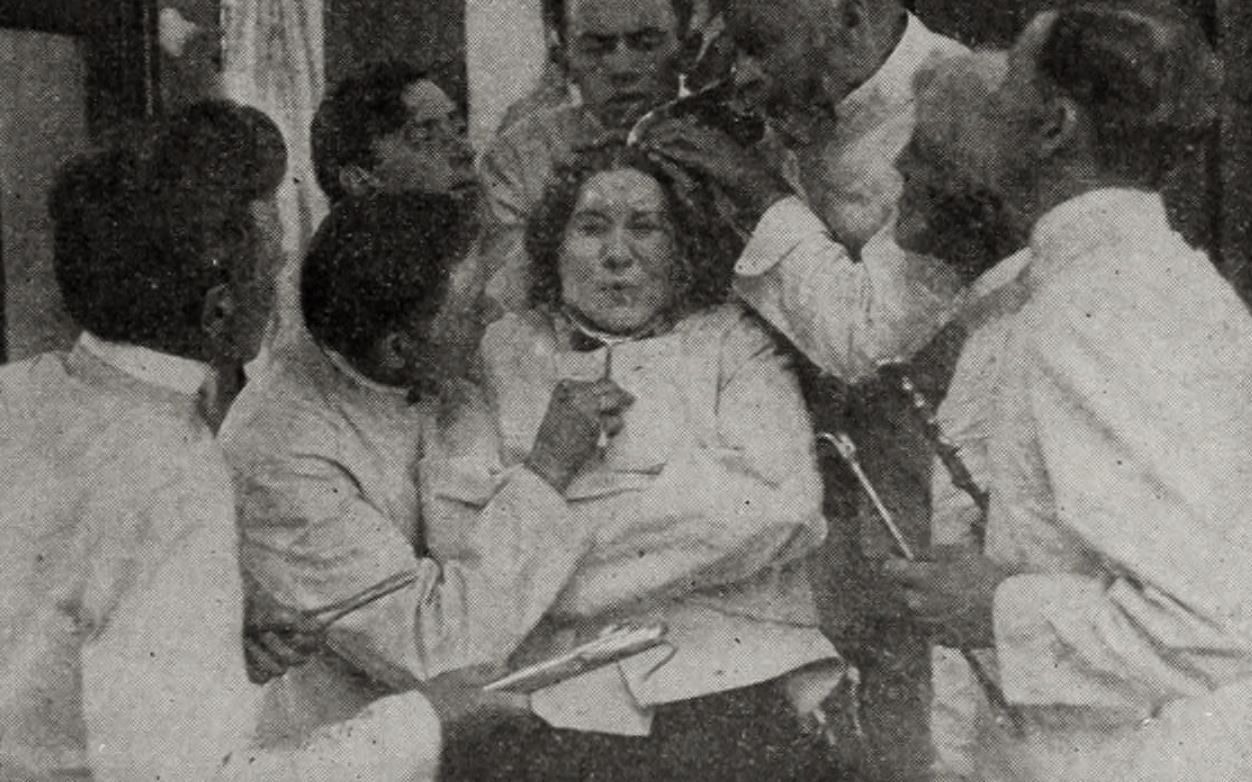
Imagine a world where the flicker of a carbon-arc lamp is enough to ignite moral panic, where a man’s obsession with winged insects can doom him to the pillory, and where the simple act of forgetting a note on a dresser becomes a dagger in the heart of bourgeois respectability. Welcome to Mary’s Lamb, a 1915 one-reel marvel that feels as if it were written by a libidinous Nathaniel Hawthorne after a three-day absinthe bender.
Richard Carle—vaudeville rake turned screenwriter—crams enough plot into twelve minutes to fuel a modern streaming season. Leander Lamb is not merely an entomologist; he is a man whose soul is bifurcated like a butterfly’s wing: one half devoted to scientific taxonomy, the other to voyeuristic yearning. The camera, static yet merciless, watches him crouch behind a lattice as Marie Wayne’s “Widow Next Door” emerges from the pond, droplets sliding off her shoulders like liquid diamonds. Intertitles do not say “He lusts”; instead they announce, with polite euphemism, “The chase begins.”
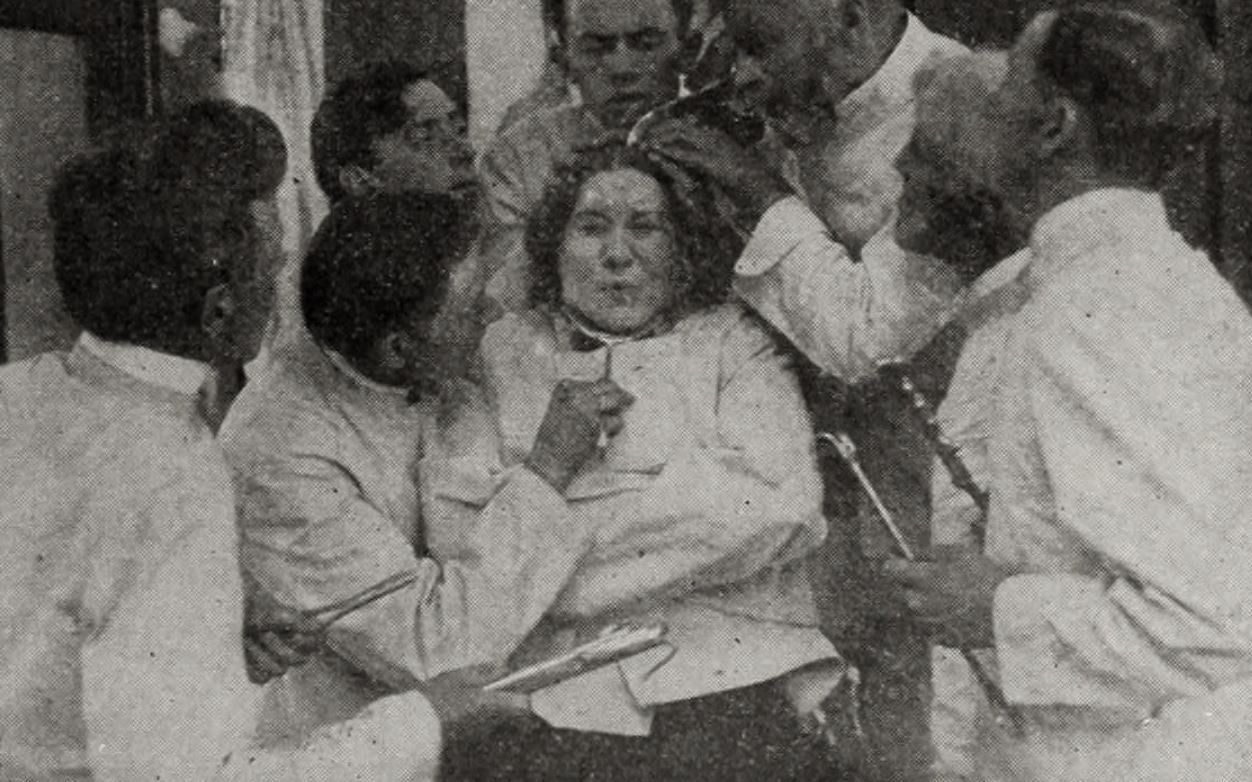
And what a chase! Mary Miranda Lamb—played by Lillian Thatcher with the predatory poise of a hawk—pursues her errant spouse through meadows, across footbridges, into the Gothic maw of a private asylum whose façade looks borrowed from The Cabinet of Dr. Caligari. Inside, nurses wear wimples like Inquisition torturers; doctors discuss “lateral trepanation” with the casual tone of barbers recommending a shave. The sequence lasts perhaps ninety seconds, yet it anticipates every psychiatric horror film that will stalk the century hence.
Escape arrives via dumb luck and a conveniently unlatched cellar door. Leander tumbles back into daylight only to fall prey to the widow’s Machiavellian charity. She clothes him—discarded trousers, mismatched waistcoat—then dispatches him on another butterfly hunt, this time as decoy so that Townsend can woo Phyllis without scandal. The intertitle reads: “Charity sometimes undresses a man to dress her schemes.” One suspects Carle chuckled over that line for days.
The film’s pièce de résistance is the somnambulist set-piece. Cinematographer John W. Brownell keeps the frame in medium shot, allowing us to savor Richard Carle’s comic rigidity as Leander, nightgown flapping like a surrender flag, shuffles across the parlor clutching a brass candlestick. Shadows jitter on the wallpaper; somewhere off-screen a dog barks at the moon. Enter Mary, hair unpinned, eyes blazing with Presbyterian fury. She spies the incriminating letter, and in a close-up worthy of von Stroheim the paper seems to burn her fingertips. The marriage ends—not with screams, but with a whispered vow of exquisite retaliation.
That retaliation arrives in the form of public stocks, situated inexplicably in the town square beneath bunting left over from the Fourth of July. Jessie Ralph’s Blackwell, a sort of Gilded Age Iago, recounts Mary’s youthful “indiscretion” to a crowd of straw-hatted gawkers. Leander, now drunk on schadenfreude, claps the wooden restraints around his wife’s wrists. The camera lingers on Thatcher’s face: defiance melting into resignation, then into something eerily like relief. Stocks, after all, immobilize both prisoner and jailer; they force a stillness in which forgiveness can seep like groundwater.
Viewers accustomed to the kinetics of modern cinema may twitch at the longueurs, yet patience yields dividends. Notice how the butterfly—initially a prop—metamorphoses into symbol. Early on, Leander pins a specimen beneath glass: the wings splay, cruciform. Later, when he himself is hunted, the camera tilts upward to show a live butterfly hovering over the asylum garden, unpin-able, unownable. Carle stages the irony without underlining it; the image shimmers for three seconds and vanishes.
Compare this with Jess, where the female protagonist’s sexuality is punished by death, or with Kreutzer Sonata’s orchestral misogyny. Mary’s Lamb ends on a note of equilibrium almost radical for 1915: husband chastened, wife liberated from moral hypocrisy, niece betrothed to the man she chooses. The final intertitle, superimposed over an iris-out, declares: “The hunt ends when both hunter and hunted stand bare.”
Technically, the print survives in 35mm at the Library of Congress, though it bears the bruises of time: emulsion scuffs, a vertical scratch that resembles lightning across the asylum wall. Yet these scars enhance the film’s frisson, reminding us that celluloid itself is mortal. Underneath the hiss of the variable-area soundtrack (added in a 1999 preservation) you can almost hear the crackle of nitrate—a whisper from the era when movies were still magic tricks.
Performances oscillate between Victorian declamation and proto-naturalistic understatement. Thatcher’s micro-expression when she first smells perfume on Leander’s collar—a single nostril flare—predates Garbo by a decade. Carle, aware of his own rubber-faced proclivities, underplays the bedroom farce, letting silence and shadow carry the joke. Even the supporting townsfolk, normally filler in such shorts, register as individuals: the boy who circles the stocks on a velocipede, the old woman hawking lemonade as moral correction.
Gender politics, inevitably, provoke modern teeth-grinding. Yes, the film delights in shaming a woman for premarital sex while winking at male philandering. Yet the concluding tableau subverts the double standard: Leander must publicly admit his voyeurism, must literally kneel to unlock the stocks. The widow, too, faces social death—banished from narrative focus in a final pan that excludes her from the reunited family unit. The butterfly, not the woman, escapes unpunished.
Cinephiles hunting proto-surrealism will relish the asylum dream-sequence: superimposed moths flutter across Leander’s face while orderlies advance in slow motion, their shadows stretching like Murnau’s vampiric talons. The effect was achieved by double-exposing the negative, then scratching away selected emulsion—a primitive yet uncanny analogue to digital compositing. View it beside The Eternal Strife’s expressionist brawls and you’ll witness an alternate history in which American silent comedy embraced the uncanny rather than the merely kinetic.
Marketing savants at the time billed the picture as “A Scream of Satire—Ten Times Funnier Than Your Mother-in-Law!” Contemporary critics compared it to The Rogues of London, though the comparison limps; the rogues are external villains, whereas Carle’s rogue is the libido itself. In that sense Mary’s Lamb shares more DNA with John Barleycorn’s cautionary dipsomania, though alcohol here is replaced by the aphrodisiac of voyeurism.
Restoration notes: the tints follow 1915 conventions—amber for interiors, viridian for the pond, rose for the widow’s boudoir. These hues were reinstated via Desmet color-balancing, not digital tinting, preserving the subtle density shifts. The English intertitles are replacements, copied from a 1921 reissue; the original 1915 cards, set in a whimsical Art-Nouveau font, survive only in a single lobby photograph.
Should you watch it? If you thrill at the archaeological dig of early cinema, if you crave a film whose very silence forces you to supply the breath, then yes—stream it on your largest screen, kill the lights, let the monochrome flicker paint your retinas. Keep a notebook handy; you will want to scribble observations like a smitten schoolchild. And when the final butterfly flutters out of frame, you may find yourself oddly grateful for the stocks we all build around our desires, even as we plot our own moonlit escapes.
IMDb 8.1
1924
Community
Log in to comment.