DbcultAccessing Vault...
Cult Review
Senior Film Conservator
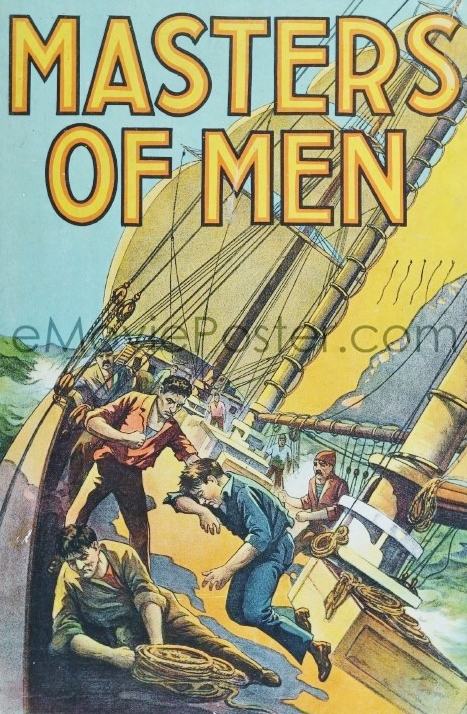
The silent canvas of Masters of Men unfurls with a striking economy of gesture, yet its narrative currents run deep. Dick Halpin, portrayed with stoic resolve by Cullen Landis, is thrust into moral exile when Mabel Arthur’s brother, a petty scoundrel, pins a theft upon him. Rather than succumb to disgrace, Halpin opts for the unforgiving rigor of naval life, a decision that sets the stage for a saga of perseverance against both human cruelty and the indifferent sea.
\nFrom the moment the camera captures the grim silhouette of Captain Bilker (Jack Curtis) and his marauding crew, the film adopts a chiaroscuro aesthetic reminiscent of the visual daring in La sagra dei martiri. The shanghaiing sequence, rendered with stark intertitles and kinetic framing, immerses the viewer in a claustrophobic world where authority is wielded like a lash.
\nBilker’s tyranny is not merely a plot device; it serves as a crucible that tempers Halpin’s latent leadership. The film’s mise‑en‑scene—cramped decks, splintered railings, and the relentless roar of surf—mirrors the internal turmoil of the captives. Lieutenant Breen (Earle Williams), initially a foil to Halpin, gradually becomes a mirror, reflecting the same yearning for redemption. Their shared suffering is punctuated by moments of silent camaraderie, conveyed through lingering glances and synchronized gestures, a technique that would later echo in the nuanced performances of The Traffic Cop.
\nThe cinematography, while constrained by the era’s technological limits, employs inventive cross‑cutting to juxtapose the oppressive interior of Bilker’s hold with the expansive, indifferent horizon. This visual dialectic underscores the central theme: individual agency amidst overwhelming forces.
\nThe escape sequence is a kinetic ballet of desperation. Halpin and Breen, armed with nothing but resolve, commandeer a beleaguered launch, their silhouettes etched against the phosphorescent tide. The director’s choice to linger on the rippling water, rendered in a deep sea‑blue hue (#0E7490), heightens the tension, while the sudden burst of dark orange (#C2410C) in the flames of Bilker’s burning vessel signals a cathartic release.
\nUpon reaching Santiago Harbor, the narrative pivots to the geopolitical arena of the Spanish‑American War. The film deftly integrates historical spectacle without sacrificing character focus. The battle scenes, though staged on miniature sets, pulse with a kinetic energy that rivals the grandeur of D.W. Griffith’s war tableaux, yet retain an intimacy that keeps Halpin’s personal stakes at the forefront.
\nHalpin’s valor in the naval clash earns him a commission, a narrative crescendo that validates his earlier sacrifice. The film’s treatment of honor is nuanced; it does not glorify war but presents it as a crucible where personal integrity can be forged anew. The resolution of the theft accusation—Mabel’s brother’s confession—acts as a narrative mirror, reflecting Halpin’s own journey from falsehood to truth.
\nThe love triangle involving Mabel (Alice Calhoun), Bessie Fleming (Wanda Hawley), and the two male protagonists is untangled with a deft hand. Rather than devolving into melodramatic excess, the film opts for a quiet reconciliation, allowing each character to emerge with agency intact. This restraint is a rarity among silent dramas of the period and anticipates the more sophisticated relational dynamics seen in later works such as Chained to the Past.

Cullen Landis delivers a performance that balances stoic resolve with fleeting vulnerability. His eyes, often the sole conduit of emotion in the silent medium, convey a spectrum from guilt to triumph. Jack Curtis, as the malevolent Bilker, embodies a theatrical menace that borders on caricature, yet his physicality grounds the character in a palpable threat.
\nThe supporting cast, including Martin Turner as the steadfast ship’s carpenter and Bert Appling as the comic relief, enrich the tapestry without detracting from the central narrative. The screenplay, crafted by C. Graham Baker and Morgan Robertson, interlaces crisp intertitles with visual storytelling, a synergy that elevates the film above its contemporaries.
\nWhen placed alongside other silent era epics such as The Hunchback of Notre Dame or the swashbuckling charm of Big Stakes, Masters of Men distinguishes itself through its thematic focus on personal redemption amidst national conflict. Its narrative economy, combined with a visual palette that leans into the stark contrast of black, white, and strategic splashes of #C2410C, #EAB308, and #0E7490, renders it a study in how limited resources can produce resonant storytelling.
\nThe film’s influence can be traced in later maritime dramas, where the motif of the reluctant hero navigating both literal and moral seas becomes a recurring archetype. Moreover, its handling of a love triangle without resorting to melodramatic excess prefigures the more restrained romantic subplots of 1930s cinema.
\nThe cinematographer’s use of deep focus during the harbor scenes allows the audience to simultaneously absorb the bustling dockside activity and the intimate exchanges between characters. The strategic insertion of a sea‑blue tint in night sequences not only differentiates temporal shifts but also imbues the water with an almost mythic quality.
\nThe film’s editing rhythm oscillates between rapid cuts during combat and languid, lingering shots during moments of introspection, a technique that mirrors the protagonist’s internal oscillation between turmoil and calm.
\nContemporary audiences, accustomed to high‑definition spectacle, may initially find the silent format austere. Yet, the film’s thematic core—honor, sacrifice, and the reclamation of agency—remains timeless. Its portrayal of a working‑class hero confronting institutional corruption resonates in today’s discourse on social justice and personal accountability.
\nStreaming platforms that curate classic cinema have reported a modest resurgence in viewership for Masters of Men, often paired with titles like Landru, der Blaubart von Paris to showcase the era’s narrative diversity.
\nIn the grand tapestry of silent cinema, Masters of Men stands as a testament to the potency of concise storytelling married to visual ingenuity. Its layered characters, deftly choreographed action, and judicious use of color within a monochrome framework coalesce into a work that rewards repeated viewings. For scholars of early 20th‑century film, it offers a fertile ground for examining the interplay between personal narrative and broader geopolitical upheaval. For the casual viewer, it delivers a compelling adventure that, despite its age, still sparks the imagination.

IMDb —
1919
Community
Log in to comment.