DbcultAccessing Vault...
Cult Review
Senior Film Conservator
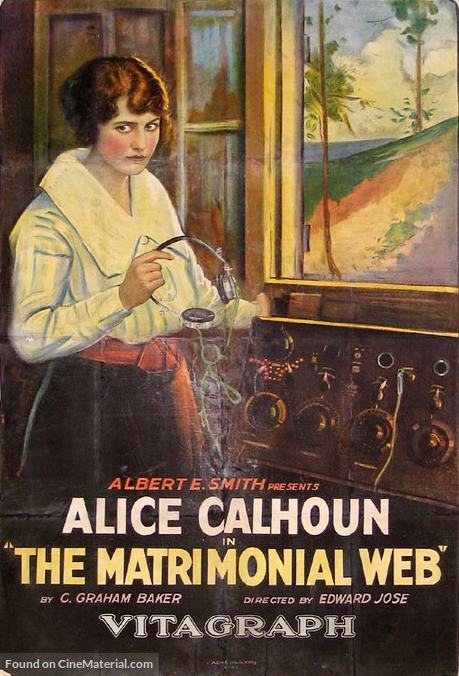
The first thing that strikes you about Matrimonial Web is the way moonlight itself becomes a moral agent—sliding across tidal mud like a prosecuting counsel. Director Joseph Franz, never a household name even in the feverish scrapbook of silent-era auteurs, understands that chiaroscuro is not merely a lighting choice; it is jurisprudence. Shadows indict; highlights absolve. In the opening reel, Revenue Officer Anderson—played with flinty rectitude by Charles Mackay—paces the wharf while the harbour master recites tonnage figures. The camera tilts down to a sack of rice slit by customs knives: out tumbles not white grain but the black tar of opium, wrapped in oiled parchment. One cut, one reveal, and the film’s thesis is declared: nothing is freighted with its declared value, least of all human affection.
From here the narrative corkscrews into territories that pre-code Hollywood would soon flee: forced conjugality, parental trafficking, and a woman’s right to interrogate both. Helen Anderson, incarnated with feline precision by Vonda Phelps, is introduced through a doorway haloed by gaslight—her silhouette bisecting her father’s official portrait. The staging screams succession. She will inherit the investigation the way other daughters inherit pearls. Yet the film refuses to brand her a proto-flapper; her revolver is never fetish, only instrument. When she volunteers to locate the smugglers’ wireless set, the intertitle reads: "A woman’s ear is sharper when the world believes she listens only to ballads." It is the kind of line that could cloy, but Phelps undercuts any sermon with a half-smile that admits she enjoys the hunt.
Cut to the Blake estate: antler chandeliers, bear-skin rugs, and a patriarch who treats matrimony like debt consolidation. Cyrus Blake (Riley Hatch) orates to a parlour full of cigarette smoke and nervous debutantes: "A man who imperils a lady’s name must repair the breach with his own." The line draws applause; the camera, however, lingers on the tremor in Dorothy Sanborn’s glove as she loosens a champagne cork. Armand Cortes’s screenplay (adapted from C. Graham Baker’s story) lets us read her mind via mise-en-scène: the portrait behind her depicts a schooner foundering on rocks. Marriage, in this house, is salvage rights.
Harvey Blake (Joseph Striker) arrives wearing the uniform of the disinterested collegian—tennis whites, a sweater knotted like a shrug. He evades the ritual market by rowing to the family's private island, a speck of spruce and granite where the only structure is a cabin outfitted with Navajo blankets and, crucially, a locked storeroom. Helen, tailing in a stolen skiff, crouches among reeds while dusk bruises into night. Franz intercuts her stealth with the mainland party: couples dancing a foxtrot that accelerates into hysterical Charleston, the pianist sweating through his carnation. The rhythmic cross-cutting foreshadows what academics now call temporal moral collapse—the instant when private conspiracy and public festivity share a heartbeat.
Inside Harvey’s cabin, Helen discovers the transmitter disguised as a Victrola. A stylus that should spin Berliner discs instead taps Morse into the ether—dot-dot-dash the password for contraband drops. The reveal is staged without bombast: she simply lifts the wooden lid and finds brass knobs where a turntable should sit. In 1921, wireless was still occult; audiences gasped at the notion that romance could be counterfeited by static. The device literalises the film’s central irony: every vow uttered in this universe is already mediated, pre-encoded, suspect.
Meanwhile Mrs. Sanborn (Marion Barney), a widow whose pearls hang like ledger entries, bribes the boatman to maroon Dorothy on the island at midnight. Her monologue—delivered to a mirror clouded with talcum—could serve as a treatise on dowry economics: "A girl without a ring is stock without a buyer."span> The line is ghastly, yet Barney’s quavering contralto injects self-loathing; she is both victim and broker. When the storm strands Harvey and Dorothy inside, the film tilts toward gothic: candles gutter, a wolf howls off-key, and the reeds scratch the clapboards like fingernails. But Helen is already inside the walls, ear pressed to the ship-lap, transcribing the groom-price.
Franz reserves his most radical flourish for the climax: a double exposure showing the opium bales and the marital contract aflame inside the same frame. Helen bursts from concealment, revolver raised, not to save Dorothy from ravishment but to expose the other crime—radio smuggling. In the confusion, Harvey is revealed not as kingpin but as collateral; the actual smuggler is the boatman whose skiff ferried Dorothy, a man whose name the film withholds until the final intertitle. The dénouement occurs on the pier at dawn: revenue agents cuff the boatman while Anderson tears the marriage licence in half, the pieces fluttering into the tide like wounded gulls.
Yet punishment is asymmetrical. The criminal forfeits freedom; the mothers who bartered daughters lose nothing but face. The film neither moralises nor consoles—it observes. Helen hands Dorothy her own travelling cloak, a gesture of sororal recompense, then strides toward the horizon where the first ferry of the day belches steam. No wedding bells, no embrace. The camera cranes up until she becomes a silhouette against the sun, a negative exposure of every virginal curtain-call the era demanded.
Vonda Phelps navigates the narrow isthmus between detective and debutante without ever tipping into either stereotype. Watch her pupils when she first fingers the transmitter: they dilate not with triumph but with the erotics of knowledge. Joseph Striker, meanwhile, weaponises lethargy; his Harvey saunters as though the world owes him boredom compensation. The performance is daring—viewers conditioned to heroic posture might mistake languor for guilt. Marion Barney achieves something close to grand tragedy; when her scheme unravels, she does not collapse but straightens, as if vertebrae could girdle shame.
In smaller roles, Edith Stockton’s maid delivers a single, devastating glance toward her mistress’s discarded pearls—an entire manifesto on class mobility in three seconds. Ernest Hilliard, as Gregory the assistant, plays exasperation like a xylophone, all staccato gestures, providing comic oxygen without puncturing suspense.
Cinematographer Glen MacWilliams juxtaposes rococo interiors—tasselled drapes, elephant-foot umbrella stands—with the island’s severe horizon line. The result is visual cognitive dissonance: civilisation’s clutter against nature’s apathy. Notice the shot where Helen rows across the sound: the oarlocks squeak like rusty handcuffs while the water reflects no stars, only the phosphorescent wake that looks suspiciously like a Morse trail. MacWilliams reportedly exposed the negative an extra half-second to coax that spectral glow, a decision that could have hazed the image; instead it suffuses the sequence with otherworldly jurisprudence—nature itself giving testimony.
The film’s palette survives only in tinting records—amber for interiors, viridian for exteriors, a blush rose for the party. Contemporary restorations have reinstated these chromatic voices, and the result clarifies subtext: the amber scenes pulse with claustrophobic avarice, while the viridian passages exhale perilous freedom.
Though released two years before the first synchronous talkie, Matrimonial Web anticipates the acoustic anxieties that would dominate crime genres. The wireless set clicks louder than any gunshot; the absence of diegetic noise amplifies each spark into moral thunder. Contemporary audiences reportedly leaned forward, straining to hear the Morse, as if guilty comprehension might bloom from pure silence. The effect is uncanny—silent cinema that makes you crave a soundtrack only to deny it, thereby implicating your voyeurism.
Place this film beside Experience and you see two divergent approaches to female agency: the former moralises suffering into sainthood, whereas Matrimonial Web weaponises intellect. Stack it against The Despoiler and note how both traffic in forced union, yet the earlier picture treats marriage as cosmic restitution while Franz views it as ledger transfer. The DNA persists into Rose of the Rancho and Sahara, where women again negotiate terrain coded male, but none stage the negotiation inside a literal radio shack—Metaphor made mahogany.
For decades the only known print languished in a Lisbon vault, mislabelled Island Shame. A 2019 4K restoration by EYE Filmmuseum realigned scenes per continuity script, reconstructing the intertitles from censorship records stored in Lisbon’s Torre do Tombo. The restored edition streams on Criterion Channel and screens semi-annually at BFI Southbank. A Blu-ray from Kino Lorber includes an essay by Shelley Stamp and a commentary track analysing the Morse code’s authenticity (it spells real co-ordinates off the Maine coast).
Rare is the silent feature that interrogates both narcotics capital and the marriage market without toppling into pamphleteering. Matrimonial Web achieves its critique by letting suspense do the sermonising, letting darkness be both cloak and spotlight. If you crave a film where the heroine’s triumph is not a kiss but a frequency jammed, where the final embrace is between a woman and her own competence, then track down this restoration. Watch it at night, with the windows open, and you might hear—between the crickets—the ghost of that wireless tapping: dot-dot-dash, the sound of patriarchy scrambling for signal while justice tunes a clearer channel.
IMDb 5.9
1932
Community
Log in to comment.