DbcultAccessing Vault...
Cult Review
Senior Film Conservator
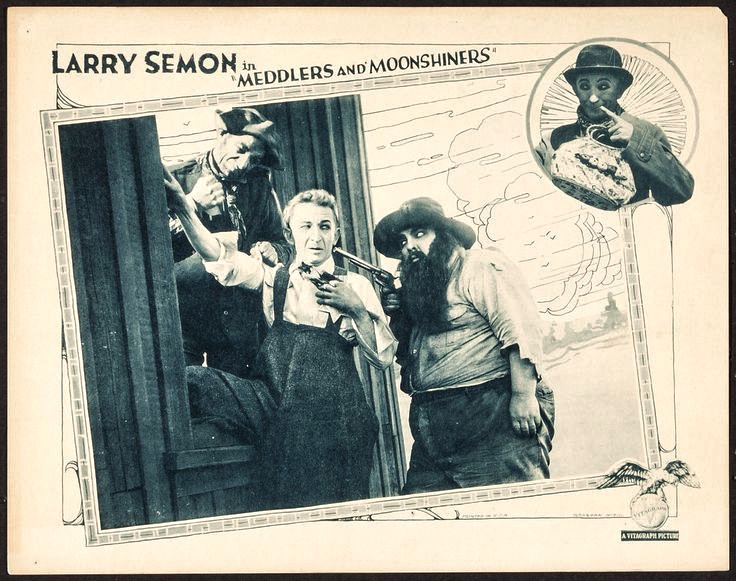
Stepping back into the raucous world of silent cinema, one frequently encounters figures whose comedic genius, though perhaps overshadowed by the titans of the era, nonetheless offers a unique, vibrant flavor. Larry Semon, a name that evokes a particular brand of frenetic, often chaotic, physical comedy, stands as a prime example. His 1920 short, 'Meddlers and Moonshiners', is a quintessential Semon vehicle, a delightful explosion of pratfalls, improbable stunts, and the kind of narrative simplicity that serves as a perfect canvas for his boundless energy. This isn't just a film; it's a meticulously choreographed ballet of blunders, a testament to the sheer ingenuity required to elicit laughter without a single spoken word.
The premise, as with many silent comedies, is disarmingly straightforward: Larry, portrayed by Semon himself, applies for a position as a revenue officer, a role that, during the Prohibition era, meant embarking on a perilous quest to apprehend illicit bootleggers. This setting, inherently charged with tension and danger, becomes Semon’s playground. Instead of grim determination, we are treated to a parade of comical ineptitude and accidental heroism. Larry is not a stoic lawman; he is a whirlwind of flailing limbs, wide-eyed bewilderment, and an almost magnetic attraction to disaster. His eagerness to serve is matched only by his profound capacity for transforming routine tasks into elaborate spectacles of physical comedy. The narrative doesn't dwell on the moral implications of Prohibition or the socio-economic realities of moonshining; rather, it uses the backdrop as a springboard for increasingly elaborate gags. It’s a smart move, allowing the audience to suspend disbelief and simply revel in the absurdity.
Larry Semon's unique brand of comedy is on full display here. Unlike Buster Keaton's stoicism or Charlie Chaplin's pathos, Semon's character is often a bewildered everyman caught in an escalating spiral of misfortune, a whirlwind of exaggerated expressions and breakneck stunts. His face, often contorted into a mask of surprise or indignation, is a marvel of silent-era expressiveness. He wasn't just falling down; he was conducting an orchestra of gravity-defying tumbles, narrow escapes, and spectacular collisions. The film is packed with the kind of inventive, often dangerous, stunt work that defined the era. You can almost hear the bones creaking as Semon navigates collapsing structures, runaway vehicles, and explosive encounters with moonshine stills. It’s a testament to his dedication and the sheer physical prowess required to pull off such sequences without the benefit of CGI or extensive safety nets. This raw, visceral quality gives his comedy an edge, a sense of genuine peril that makes the eventual comedic payoff all the more satisfying. One cannot help but be drawn into the sheer audacity of his performance, a blend of meticulous planning and spontaneous chaos.
No Semon film would be complete without a strong supporting cast, and Madge Kirby fills this role admirably. As the female lead, she often serves as the anchor to Semon's boundless chaos, either as the object of his affections, the damsel in distress, or, quite frequently, an unwitting participant in his schemes. Kirby's presence provides a crucial dynamic. Her reactions, often a mix of exasperation and genuine concern, ground Semon's more outlandish antics in a semblance of reality. She's not merely a passive observer; she's an active player in the comedic tapestry, her expressions and physical responses adding another layer of humor and relatability. Her ability to hold her own amidst Semon's whirlwind of activity speaks volumes about her comedic timing and stage presence. It's a partnership that, while perhaps less celebrated than some, was undeniably effective in delivering consistent laughter. Her character often finds herself tangled in the very webs of confusion that Larry inadvertently spins, making her an indispensable part of the narrative's comedic engine. Without her, Semon's character might simply float off into pure abstraction; with her, his antics have a human context, a point of reference for the audience's emotional engagement.
The plot, thin as it may seem, is merely a framework for a series of increasingly elaborate and physically demanding gags. Larry's journey from eager applicant to bumbling officer is punctuated by a succession of encounters with the wily moonshiners, each leading to a new set of challenges that Semon, with his characteristic blend of clumsiness and unexpected agility, must overcome. The pacing is relentless, a hallmark of silent comedies designed to keep audiences engaged through visual spectacle. There's little time for introspection or character development in the traditional sense; instead, the film relies on the immediate impact of its visual humor. Every scene is meticulously crafted to set up a punchline, a fall, or a chase sequence that builds upon the previous one, creating a cumulative effect of joyous pandemonium. The climax, as expected, is a tour de force of destruction and resolution, where the bootleggers are ultimately foiled, not necessarily by Larry's skill, but by the sheer, overwhelming force of his accidental chaos. It's an affirmation of the idea that sometimes, the most effective way to solve a problem is to inadvertently create an even bigger, more humorous one.
When considering Semon's work, it's illuminating to place it alongside his contemporaries. While he might not possess the philosophical depth of a Chaplin or the architectural precision of a Keaton, Semon's strength lies in his unbridled, almost unhinged, enthusiasm for physical comedy. His films are often more overtly destructive, more focused on the sheer spectacle of things falling apart. For instance, comparing 'Meddlers and Moonshiners' to another Semon vehicle like Filling His Own Shoes reveals a consistent comedic persona and a reliance on similar gag structures, albeit with fresh scenarios. Semon built a recognizable brand around his character's perpetual bewilderment and the escalating scale of his predicaments. Where other comedians might employ subtlety, Semon opted for broad strokes, bold movements, and often, explosions. His humor is less about the human condition and more about the delightful chaos of an individual struggling against an increasingly hostile, inanimate world. This isn't to say his work lacks nuance, but rather that its nuances are found in the precise timing of a fall or the perfect expression of surprise, rather than in complex character arcs. It’s a distinct voice in the chorus of silent comedy, one that prioritizes immediate, visceral laughter over lingering introspection. The film, in its very essence, embodies a particular strain of American humor from the period, one that found joy in the subversion of order and the triumph of the underdog, however clumsy that underdog might be.
What is it about a film like 'Meddlers and Moonshiners' that continues to resonate? Perhaps it’s the universal appeal of slapstick, a form of humor that transcends language barriers and cultural nuances. The sight of a man slipping on a banana peel or narrowly avoiding a collapsing wall is inherently funny, regardless of the era. Furthermore, Semon’s films, with their simple plots and clear-cut good-versus-evil dynamics (even if the 'good' is exceptionally clumsy), offer a comforting escape. They are a window into a bygone era of filmmaking where ingenuity and physical prowess were paramount. The visual storytelling is masterfully executed, relying entirely on the actors' expressions, gestures, and the director's clever staging. There’s a purity to this form of entertainment, an unadulterated joy in watching carefully constructed chaos unfold. It's a reminder of the foundational elements of comedy, stripped bare of dialogue and elaborate special effects, relying solely on human performance and clever scenario building. The film doesn't aim for profound social commentary; its ambition is simply to entertain, to provide a brief respite from the mundane through laughter, and in this, it succeeds spectacularly.
While Larry Semon may not occupy the same hallowed ground as some of his more famous contemporaries in the pantheon of silent film, his contributions are nonetheless significant. His films, including 'Meddlers and Moonshiners', represent a vital part of early cinematic history, showcasing a particular style of robust, often extravagant, comedy that paved the way for future generations of physical comedians. His influence, though perhaps subtle, can be traced through the lineage of cartoon violence and the sheer spectacle of destruction that would later become staples of animated shorts and live-action comedies. For modern audiences, rediscovering Semon is like unearthing a hidden treasure. It offers a fresh perspective on the diverse comedic landscape of the silent era, proving that humor came in many forms, each with its own unique charm and appeal. To watch 'Meddlers and Moonshiners' today is to engage with a piece of living history, a vibrant, hilarious document of a time when the moving image was still a burgeoning art form, and laughter was its most potent currency. It’s a film that demands to be seen, not just for its historical value, but for the sheer, unadulterated pleasure it provides. The meticulous construction of its gags, the relentless pace, and Semon's indefatigable performance all combine to create an experience that is both timeless and deeply rooted in its specific historical moment. It’s a reminder that true comedic brilliance, regardless of its era, always finds a way to shine through, leaving an indelible mark on those fortunate enough to witness it.
In conclusion, 'Meddlers and Moonshiners' is more than just a historical artifact; it's a vibrant, laugh-out-loud comedy that stands as a testament to Larry Semon's unique comedic vision. His portrayal of Larry, the well-meaning but utterly chaotic revenue officer, is a masterclass in silent slapstick. The film is a joyous romp, a testament to the enduring power of physical comedy and the boundless creativity of the silent film era. It invites audiences to shed their inhibitions and simply bask in the glorious, unadulterated chaos that unfolds on screen. A true gem that deserves its place in the spotlight, reminding us that sometimes, the most profound entertainment comes from the most spectacularly silly endeavors.
IMDb —
1914
Community
Log in to comment.