DbcultAccessing Vault...
Cult Review
Senior Film Conservator
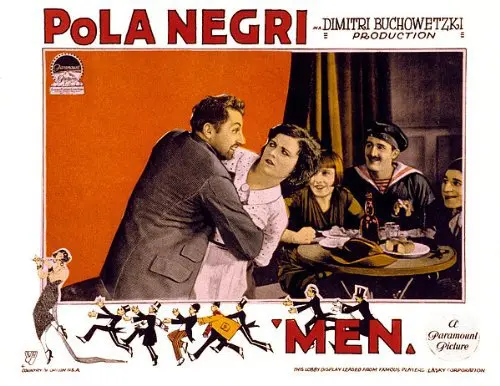
To witness Pola Negri in the 1924 silent opus Men is to observe a masterclass in the transmutation of cinematic energy. Directed by the often-underappreciated Dmitriy Bukhovetskiy, this film stands as a monumental pillar of the mid-1920s melodrama, a period where the silent screen was reaching its expressive zenith. Unlike the more simplistic moralities found in The Evil Thereof, Men navigates the murky waters of social mobility and psychological scarring with a sophistication that feels startlingly modern.
The opening sequences in Marseilles are drenched in an atmospheric grime that the cinematography captures with tactile precision. Cleo, portrayed by Negri with a simmering restlessness, is not merely a waitress; she is a coiled spring of ambition. The waterfront cafe, a microcosm of transient desires, serves as the perfect backdrop for the arrival of the Baron. Here, the film diverges from the traditional 'damsel in distress' trope seen in The Girl of My Dreams, opting instead for a more visceral exploration of class-based exploitation.
When the Baron lures Cleo to Paris, the film shifts its visual language from the shadowy, claustrophobic docks to the expansive, albeit deceptive, brilliance of the metropole. The betrayal that follows is not just a plot point; it is a fundamental restructuring of Cleo’s world. Bukhovetskiy utilizes the silent medium’s unique ability to emphasize internal states through external spectacle. We see Cleo’s disillusionment not through dialogue, but through the hard set of her jaw and the sharpening of her gaze. This is a woman who, much like the protagonist in Her Reckoning, understands that justice is a luxury the poor cannot afford.
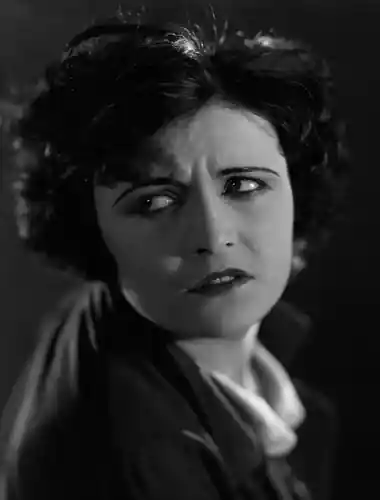
Cleo’s subsequent rise to stardom on the Parisian boulevards is depicted as a series of calculated maneuvers. She becomes a 'man-eater,' a term that the film deconstructs with surgical precision. Her success is a retaliatory strike against the gender that sought to diminish her. The opulent sets and intricate costume design reflect her new status, yet there is a pervasive sense of emptiness. The luxury is a cage, far more gilded than her Marseilles origins but no less restrictive. This thematic resonance with The Misleading Lady highlights the era's fascination with the performative nature of female identity.
The cast, including Robert Frazer and Robert Edeson, provides a sturdy framework for Negri’s pyrotechnics. Edeson, in particular, brings a gravity to his role that anchors the more fantastical elements of the plot. The screenplay, co-written by Paul Bern, avoids the repetitive beats common in lesser dramas like The Man from Mexico. Instead, it builds a crescendo of emotional stakes that find their release in the introduction of Georges.
The entry of Georges—a poor youth—into Cleo’s orbit functions as the film’s moral pivot. His love is unburdened by the transactional nature of her previous encounters. This is where Men transcends its melodramatic roots. The restoration of Cleo’s faith is not a saccharine turn but a painful shedding of her defensive armor. The juxtaposition of her high-society life with Georges’ humble existence creates a friction that Bukhovetskiy exploits for maximum dramatic impact. It mirrors the social contrasts explored in Lombardi, Ltd., yet with a more profound focus on the internal transformation.
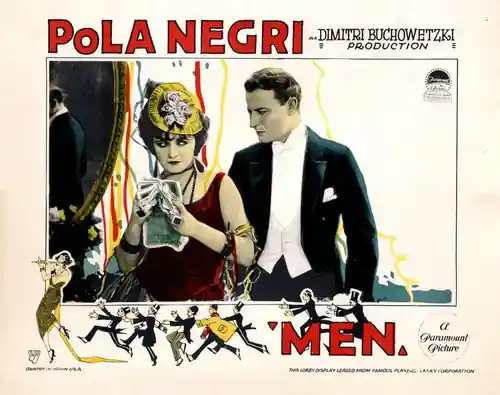
Technically, the film is a marvel of its time. The editing rhythm, particularly during the stage performance sequences, creates a sense of vertigo that mirrors Cleo’s own spiritual disorientation. The lighting, often shifting from high-key glamour to stark, expressionistic shadows, underscores the duality of her existence. One cannot help but compare the visual ambition here to the epic scales of The Birth of a Nation, though Men is far more intimate and psychologically nuanced.
Released in a year that saw the industry grappling with shifting audience tastes, Men remains a testament to the power of the star vehicle when steered by a visionary director. Pola Negri’s performance is a reminder of why she was one of the most formidable screen presences of the silent era. Her ability to convey complex, conflicting emotions with a single look is something that contemporary cinema often struggles to replicate. The film’s exploration of the 'fallen woman' who rises through her own agency prefigures many of the Pre-Code themes that would dominate Hollywood a decade later.
In the broader canon of 1920s cinema, Men stands alongside works like The Wolf Man (1923) and The Border Legion as a film that pushes the boundaries of its genre. It refuses to offer easy answers to the questions of morality and survival it raises. Cleo’s journey is one of immense cost, and the film does not shy away from the scars she bears. The final act, while redemptive, carries a weight of history that prevents it from feeling unearned.
Men is a searing indictment of a society that necessitates a woman's hardening for her survival, yet it is also a luminous celebration of the human capacity for renewal. It avoids the narrative pitfalls of its contemporaries like Chains of Evidence by maintaining a laser-like focus on its protagonist's psyche. It is a film that demands to be seen not just as a historical artifact, but as a living, breathing piece of art that still speaks to the complexities of the human heart.
Notable mentions for the supporting ensemble: Josef Swickard and Monte Collins provide essential texture to the Parisian underworld, while the cinematography by the uncredited masters of the Paramount lot remains a high-water mark for the studio's output in 1924. This film is a vital link in the evolution of the social drama, bridging the gap between the Victorian moralities of Life Story of John Lee and the gritty realism of the late silent period.
IMDb —
1927
Community
Log in to comment.