DbcultAccessing Vault...
Cult Review
Senior Film Conservator
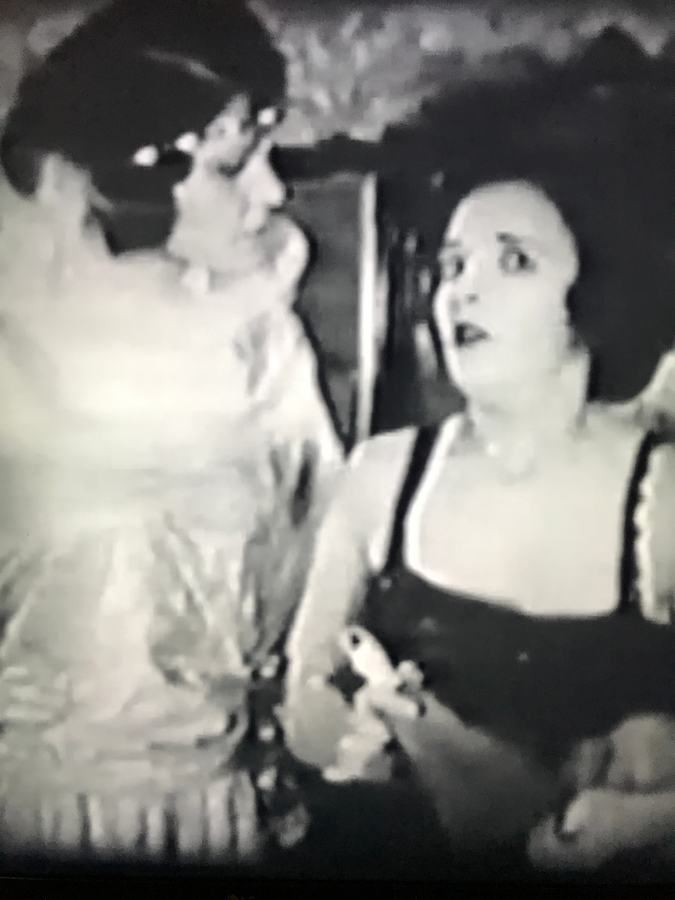
A champagne coupe smashes against a parquet floor; the shards catch the chandelier’s blaze and for one crystalline instant the whole bourgeois century seems to fracture—this is how Merely a Maid announces itself, a 1921 one-reeler that punches far above its eight-minute weight.
Beatrice La Plante, eyes the bruised violet of twilight lilacs, incarnates the downstairs girl whose surname history forgot. She polishes silver while the gramophone croons of love she is not invited to purchase. Upstairs, Gaylord Lloyd’s society siren—think Constance Talmadge dipped in liquid mercury—flirts with John J. Richardson’s aristocratic tomcat, a man sporting a moustache so thin it could split atoms. The camera, starved of dialogue, lingers on gloved hands exchanging invitations: the rustle of cardstock becomes a drumroll.
Director Fred McPherson choreographs the ensuing mayhem like a pagan rite. Footmen become satyrs, debutantes turn maenads, and the viewer is complicit—every cut is a wink that says you too crave disorder.
The pivotal masquerade is shot in a single cavernous set draped with enough tulle to outfit a flotilla of brides. Note the iris shots: Beatrice’s face ringed in black as though the lens itself were cupping her chin, forcing us to confront the erotic capital hidden beneath calico. When Richardson’s character trades partners mid-dance—swapping the mistress for the maid—the orchestra’s tempo accelerates from foxtrot to fugue. A bassoon wheezes like an old colonel; violins saw faster, and the image track erupts: fists, feathers, a flung garter that lands in a tureen of consommé.
Scholars of early cinema often pigeonhole such slapstick as mere keystone chaos, yet here the butts of the joke are the elite themselves. The maid’s apron, stripped off in the getaway, becomes a pennant of rebellion—think of it as a textile analogue to the red flag waved in Mutiny but laced with erotic rather than proletarian urgency.
Compare the climax to The Matrimaniac where Douglas Fairbanks leaps across rooftops for love; in Merely a Maid the leap is horizontal, motorized, and complicit. Beatrice is no passive damsel—her body arcs through the passenger window with the self-authored velocity of someone who has weighed servitude against the unknown and opted for combustion.
Intertitles are sparse, almost aphoristic: "He kissed—then chaos." The scarcity forces the visual to do the heavy lifting. Watch how cinematographer Robert S. Cadwallader (uncredited in most archives) floods the scene with top-light so that cheekbones become cliffs of shadow—an Expressionist trick borrowed from the German studios but repurposed for American farce.
There is also a sly self-reflexivity: a guest at the ball carries a cardboard cut-out camera, cranking it toward the melee. The gesture reminds us that voyeurism is the real national pastime, a theme later magnified in The Doll but here delivered with the brevity of a thrown custard pie.
The final escape vehicle—a 1919 Mercer Raceabout—occupies nearly thirty seconds of screen time, a lavish indulgence for a one-reeler. Painted arterial red, it throbs like a heart torn out. Beatrice’s hand on the side-curtain strap is filmed in insert, the leather grain magnified until it resembles a landscape. In that close-up, her unpainted fingernails become class hieroglyphs: the ridges, the half-moons, the tiny cut testify to years of lye and labor. The car, then, is not just transport but a temporal wormhole hurtling her from Edwardian servitude into the roaring unknown.
Contemporary reviewers in Motion Picture News dismissed the film as "a trifle of taffeta," yet that misses the subtext: the runaway automobile is the 1920s equivalent of a rocket ship, and Beatrice its unwitting astronaut.
Gaylord Lloyd (Harold’s lesser-known sibling) specializes in the hauteur of the idle classes—his eyebrow lift could frost champagne. Opposite him, Richardson plays seduction as a contact sport: every eyelid droop calibrated, every smile a loaded spring. Yet it is Beatrice La Plante who magnetizes the frame; her silence is a dialect, a Morse code of glances. When she registers panic upon being unmasked, the emotion ripples from pupils to fingertips in one fluid spasm—no histrionics, just biology.
Compare her minimalist approach to the grotesque mugging in Le peripezie dell’emulo di Fortunello; here, restraint becomes revolution.
For decades the film slumbered in the Library of Congress paper-print vaults, mis-catalogued under Mary’s Merry Mishap. A 2018 4K restoration by the EYE Filmmuseum unearthed the original nitrate’s amber glow, revealing textures previously muddied: the glint of a diamond stomped into the floor, the translucent scallop of a lace cuff. The new scan runs at a corrected 22fps rather than the broadcast-standard 24, allowing the slapstick to breathe—each pratfall now has the gravitational heft of a minor planet breaking orbit.
Available for streaming via Kanopy’s silent-comedy bundle or on Blu-ray paired with The Adventure Shop, the release touts a brand-new score by Guatemalan pianist Ana María López. She opts for stride-piano syncopations punctuated by toy-trumpet blats, underscoring the class carnivalesque without drowning it in nostalgia.
Today’s gig-economy precariat will recognize Beatrice’s zero-hour contract servitude; her dash toward autonomy prefigures every rideshare moonlighter who quits via text. The film’s brevity mirrors TikTok’s attention span, yet its wit is analog, tactile—no filters, no algorithmic nudges, just the chemistry of light on silver halide.
Scholars of feminist cinema can fruitfully read the maid’s flight as an early iteration of what theorist Constance Penley terms "the narrative getaway," a trope revisited from His Wife to The Island of Desire. Yet unlike those melodramas, Merely a Maid refuses moral comeuppance; its final frame—a smeared headlamp dissolving into pure white—offers no return, no chastisement, only the ecstasy of speed.
Does the film surpass the sum of its gags? Absolutely, in the way a shooting star outshines the physics that births it. At eight minutes it is less a story than a chemical reaction: combine one repressed maid, one decadent ballroom, one combustible automobile—result, liberation. Watch it once for the belly-laugh, again for the sociology, a third time for the sheer kinetic poetry of bodies colliding under strobing chandeliers. In an age when content overstays its welcome, here is a fling of satin that vanishes before the echo of laughter fades, leaving only the scent of burnt rubber and a lingering question: when the world next masquerades, which side of the apron will you inhabit?

IMDb —
1919
Community
Log in to comment.